> For the complete documentation index, see [llms.txt](https://docs.digit.org/llms.txt). Markdown versions of documentation pages are available by appending `.md` to page URLs; this page is available as [Markdown](https://docs.digit.org/complaints-management/complaints-management-v2.11/deploy/setup/production-setup/deploy-complaints-management/alternative-approach/three-notebooks-completion-checklist.md).

# Three Notebooks Completion Checklist

#### Notebook 1: Tenant & Common Masters

* \[ ] Authentication successful
* \[ ] Tenant(s) created
* \[ ] Branding uploaded
* \[ ] Departments created
* \[ ] Designations created
* \[ ] Complaint types created

#### Notebook 2: Boundary Setup

* \[ ] Authentication successful
* \[ ] Hierarchy created/selected
* \[ ] Template generated
* \[ ] Boundaries filled
* \[ ] Boundaries processed successfully

#### Notebook 3: Employee Onboarding

* \[ ] Authentication successful
* \[ ] Dynamic template generated
* \[ ] Employees filled
* \[ ] Employees uploaded
* \[ ] All employees SUCCESS or corrected

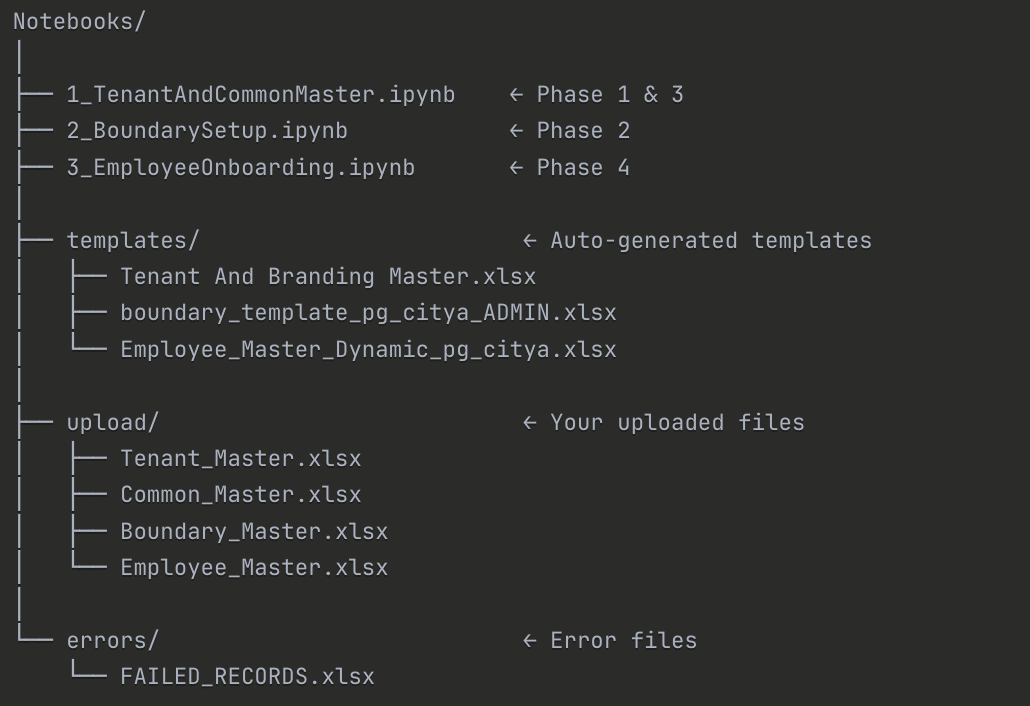
<figure><img src="https://content.gitbook.com/content/jXXjB2bSqCC6E6B5s39Y/blobs/ZgFZqqxbaeXJzgM6lGtR/unknown.png" alt=""><figcaption></figcaption></figure>

#### When to Use Which Approach?

<table><thead><tr><th width="292.55859375">Scenario</th><th>Recommended Approach</th></tr></thead><tbody><tr><td>First-time complete setup</td><td>Single DataLoader.ipynb OR all 3 notebooks</td></tr><tr><td>Only adding new employees</td><td>Notebook 3 only</td></tr><tr><td>Only adding new boundaries</td><td>Notebook 2 only</td></tr><tr><td>Different teams for different phases</td><td>3 separate notebooks</td></tr><tr><td>Re-running failed phase</td><td>Specific notebook only</td></tr><tr><td>Learning/Training</td><td>3 separate notebooks (easier to understand)</td></tr></tbody></table>


---

# Agent Instructions
This documentation is published with GitBook. GitBook is the documentation platform designed so that both humans and AI agents can read, navigate, and reason over technical content effectively. Learn more at gitbook.com.

## Querying This Documentation
If you need additional information that is not directly available in this page, you can query the documentation by asking a question.

Perform an HTTP GET request on the following URL with the `ask` and `goal` query parameters:

```
GET https://docs.digit.org/complaints-management/complaints-management-v2.11/deploy/setup/production-setup/deploy-complaints-management/alternative-approach/three-notebooks-completion-checklist.md?ask=<question>&goal=<user_goal>
```

`ask` is the immediate question: it should be specific, self-contained, and written in natural language.
`goal` is what the user is ultimately trying to achieve, the reason they need the answer. Sharing it helps GitBook give you a better, more relevant answer. A goal is most helpful when it describes the outcome the user wants rather than restating the question. For example, with `ask=how do I create an API token`, a goal like `automate deployments from our CI pipeline` lets GitBook tailor the answer to that use case.

The response will contain a direct answer to the question and relevant excerpts and sources from the documentation.

Use this mechanism when the answer is not explicitly present in the current page, you need clarification or additional context, or you want to retrieve related documentation sections.
