> For the complete documentation index, see [llms.txt](https://docs.digit.org/llms.txt). Markdown versions of documentation pages are available by appending `.md` to page URLs; this page is available as [Markdown](https://docs.digit.org/health/ph-v1.7/access/public-health-product-suite/health-campaign-management-hcm/user-manual/common-functions/track-adverse-events.md).
# Track Adverse Events
An illustrative guide to using the Adverse Events feature
## Overview
While administering the dose to a beneficiary (usually children), there can be instances when the beneficiary shows some symptoms against the dose provided. These adverse events need to be recorded and monitored as they help to take precautionary measures for further doses as well as in future campaigns for that beneficiary. It is helpful for cases when a beneficiary's situation becomes critical and he/she need to be referred to a healthcare facility. This is also crucial for resource tracking because, in certain campaigns, the beneficiary can be re-administered the dose even after they vomit out the medicine.
## Key Features
1. Recording adverse events.
2. Enabling actors to record and track the adverse events observed in a beneficiary after administration of the dose.
3. Monitoring the data to plan and decide on upcoming doses during the campaign.
## User Roles
| User Role | Scope of Action | Role Description |
| ----------- | --------------------------------------- | ------------------------------------------------------------------------------------------------------------------------------------------ |
| Distributor | Record adverse events for beneficiaries | The user goes from house-to-house for drug administration and records the adverse events observed in the beneficiary before administration |
## Steps
### Deliver Intervention
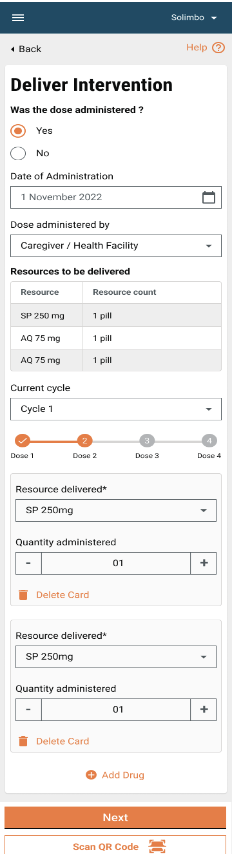
* Navigate to the **Deliver Intervention** screen. This screen is configured based on the selected campaign type. The system automatically displays the list of resources and their quantities based on the intervention plan. These values are pre-filled in the form.
* Update the resource delivery details if required. Click on the Next button to submit the form to save the intervention record for the beneficiary.
### Adverse Events
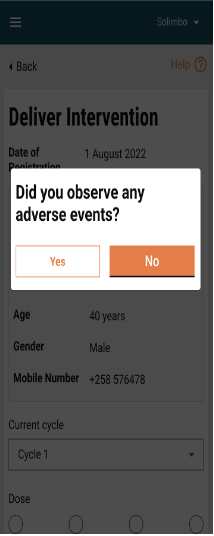
* Click on the **Next** button - a pop-up appears with the question: **“Did you observe any adverse events?”**
* **If ‘No’ is Selected**
* The system skips the adverse events screen.
* The user is directly navigated to the next screen in the workflow.
* **If ‘Yes’ is Selected**
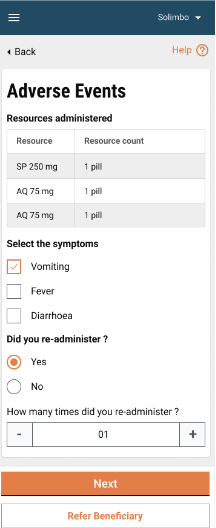
* The **Adverse Events Form** opens.
* A **summary table** of delivered resources is shown at the top.
* Enter any details of the observed symptoms. The list of symptoms is **configurable** to allow new values as needed. The user can select **multiple symptoms** from the list to reflect the beneficiary’s condition.
* **If Dose Was Readministered**
* The user selects **‘Yes’** to indicate re-administration.
* The user must also enter the **number of times** the dose was readministered.
* **Refer Beneficiary (If Required)**
* If the beneficiary is in critical condition, the user can click the **“Refer Beneficiary”** button.
* This navigates to the **refer beneficiary flow** for further medical assistance.
* **Proceed to Next Step**
* After completing the form, clicking the **‘Next’** button will move the user to the next screen in the workflow.
{% columns %}
{% column %}
{% endcolumn %}
{% column %}
{% endcolumn %}
{% endcolumns %}
---
# Agent Instructions
This documentation is published with GitBook. GitBook is the documentation platform designed so that both humans and AI agents can read, navigate, and reason over technical content effectively. Learn more at gitbook.com.
## Querying This Documentation
If you need additional information that is not directly available in this page, you can query the documentation dynamically by asking a question.
Perform an HTTP GET request on the current page URL with the `ask` query parameter, and the optional `goal` query parameter:
```
GET https://docs.digit.org/health/ph-v1.7/access/public-health-product-suite/health-campaign-management-hcm/user-manual/common-functions/track-adverse-events.md?ask=&goal=
```
`ask` is the immediate question: it should be specific, self-contained, and written in natural language.
`goal` is optional and describes the broader end goal you are ultimately trying to accomplish on behalf of the user. GitBook uses it to tailor the answer towards what is most useful for that goal.
The response will contain a direct answer to the question and relevant excerpts and sources from the documentation.
Use this mechanism when the answer is not explicitly present in the current page, you need clarification or additional context, or you want to retrieve related documentation sections.