> For the complete documentation index, see [llms.txt](https://docs.digit.org/llms.txt). Markdown versions of documentation pages are available by appending `.md` to page URLs; this page is available as [Markdown](https://docs.digit.org/health/v1.5/setup/planning-an-hcm-implementation.md).
# Planning an HCM Implementation
## Implementation Phases
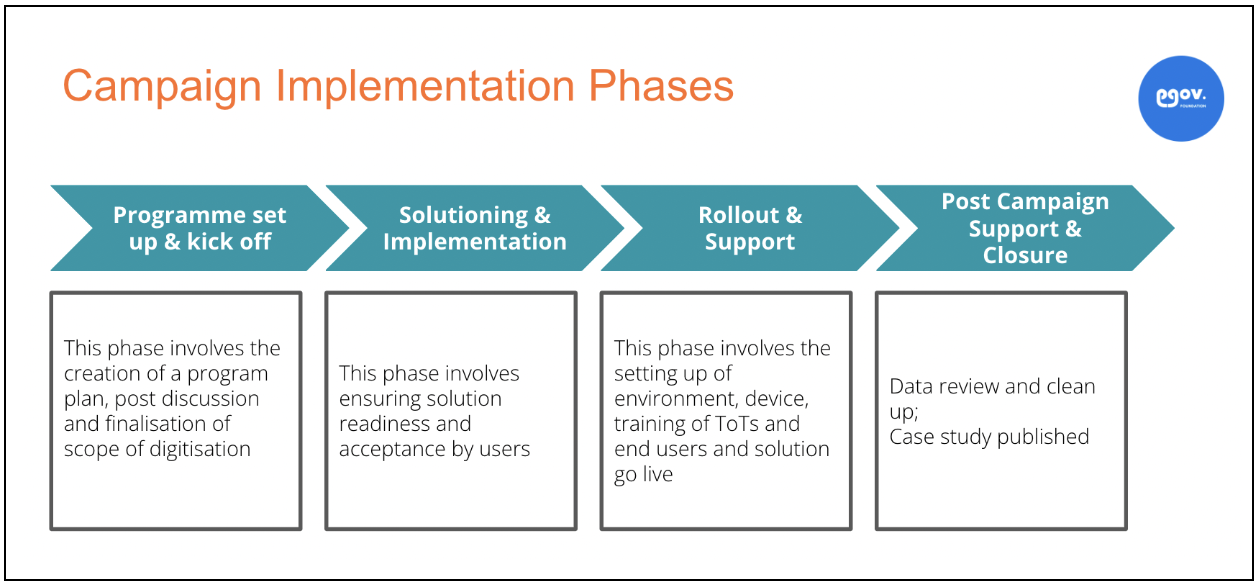
The document gives an overview of how an HCM implementation is carried out, the activities in each phase, and the output generated in each phase. There are 4 phases of an HCM implementation:
* [Programme Setup & Kick-off](#programme-setup-and-kick-off)
* [Solutions & Implementation](#solutions-and-implementation)
* [Rollout & Support](#rollout-and-support)
* [Post Campaign Support & Closure](#post-campaign-support-and-closure)
## Programme Setup & Kick-off
This phase involves the creation of a programme plan, post-discussion, and finalisation of the scope of digitisation. The output includes the following:
* Creation of an Excel documentation of solution requirements as well as JIRA stories.
* Creation of documentation on the dashboard and custom reports requirements.
* Finalisation and sharing of the master data template.
* Detailing a high-level and detailed programme plan with key milestones.
## Solutions & Implementation
This phase involves ensuring solution readiness and acceptance by users. The output includes the following:
* Customised solution as per requirement.
* Customised solution demo and feedback received, if any.
* Plans for user acceptance testing (UAT), including identification of participants, duration, and agenda.
* Creating UAT deck, feedback collection forms, and test cases.
* Getting feedback with change requests on the order of priority.
* Sign off on the solution after testing.
## Rollout & Support
This phase involves the setting up of the environment, device, and training of trainers as well as end-users. This phase also involves the go-live of the solution. The output includes the following:
* Creation of training materials along with SOPs.
* Readiness of the training environment.
* Conducting master training of trainers, cascade training, as well as training of the helpdesk.
* Readiness of the production environment.
* Loading filled-out microplan into the platform.
* Setting up campaign devices with appropriate settings.
* L1, L2, and L3 support as needed for the campaign.
* Creation of custom reports during the campaign and analysis of data for insights.
## Post Campaign Support & Closure
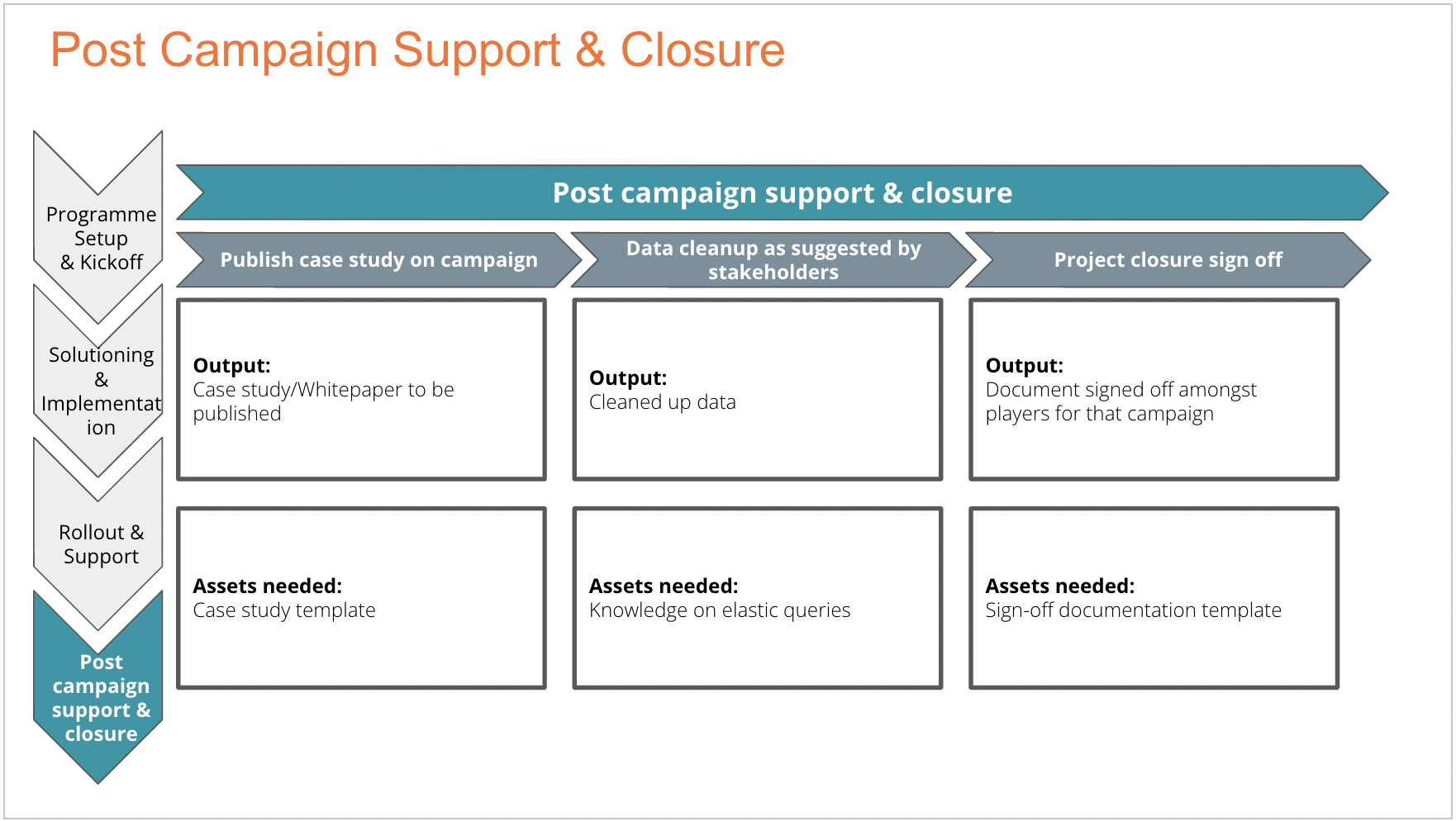
* Publishing a case study or whitepaper.
* Signing off the document among players for the campaign.
---
# Agent Instructions
This documentation is published with GitBook. GitBook is the documentation platform designed so that both humans and AI agents can read, navigate, and reason over technical content effectively. Learn more at gitbook.com.
## Querying This Documentation
If you need additional information that is not directly available in this page, you can query the documentation by asking a question.
Perform an HTTP GET request on the following URL with the `ask` and `goal` query parameters:
```
GET https://docs.digit.org/health/v1.5/setup/planning-an-hcm-implementation.md?ask=&goal=
```
`ask` is the immediate question: it should be specific, self-contained, and written in natural language.
`goal` is what the user is ultimately trying to achieve, the reason they need the answer. Sharing it helps GitBook give you a better, more relevant answer. A goal is most helpful when it describes the outcome the user wants rather than restating the question. For example, with `ask=how do I create an API token`, a goal like `automate deployments from our CI pipeline` lets GitBook tailor the answer to that use case.
The response will contain a direct answer to the question and relevant excerpts and sources from the documentation.
Use this mechanism when the answer is not explicitly present in the current page, you need clarification or additional context, or you want to retrieve related documentation sections.