> For the complete documentation index, see [llms.txt](https://docs.digit.org/llms.txt). Markdown versions of documentation pages are available by appending `.md` to page URLs; this page is available as [Markdown](https://docs.digit.org/health/v2.1/design/architecture/low-level-design/services/health-services/generate-bill/my-bills.md).

# My Bills

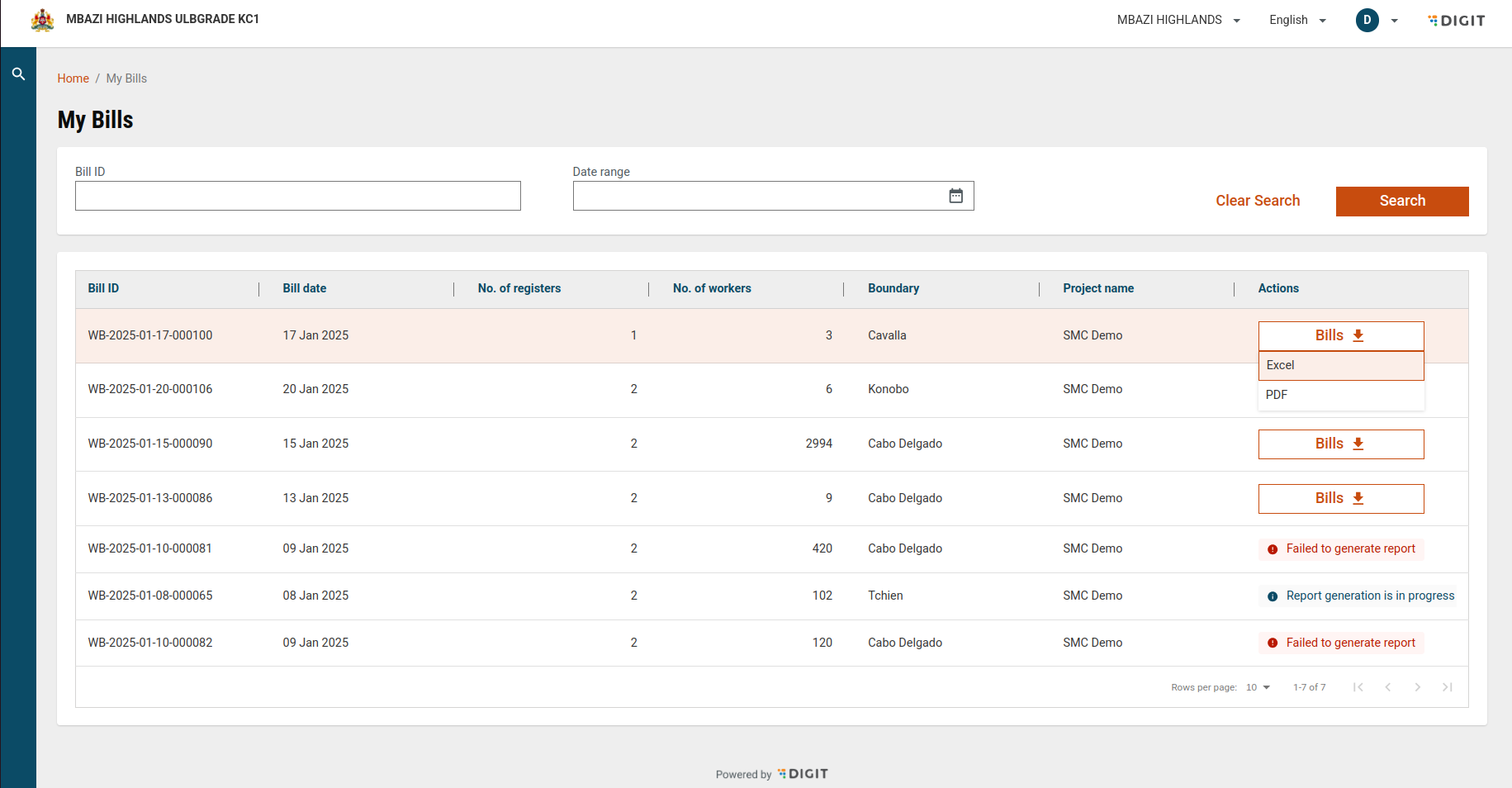
The "My Bills" section serves as a centralised dashboard for campaign supervisors to view and manage all bills associated with their assigned projects. By default, the dashboard displays all bills related to the projects under their supervision. Supervisors can search for specific bills or filter them using date ranges or by bill ID.

<figure><img src="https://content.gitbook.com/content/I0KFbSBTySIQ7TCOKnJF/blobs/ilcNYCM7H0u3cMK2KB20/image.png" alt=""><figcaption></figcaption></figure>

**Interface Elements**

**Search Filters**

1. **Bill ID**: Enter a specific Bill ID.
2. **Date Range**: Select a start and end date to filter bills within a specific time frame.
3. **Action Buttons**:
   * **Search**: Filters the results based on the provided criteria.
   * **Clear Search**: Resets the filters and shows all assigned bills.

***

**Bill List**

A table format displays the bills with the following columns:

<table><thead><tr><th width="231">Field Name</th><th>Description</th></tr></thead><tbody><tr><td><strong>Bill ID</strong></td><td>A unique identifier assigned to each bill (e.g., WB-YYYY-MM-DD-XXXXX).</td></tr><tr><td><strong>Date</strong></td><td>The creation date of the bill.</td></tr><tr><td><strong>Boundary</strong></td><td>The geographic boundary associated with the bill (e.g., District, Province).</td></tr><tr><td><strong>Project Name</strong></td><td>The name of the project for which the bill was generated.</td></tr><tr><td><strong>Workers</strong></td><td>The total number of workers covered under the bill.</td></tr><tr><td><strong>No of Registers</strong></td><td>The total number of registers associated with the bill</td></tr><tr><td><strong>Status</strong></td><td>The current status of the bill (e.g., Generated, In Progress, Failed).</td></tr></tbody></table>

***

&#x20;**Status Descriptions**

* **Generated**: The bill has been successfully generated. The user can download it in **PDF** or **Excel** format.
* **In Progress**: The report is still being generated. The user should wait for completion.
* **Failed**: The report generation failed. The user can:
  * **Retry** the process.
  * Contact support if the issue persists.

***

**API Endpoints**

| EndPoint                           | Purpose                             |
| ---------------------------------- | ----------------------------------- |
| `/health-expense/bills/v1/_search` | Search bills by project id          |
| `/filestore/v1/files/{id}`         | Download details of a specific bill |


---

# Agent Instructions
This documentation is published with GitBook. GitBook is the documentation platform designed so that both humans and AI agents can read, navigate, and reason over technical content effectively. Learn more at gitbook.com.

## Querying This Documentation
If you need additional information that is not directly available in this page, you can query the documentation by asking a question.

Perform an HTTP GET request on the following URL with the `ask` and `goal` query parameters:

```
GET https://docs.digit.org/health/v2.1/design/architecture/low-level-design/services/health-services/generate-bill/my-bills.md?ask=<question>&goal=<user_goal>
```

`ask` is the immediate question: it should be specific, self-contained, and written in natural language.
`goal` is what the user is ultimately trying to achieve, the reason they need the answer. Sharing it helps GitBook give you a better, more relevant answer. A goal is most helpful when it describes the outcome the user wants rather than restating the question. For example, with `ask=how do I create an API token`, a goal like `automate deployments from our CI pipeline` lets GitBook tailor the answer to that use case.

The response will contain a direct answer to the question and relevant excerpts and sources from the documentation.

Use this mechanism when the answer is not explicitly present in the current page, you need clarification or additional context, or you want to retrieve related documentation sections.
