> For the complete documentation index, see [llms.txt](https://docs.digit.org/llms.txt). Markdown versions of documentation pages are available by appending `.md` to page URLs; this page is available as [Markdown](https://docs.digit.org/platform/deep-dive/readme.md).
# What Is DIGIT?
Digital Infrastructure for Governance and Inclusive Transformation
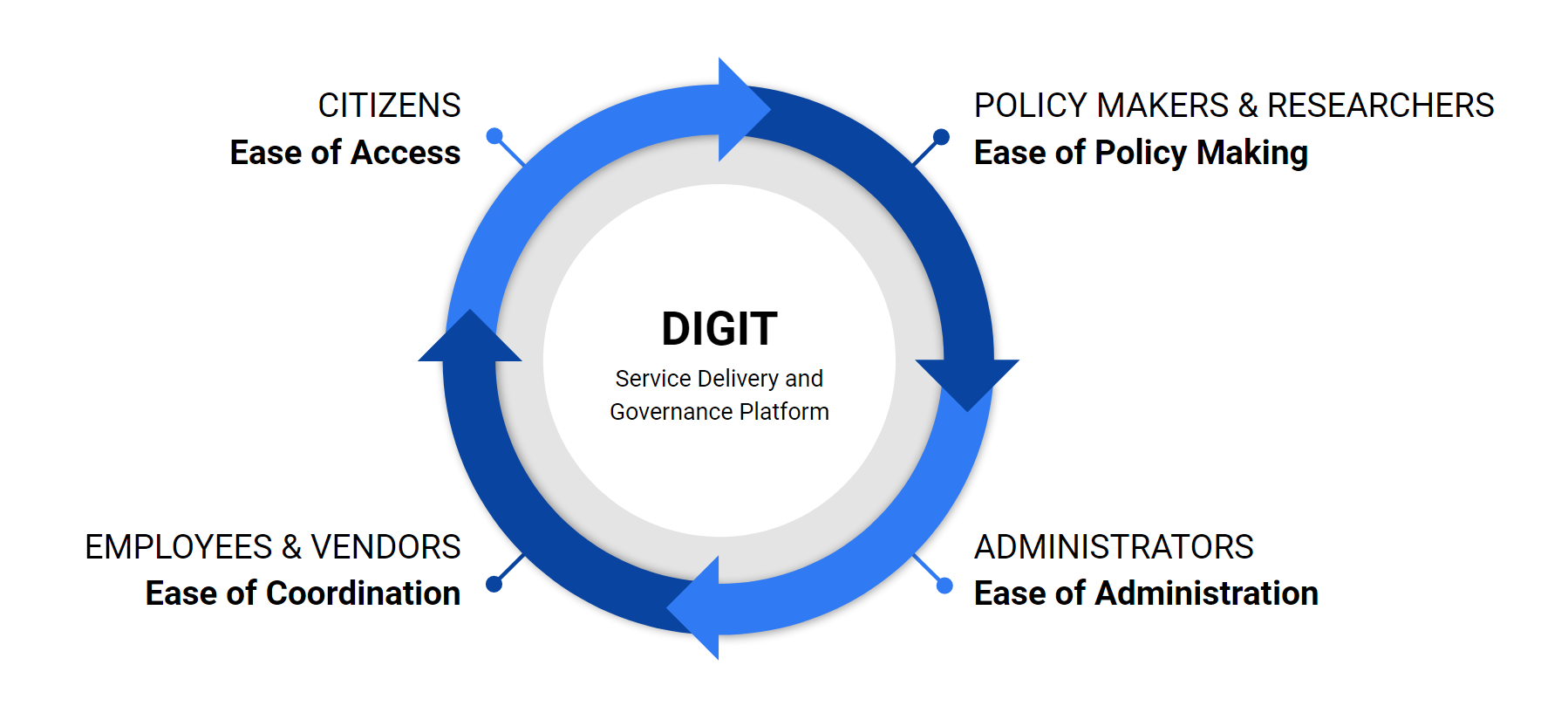
**D**igital **I**nfrastructure for **G**overnance and **I**nclusive **T**ransformation (DIGIT) is an open-source, scalable, interoperable platform for responsive public service delivery and good governance. It enables government agencies to digitise public service delivery, providing unified interfaces that allow citizens, front-line employees, and administrators to exchange information seamlessly and securely. DIGIT is an open-source platform built for scale. DIGIT is multi-tenant and enables the digital transformation of multiple government agencies at speed and scale through a shared infrastructure.
## Motivation
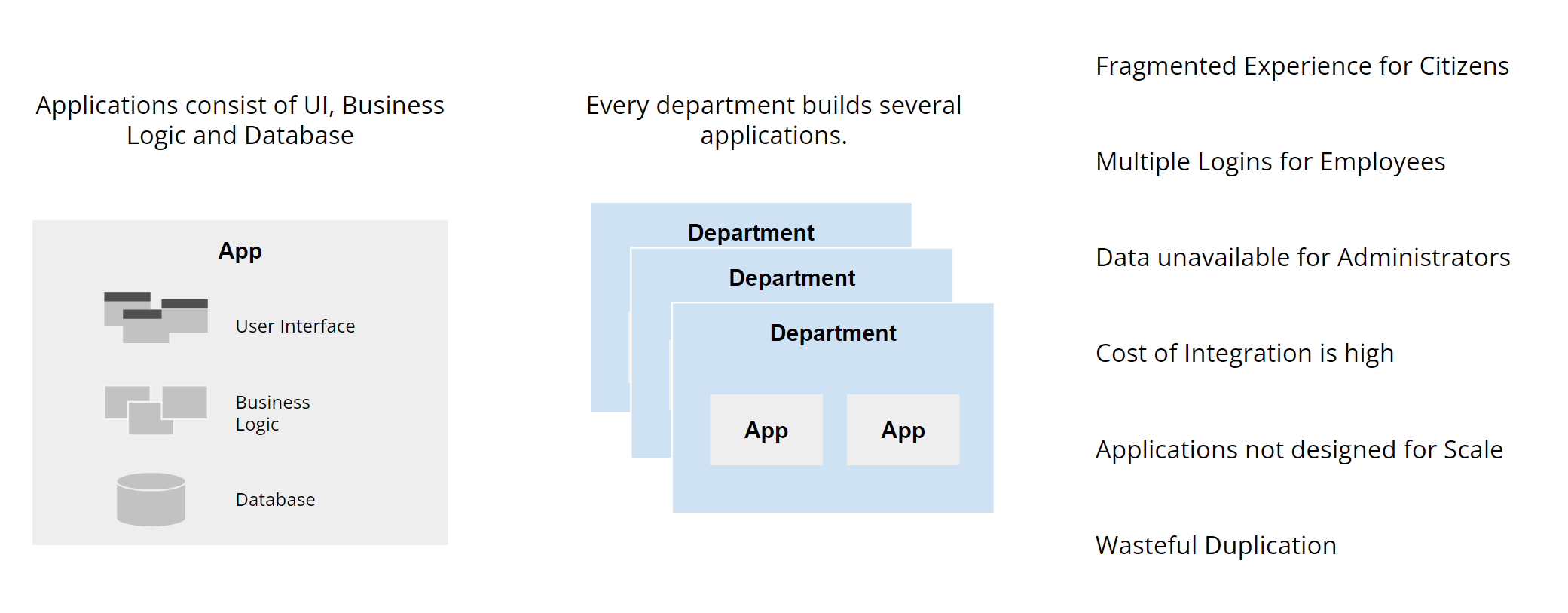
Government agencies deliver and manage a host of public services. Each of them is increasingly leveraging information technology to automate and manage the delivery of these services. Inadvertently, they build systems with common functionality and duplicate similar datasets that are out of sync. This creates several long-term challenges.
1. Lack of a Single Source of Truth: Multiple systems with similar datasets create multiple sources of truth.
2. Siloed: These systems often don't talk to each other, so citizens have to run pillar to post to get the same data across multiple systems, updated to receive services and benefits. Administrators also struggle to access data to identify areas for improvement. Employees must learn to work across multiple systems to deliver services.
3. Scalability: Many of these systems are built for internal users and cannot be opened to direct citizen access. This makes it difficult for citizens to access their own data.
4. Vendor Lock-In: Often, these systems have been developed by external vendors, and government agencies lack the capacity to take them over, leading to vendor lock-in.
Multiple other challenges, like security concerns and limited technical capabilities, hinder the government's ability to utilise technology for large-scale public service delivery effectively.
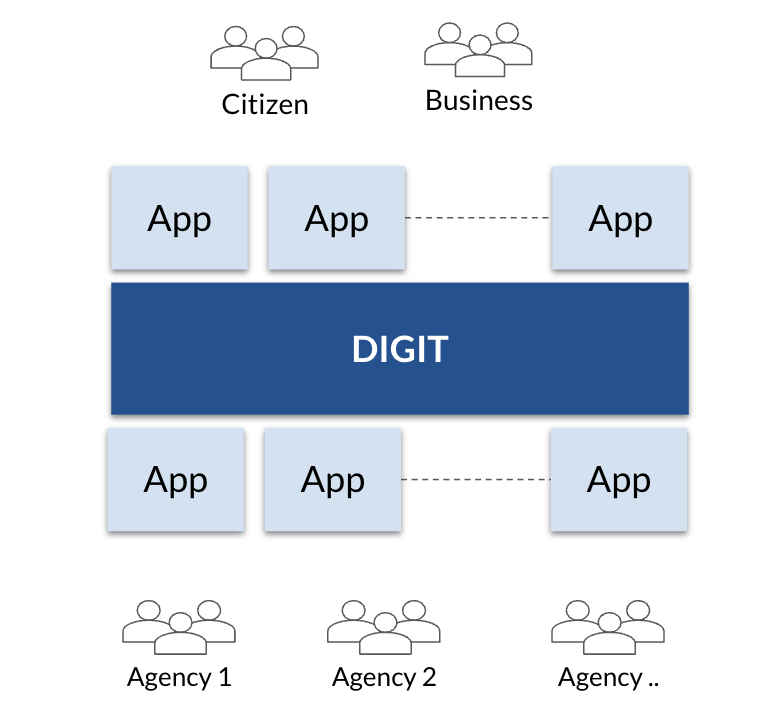
The DIGIT platform is developed using sound architectural principles to enable multiple government agencies to deliver public services in an inclusive, accessible way to all citizens and businesses at scale and speed. DIGIT provides a shared infrastructure comprising shared data registries and common services such as authentication, authorisation, workflow, notification, and payments, enabling agencies to develop and deliver services in a secure, scalable, and cost-effective manner.
Refer to the [DIGIT platform design principles](https://docs.digit.org/platform/deep-dive/principles.md) page.
## Typical Public Service Design
A typical public service delivery begins when a citizen applies for a service or a service connection. The diagram below abstracts the typical information exchange required to deliver a service.

A digital system offers the following capabilities to improve citizen experience:
1. Register/Login - Citizens can register, sign in, or authenticate themselves. Single sign-on capability streamlines access to digital services.
2. Apply/Upload - Citizens can request services by completing an application form and uploading necessary documents. Services should be accessible through multiple channels and in various languages.
3. Pay/Bill - Citizens can make payments for services and download bills. Multiple payment options, including digital and cash, should be available..
4. Inform/Track - Citizens can track service progress or receive updates via SMS, email, or app notifications.
5. Support/Feedback - Citizens can raise support requests or provide feedback on service closure. The system should allow configuring surveys and feedback forms, with the ability to analyse responses for corrective action.
The following capabilities support the employee and management experience:
1. Assign - Employees or vendors can assign service applications or trigger workflows tailored to different user/agency local requirements.
2. Search/View - Employees and vendors can search for and view applications by multiple attributes.
3. Update/Comment - Employees can update and comment on service applications, facilitating structured and unstructured data exchange between parties.
4. Deliver/Verify- Employees or vendors can deliver services, such as setting up a new connection, or verify and certify information provided by citizens. Offline-capable apps are crucial in low mobile coverage areas, with data synchronisation capabilities to handle load spikes.
5. Monitor/Improve - Administrators can monitor service performance and identify areas for improvement. All transactions should generate data events in an analytics database to enable comprehensive performance monitoring.
6. Plan/Budget - Administrators and policymakers can plan and budget for service improvement, linking expenditures to outcomes.
## DIGIT Service Design
DIGIT offers a set of [building blocks](https://docs.digit.org/platform/build/core-services.md) (i.e. services) that can be leveraged to develop any [digital services ](#typical-public-service)while adhering to the [key design principles](#key-principles). Additionally, DIGIT provides optional accelerators, such as DIGIT UI and the Dashboard Framework, that can be extended to create citizen, employee, and administrator dashboards.
The diagram below illustrates how reusable building blocks interact to realise a typical public service delivery. Leveraging reusable building blocks not only speeds up delivery but also ensures well-structured digital services. The interactions between these services are detailed in the [Service Architecture](https://docs.digit.org/platform/deep-dive/architecture/service-architecture.md).

All services are built on DIGIT, which emits micro-level transactional data into an analytical database. This is key for real-time monitoring and auditing of the operations. It facilitates planning, budgeting and policy decision-making.
---
# Agent Instructions
This documentation is published with GitBook. GitBook is the documentation platform designed so that both humans and AI agents can read, navigate, and reason over technical content effectively. Learn more at gitbook.com.
## Querying This Documentation
If you need additional information that is not directly available in this page, you can query the documentation by asking a question.
Perform an HTTP GET request on the following URL with the `ask` and `goal` query parameters:
```
GET https://docs.digit.org/platform/deep-dive/readme.md?ask=&goal=
```
`ask` is the immediate question: it should be specific, self-contained, and written in natural language.
`goal` is what the user is ultimately trying to achieve, the reason they need the answer. Sharing it helps GitBook give you a better, more relevant answer. A goal is most helpful when it describes the outcome the user wants rather than restating the question. For example, with `ask=how do I create an API token`, a goal like `automate deployments from our CI pipeline` lets GitBook tailor the answer to that use case.
The response will contain a direct answer to the question and relevant excerpts and sources from the documentation.
Use this mechanism when the answer is not explicitly present in the current page, you need clarification or additional context, or you want to retrieve related documentation sections.