> For the complete documentation index, see [llms.txt](https://docs.digit.org/llms.txt). Markdown versions of documentation pages are available by appending `.md` to page URLs; this page is available as [Markdown](https://docs.digit.org/platform/introducing-digit/releases/digit-2.9-lts/upgrade-guide-transitioning-digit-modules-to-spring-boot-version-3.2.2.md).
# Upgrade Guide: Transitioning DIGIT Modules to Spring Boot Version 3.2.2
## Overview
This document contains information about the code changes that will be required in the registries for upgrading Spring boot and client libraries
## Steps
### POM Updates
1. Upgrade the Java version in the module to Java 17 before upgrading the Spring Boot version to 3.2.2. Following is a sample snippet of the Java version upgrade:
```
17${java.version}${java.version}
```
2. Upgrade spring-boot-starter-parent library to version 3.2.2. The code snippet of the dependency is shown below:
```
org.springframework.bootspring-boot-starter-parent3.2.2
```
3. Upgrade the Flyway library to version 9.22.3 for compatibility with Postgres 14. Below is the code snippet:
```
org.flywaydbflyway-core9.22.3
```
4. Upgrade the *postgresql* library to version 42.7.1:
```
org.postgresqlpostgresql42.7.1
```
5. The tracer library is upgraded to springboot 3.2.2. The updates are available in the library version 2.9.0-SNAPSHOT. If the module is using the tracer, upgrade the tracer version to 2.9.0-SNAPSHOT as shown below:
```
org.egov.servicestracer2.9.0-SNAPSHOT
```
6. The *service-common* library is upgraded and added in tracer. You don't have to explicitly upgrade the *services-common* library and remove it from POM if you upgrade the tracer. In case your module is using only *services-common,* you can directly upgrade the version to 2.9.0-SNAPSHOT
7. Use the below version of *JUnit* which is compatible with Java 17:
```
junitjunit4.13.2test
```
8. If you are using the MDMS client library update the dependency version to 2.9.0-SNAPSHOT as shown below:
```
org.egovmdms-client2.9.0-SNAPSHOT
```
9. Update the Lombok version in the pom.xml to 1.8.22:
```
2.17.1UTF-817UTF-81.18.22
```
10. If you are using net.minidev library, upgrade the version to `2.5.0`
```
net.minidevjson-smart2.5.0
```
11. To simplify dependency management and ensure version compatibility for Spring Kafka and Spring Redis dependencies use the spring-boot-starter-parent as your project's parent in the pom.xml. This ensures the *spring-kafka* or *spring-redis* dependency is included without specifying a version, Spring Boot will automatically provide a compatible version of the dependency. Following are code snippets of both the dependencies:
```
org.springframework.kafkaspring-kafka
```
```
org.springframework.bootspring-boot-starter-data-redis
```
*Note: If a tracer library is implemented there is no need to explicitly import spring-kafka.*
### Registry Code Changes
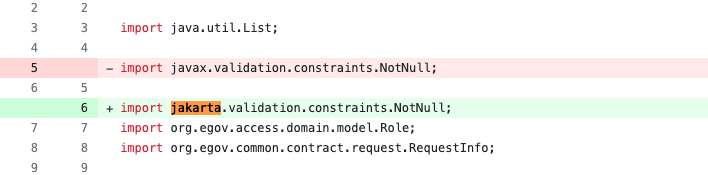
1. Javax is deprecated and transitioning to Jakarta. Remove any Javax dependencies and update all Javax imports to Jakarta. For example, change imports like PostConstruct and valid to their Jakarta counterparts in all occurrences.\\
2. Remove the annotation *@javax.annotation.Generated* which is now deprecated.
3. Update the Dockerfile for flyway migration with the below content:\
\
`FROM egovio/flyway:10.7.1`
`COPY ./migration/main /flyway/sql`
`COPY migrate.sh /usr/bin/migrate.sh`
`RUN chmod +x /usr/bin/migrate.sh`
`ENTRYPOINT ["/usr/bin/migrate.sh"]`
3. Update the migrate.sh script:\
`#!/bin/sh`
`flyway -url=$DB_URL -table=$SCHEMA_TABLE -user=$FLYWAY_USER -password=$FLYWAY_PASSWORD -locations=$FLYWAY_LOCATIONS -baselineOnMigrate=true -outOfOrder=true migrate`
4. If you are using *spring-redis*, add the following configuration file:
```
import org.springframework.beans.factory.annotation.Value;
import org.springframework.context.annotation.Bean;
import org.springframework.context.annotation.Configuration;
import org.springframework.data.redis.connection.RedisConfiguration;
import org.springframework.data.redis.connection.RedisConnectionFactory;
import org.springframework.data.redis.connection.RedisStandaloneConfiguration;
import org.springframework.data.redis.connection.jedis.JedisConnectionFactory;
import org.springframework.data.redis.connection.lettuce.LettuceConnectionFactory;
import org.springframework.data.redis.core.StringRedisTemplate;
@Configuration
public class RedisConfig {
@Value("${spring.redis.host}")
private String redisHost;
@Value("${spring.redis.port}")
private int redisPort;
@Bean
public RedisConnectionFactory redisConnectionFactory() {
RedisConfiguration redisConfiguration = new RedisStandaloneConfiguration(redisHost, redisPort);
return new LettuceConnectionFactory(redisConfiguration);
}
@Bean
public StringRedisTemplate stringRedisTemplate(RedisConnectionFactory redisConnectionFactory) {
return new StringRedisTemplate(redisConnectionFactory);
}
}
```
5. Remove @SafeHtml annotation from the fields in POJO models as it is deprecated.
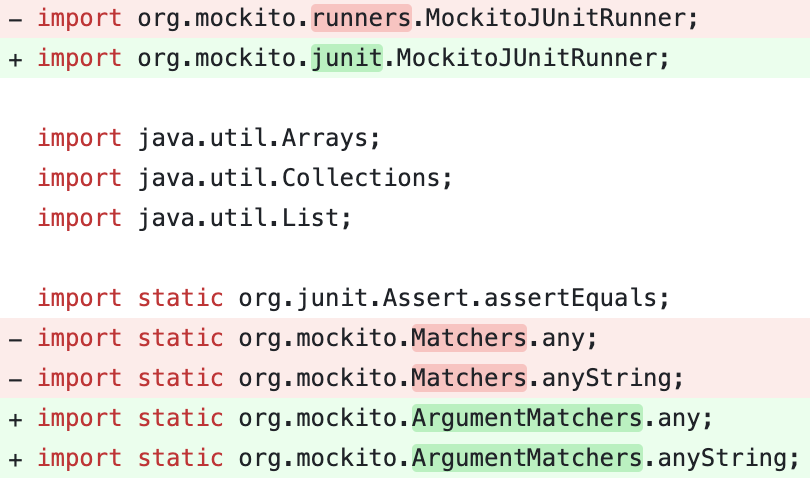
6. Update the Junit dependencies in the test cases as shown below:
---
# Agent Instructions
This documentation is published with GitBook. GitBook is the documentation platform designed so that both humans and AI agents can read, navigate, and reason over technical content effectively. Learn more at gitbook.com.
## Querying This Documentation
If you need additional information that is not directly available in this page, you can query the documentation by asking a question.
Perform an HTTP GET request on the following URL with the `ask` and `goal` query parameters:
```
GET https://docs.digit.org/platform/introducing-digit/releases/digit-2.9-lts/upgrade-guide-transitioning-digit-modules-to-spring-boot-version-3.2.2.md?ask=&goal=
```
`ask` is the immediate question: it should be specific, self-contained, and written in natural language.
`goal` is what the user is ultimately trying to achieve, the reason they need the answer. Sharing it helps GitBook give you a better, more relevant answer. A goal is most helpful when it describes the outcome the user wants rather than restating the question. For example, with `ask=how do I create an API token`, a goal like `automate deployments from our CI pipeline` lets GitBook tailor the answer to that use case.
The response will contain a direct answer to the question and relevant excerpts and sources from the documentation.
Use this mechanism when the answer is not explicitly present in the current page, you need clarification or additional context, or you want to retrieve related documentation sections.