> For the complete documentation index, see [llms.txt](https://docs.digit.org/llms.txt). Markdown versions of documentation pages are available by appending `.md` to page URLs; this page is available as [Markdown](https://docs.digit.org/public-finance/community/public-finance-blogs/why-pfm-needs-fiscal-information-exchange-standards.md).
# Why PFM Needs Fiscal Information Exchange Standards
Authors: Manish Srivastava & Gautam Ravichander
## Horses, Manure & Platforms - The Context
"In 50 years, every street in London will be buried under nine feet of manure". The Times reported in 1894. At that time the city of London primarily commuted through horse carts and had 50000 horses that each produced 15-35 pounds of manure. This was a health nightmare for the city administration.
In 1834, Eugenio Barsanti and Felice Matteucci built the first gas-based internal combustion engine. By 1879, Carl Benz demonstrated his one-cylinder two-stroke unit built on a gas engine. By 1904, the UK was developing a motor vehicle act requiring drivers to have a license, enforcing speed limits, and penalties for reckless driving. Today, the number of registered vehicles across the world is nearing 1.5 billion. London has 2.5 million of these and the city is not covered in manure.
General purpose technologies like internal combustion engines provide a base foundation to accelerate innovation. A well-defined specification evolves around these general-purpose technologies enabling various actors to build interoperable components which can then be combined into various products to meet a variety of needs. Over time market actors compete in building better and cheaper parts with the confidence that it can work with the existing and new products.
However, this is not a blog about horses, manure and automobiles. This is about Public Finance Management.
## Public Finance Management - Information Flows
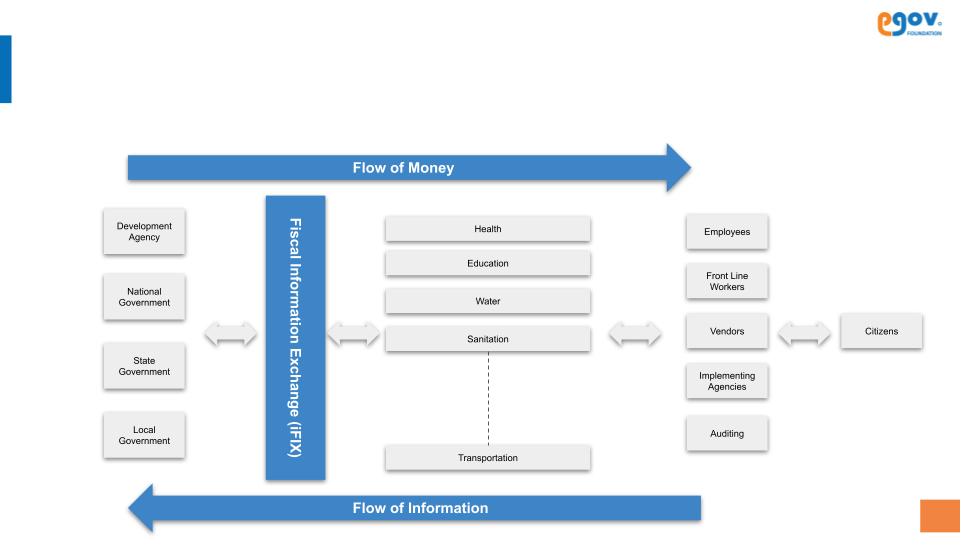
Public Finance Management drives government and all development programs, be it through the development of public infrastructure, delivery of public services or direct benefits transfers. It does this by making the right amount of money available from various funding sources/agencies to the implementing agencies at the right time - in a fiscally sustainable and responsible manner. In order to do so, funding agencies need information from the implementation agencies on how the money is being spent. So, each flow of money from funding agencies is correlated with the flow of information from implementing agencies in the reverse direction.
Development programs are funded by various stakeholders - national governments, sub national governments, local governments, development bodies and various multi-lateral agencies. At a global scale, multi-laterals and bi-laterals fund a variety of development programs across countries. There are thousands of funding and implementing agencies across the world. Money and information needs to flow between agencies seamlessly for accelerated development - especially if we need to meet the sustainable development goals which has been set back due to the recent COVID pandemic and ongoing war.
## Fiscal Information Exchange Standards
In a manner of speaking, today's information flow is like the flow of commuters in horse carts in 19th-century London. Existing methods often lead to issues of poor quality and delays in the flow of information. This is the manure that clogs the information highways and impedes development. What is needed today is a general-purpose innovative technology like the internal combustion engine that can transform the flow of information in the public finance management space and unleash development.
We believe that fiscal information data standards equate to general-purpose technology. Fiscal information data standards can substantially increase the velocity and quality of PFM information flow - similar to how email standards (like SMTP, POP3, IMAP) help us exchange emails across the world. Fiscal Information Data standards can streamline the flow of information between funding and implementing agencies around the world. Through these standards, we can start modernising the world of PFM to bring about a more seamless and coordinated way of driving development around the world.
{% hint style="info" %}
In the next blog, we will discuss how fiscal information exchange can start addressing some of the problems faced by all stakeholders in Public Finance Management.
{% endhint %}
---
# Agent Instructions
This documentation is published with GitBook. GitBook is the documentation platform designed so that both humans and AI agents can read, navigate, and reason over technical content effectively. Learn more at gitbook.com.
## Querying This Documentation
If you need additional information that is not directly available in this page, you can query the documentation by asking a question.
Perform an HTTP GET request on the following URL with the `ask` and `goal` query parameters:
```
GET https://docs.digit.org/public-finance/community/public-finance-blogs/why-pfm-needs-fiscal-information-exchange-standards.md?ask=&goal=
```
`ask` is the immediate question: it should be specific, self-contained, and written in natural language.
`goal` is what the user is ultimately trying to achieve, the reason they need the answer. Sharing it helps GitBook give you a better, more relevant answer. A goal is most helpful when it describes the outcome the user wants rather than restating the question. For example, with `ask=how do I create an API token`, a goal like `automate deployments from our CI pipeline` lets GitBook tailor the answer to that use case.
The response will contain a direct answer to the question and relevant excerpts and sources from the documentation.
Use this mechanism when the answer is not explicitly present in the current page, you need clarification or additional context, or you want to retrieve related documentation sections.