> For the complete documentation index, see [llms.txt](https://docs.digit.org/llms.txt). Markdown versions of documentation pages are available by appending `.md` to page URLs; this page is available as [Markdown](https://docs.digit.org/sanitation/water-sanitation-product-suite/waste-management-system/functional-specifications/tqm-ui/ui-plant-operator/plant-user-mapping.md).
# Plant-User Mapping
Every plant operator created will be linked to one or more plants under an urban local body (ULB).
## Plant-User Mapping Flow
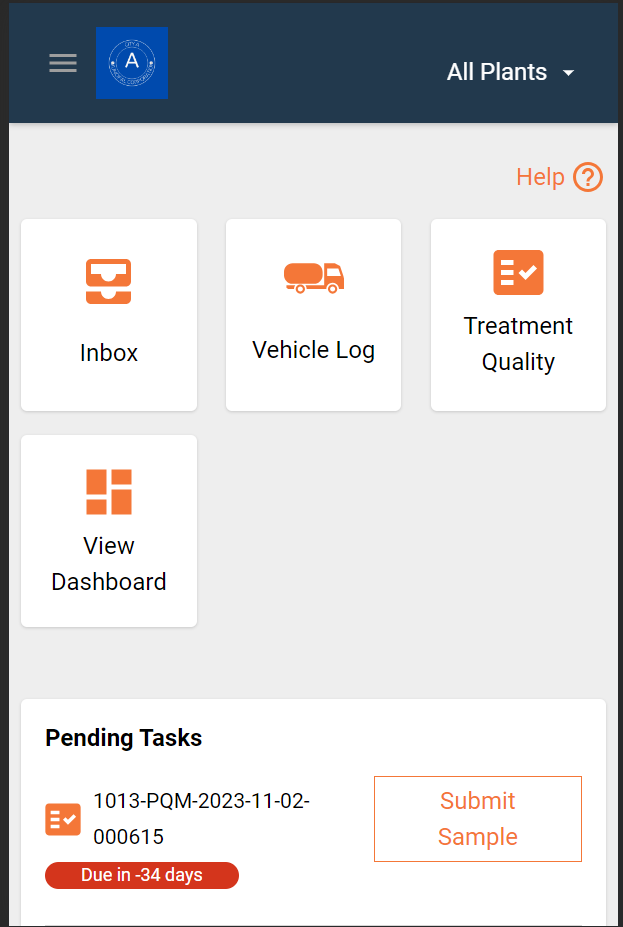
* When a plant operator logs in to the system, the top bar is populated with a dropdown which shows a list of plants this user (plant operator) is linked to.
* By default, the option "All Plants" is selected.
* When a user selects a plant, lets say, plant A, all the data of plant A will be shown in the app, whether it's inbox, view past results page, home page, etc.
* Whenever a change in a plant is detected through the dropdown, the app is redirected to the landing screen.
* A plant operator is a sanitation worker; while creating a sanitation worker, you can link the sanitation worker to one or multiple plants.
* Data such as a list of the current user's plants and active plant is stored in session storage, and is available to use within the app.
## How a Plant's Dropdown is Populated
* Whenever a plant operator logs in, he/she can make a call to this API endpoint "/pqm-service/plant/user/v1/\_search" to get a list of the plants that the user is linked to .
* Sample payload:
```json
{
"RequestInfo": {
"apiId": "asset-services",
"ver": null,
"ts": null,
"action": null,
"did": null,
"key": null,
"msgId": "search with from and to values",
"authToken": "{{access_token}}",
"correlationId": null,
"userInfo": {
"id": "1",
"userName": null,
"name": null,
"type": null,
"mobileNumber": null,
"emailId": null,
"roles": null,
"uuid": "d7867ef2-d046-4361-9a82-94c35c98416e"
}
},
"plantUserSearchCriteria": {
"ids": [],
"tenantId": "pg",
"plantCodes": [
],
"individualIds": ["d7867ef2-d046-4361-9a82-94c35c98416e"],
"additionalDetails": {}
},
"pagination": {}
}
```
* Send the user's individual id/uuid in the request object.
* Curl for the above API call:
```json
curl --location 'http://localhost:7008/pqm-service/plant/user/v1/_search' \
--header 'Content-Type: application/json' \
--data '{
"RequestInfo": {
"apiId": "asset-services",
"ver": null,
"ts": null,
"action": null,
"did": null,
"key": null,
"msgId": "search with from and to values",
"authToken": "",
"correlationId": null,
"userInfo": {
"id": "1",
"userName": null,
"name": null,
"type": null,
"mobileNumber": null,
"emailId": null,
"roles": null,
"uuid": "d7867ef2-d046-4361-9a82-94c35c98416e"
}
},
"plantUserSearchCriteria": {
"ids": [],
"tenantId": "pg",
"plantCodes": [
],
"individualIds": ["d7867ef2-d046-4361-9a82-94c35c98416e"],
"additionalDetails": {}
},
"pagination": {}
}'
```
* You will get a list of plants in the response which is used to populate the dropdown.
* By default, the "All Plants" option is selected which is the default behaviour.
* When a user selects a particular plant, it becomes active and one can filter the data (all tests shown in the app) by that plant's code in the UI.
* UI for the top bar:
---
# Agent Instructions
This documentation is published with GitBook. GitBook is the documentation platform designed so that both humans and AI agents can read, navigate, and reason over technical content effectively. Learn more at gitbook.com.
## Querying This Documentation
If you need additional information that is not directly available in this page, you can query the documentation by asking a question.
Perform an HTTP GET request on the following URL with the `ask` and `goal` query parameters:
```
GET https://docs.digit.org/sanitation/water-sanitation-product-suite/waste-management-system/functional-specifications/tqm-ui/ui-plant-operator/plant-user-mapping.md?ask=&goal=
```
`ask` is the immediate question: it should be specific, self-contained, and written in natural language.
`goal` is what the user is ultimately trying to achieve, the reason they need the answer. Sharing it helps GitBook give you a better, more relevant answer. A goal is most helpful when it describes the outcome the user wants rather than restating the question. For example, with `ask=how do I create an API token`, a goal like `automate deployments from our CI pipeline` lets GitBook tailor the answer to that use case.
The response will contain a direct answer to the question and relevant excerpts and sources from the documentation.
Use this mechanism when the answer is not explicitly present in the current page, you need clarification or additional context, or you want to retrieve related documentation sections.