> For the complete documentation index, see [llms.txt](https://docs.digit.org/llms.txt). Markdown versions of documentation pages are available by appending `.md` to page URLs; this page is available as [Markdown](https://docs.digit.org/works/platform/architecture.md).
# Architecture
Works platform design principles, approach and rationale
## Principles
The Works platform design approach is based on the principles of interoperability, open, standards-based, real-time, inclusivity, a single source of truth, security and privacy. The principles define the framework for a scalable and reliable platform that adapts to evolving needs. Read more about the platform [design principles here](https://core.digit.org/platform/principles).
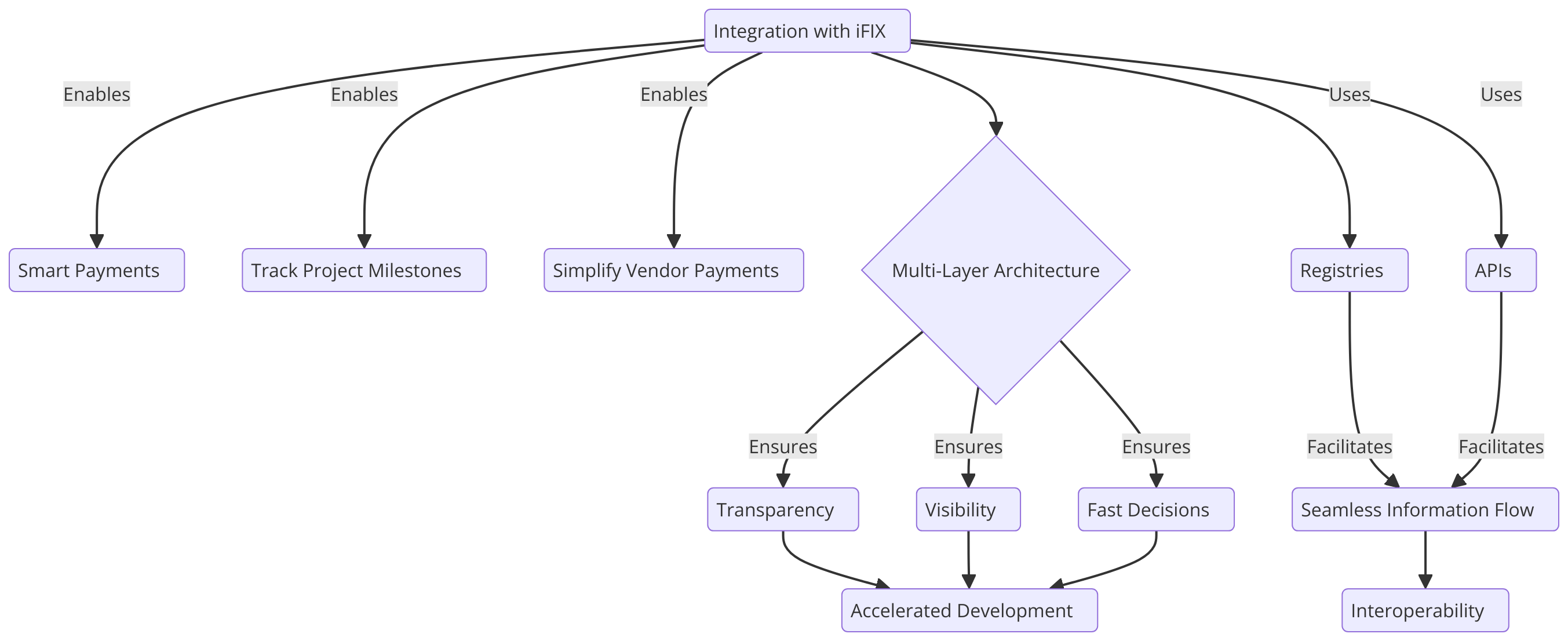
Works aims to expedite payments for public works projects undertaken by different departments. The platform registries and APIs ensure units have instant access to trusted information that improves coordination between the various departments. The seamless flow of information ensures payments are fast-tracked, projects are managed better, and departments can execute more work.
## Approach
iFIX integration approach
The platform design provides the capability to integrate smart payments with [iFIX](https://pfm.digit.org/). The integration enables departments to track project milestones and simplify vendor payments. The multi-layer architecture design ensures transparency, visibility and fast decisions all of which translate to an accelerated pace of development. The registries and APIs ensure information flows seamlessly across channels removing the challenges of siloed data structures and facilitating interoperability.
Click on the page link below to learn more about the DIGIT platform architecture.
{% embed url="" %}
---
# Agent Instructions
This documentation is published with GitBook. GitBook is the documentation platform designed so that both humans and AI agents can read, navigate, and reason over technical content effectively. Learn more at gitbook.com.
## Querying This Documentation
If you need additional information that is not directly available in this page, you can query the documentation by asking a question.
Perform an HTTP GET request on the following URL with the `ask` and `goal` query parameters:
```
GET https://docs.digit.org/works/platform/architecture.md?ask=&goal=
```
`ask` is the immediate question: it should be specific, self-contained, and written in natural language.
`goal` is what the user is ultimately trying to achieve, the reason they need the answer. Sharing it helps GitBook give you a better, more relevant answer. A goal is most helpful when it describes the outcome the user wants rather than restating the question. For example, with `ask=how do I create an API token`, a goal like `automate deployments from our CI pipeline` lets GitBook tailor the answer to that use case.
The response will contain a direct answer to the question and relevant excerpts and sources from the documentation.
Use this mechanism when the answer is not explicitly present in the current page, you need clarification or additional context, or you want to retrieve related documentation sections.