Loading...
Loading...
Loading...
Loading...
Loading...
Loading...
Loading...
Loading...
Loading...
Loading...
Loading...
Loading...
Loading...
Loading...
Loading...
Loading...
Loading...
Loading...
Loading...
Loading...
Loading...
Loading...
Loading...
Loading...
Loading...
Loading...
Loading...
Loading...
Loading...
Loading...
Loading...
Loading...
Loading...
Loading...
Loading...
Loading...
Loading...
Loading...
Loading...
Loading...
Loading...
Loading...
Loading...
Loading...
Loading...
Loading...
Loading...
Loading...
Loading...
Loading...
Loading...
Loading...
Loading...
Loading...
Loading...
Loading...
Loading...
Loading...
Loading...
Loading...
Loading...
Loading...
Loading...
Loading...
Loading...
Loading...
Loading...
Loading...
Loading...
Loading...
Loading...
Loading...
Loading...
Loading...
Loading...
Loading...
Loading...
Loading...
Loading...
Loading...
Loading...
Loading...
Loading...
Loading...
Loading...
Loading...
Loading...
Loading...
Loading...
Loading...
Loading...
Loading...
Loading...
Loading...
Loading...
Loading...
MUKTASoft v2.2 is the latest version containing changes linked to the implementation of data privacy and protection principles.
Works: Streamlining Civil Works Project Management
Works Management Systems are complex and challenging. While many agencies are building their products and solutions, these are independent systems that do not exchange data. This leads to inefficiencies in projects closely linked by nature, type, location, citizens etc.
The Works Management solution seamlessly exchanges civil works/project-related information.
The Works Management solution facilitates the smooth flow of information related to projects, vendors, assets, attendance, estimates, contracts, and payments. Below are the key reasons for using Works solution.
Streamlined Payments: Integrates works and finance systems to speed up payments.
Improved Coordination: Enables collaboration between different agencies for better project management.
Eliminates Duplication: Shares open data and registries to avoid misuse of resources.
The platform is designed for diverse agencies, including national, sub-national, urban or rural local bodies, and para-statal organizations, to manage any type of civil project.
The solution is a “shared source of truth” that all stakeholders can use to align resources and decisions to achieve operational and financial efficiency. It improves the transparency and competency of agencies executing Works.
Various departments in the government typically use a Works Management System (WMS) to track end to end lifecycle of a project (scope and finances).
End-to-End Project Tracking: From scope definition to financial management.
Smart Payment Integration: Links with iFIX for milestone tracking and simplified vendor payments.
Interoperability: Uses registries and APIs to overcome siloed data challenges and enable seamless data sharing.
The input to Works could be a decision that is taken in the legislature for the construction of new capital works or demand that is generated from within society or officers, for maintenance of existing projects.
Examples:
Construction of new metro rail is of nature capital works (New Works)
Repair of existing roads is of nature operations and maintenance (O&M)
Once the project is identified, the next step is estimating project costs. This is followed by tendering, contracting, sharing the work order with the contractor, tracking milestones, payments and closure.
The application design provides the capability to integrate smart payments with. The integration enables departments to track project milestones and simplify vendor payments. The multi-layer architecture design ensures transparency, visibility and fast decisions all of which translate to an accelerated pace of development. The registries and APIs ensure information flows seamlessly across channels removing the challenges of siloed data structures and facilitating interoperability.
Learn more about our multi-layered platform architecture and its benefits.
The Works Management Solution -
Accelerates development through transparency, visibility, and fast decision-making.
Provides a reusable and configurable platform for any public works project.
Scales to meet the needs of diverse agencies and project types.
The DIGIT Works solution is built as an open-source Digital Public Good to expand capabilities in public infrastructure. It is designed to work across boundaries at varying levels of capacity and complexity.
As per a recent article in Economic Times (2022), “Capital investment outlay is being increased steeply by 33% to Rs 10 lakh crore. This will be 3.3% of GDP. Will be almost three times the outlay made in 2019”
The majority of this capital investment (capital expenditure) which is on civil works is managed by offline or independent systems lying within the executing agencies. This is a massive problem as information is not exchanged between planning, executing, owning, financing, auditing and other authorities which leads to payment delays, poor quality of execution, poor financing and auditing amongst many other issues.
To verify the IDs of the individuals, the attendance service depends on the Individual Registry. It is an optional dependency. If the no individual registry is linked with the attendance service, then the IDs would not be checked for validity and assumed to be correct.
Attendance Service manages the following:
Attendance-Register: It maintains a list of individuals enrolled for a given register.
Staff: Staff members manage the register. Staff can be created or deleted from a register.
Attendee: Attendees are the individuals participating in the register. Attendees can be created or deleted from the register.
Attendance-Log: The log entries of the attendance. It will have events of entry and exit.
Muster-Roll is a report built upon the attendance logs. It has computed attendance values. It will pass through an approval workflow.
MuktaSoft functional specifications details
Detailed Estimation of Project
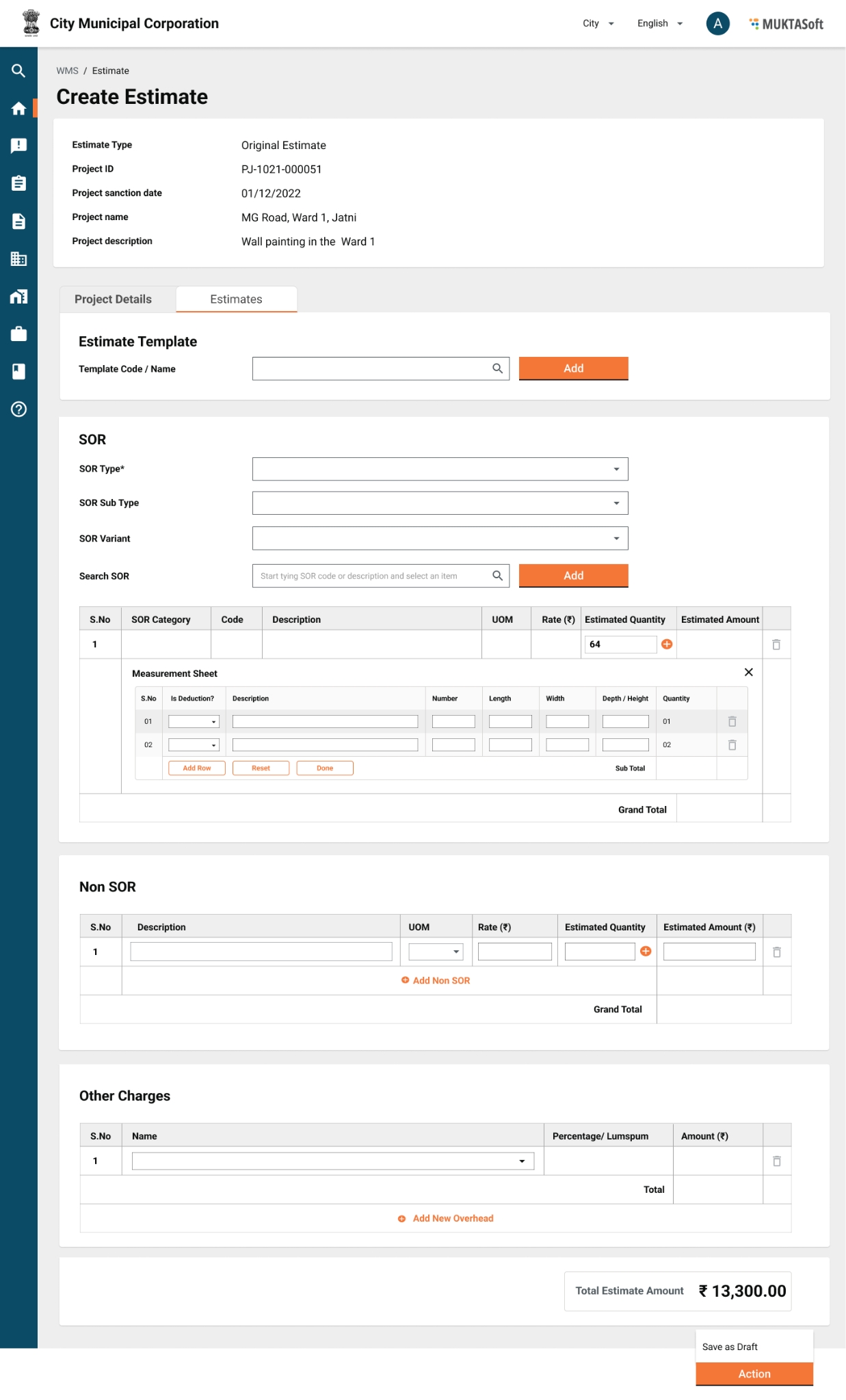
After getting administrative approval on a pre-estimation of project cost a detailed estimate is prepared. It helps to capture the measurement of works in details estimate the cost accurately in terms of predicting the cost, material, labour, and machinery required to complete the work. It is also used for tendering and contracting the work.
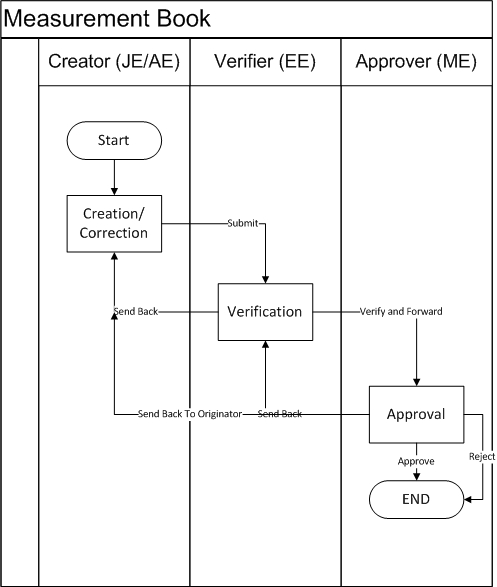
Measurement Book
The measurement book is a most important record. It is the basis of all accounts of quantities of work done, purchase made and it must contain such a complete record of facts as to be conclusive evidence in court of law.
It is the basis of all accounts of quantities whether of works done by Contractors or by laborers employed departmentally, or materials received. It is so written the transactions are readily traceable.
Offers key capabilities required by state/dept/ULB/other entities to manage Works (new and old)
Interoperable with other applications such as engineering estimation, measurement, attendance tracking, and billing apps.
Use registries or existing shared registries for projects, assets, beneficiaries, contractors etc.
Configurable for both ULBs and state departments & understands both books of accounts.
Reports & dashboards with real-time data to monitor progress and make decisions
Uses a template-based approach for creating & issuing new documents to save time and avoid mistakes
The features mentioned below are included in the scope of MUKTASoft v2.1.
Schedule of rates
The scheduled items for which the works department publishes the rates are known as schedule of rates. There are mainly 4 types of items for which schedules of rates are published.
Material - These are the material items which are required to accomplish a work.
Labour - The skilled and unskilled laborers which are required to accomplish the work.
Machinery - These are the equipment which are required to accomplish the work.
Projects that are created in the selected time period by project type
Show total project count within the PIE.
Switching to Amount should show same split by Amount instead of Count
Default Action on Hover
By Bill Type
Amount Billed (created) by Bill Type in the selected time frame. May not be approved or may be rejected also in that time-frame.
Show total Amount in the PIE
Switching to number should give number of bills the above KPI refers to while calculating amount.
Works - The composition of material, labours, machinery together to form a building block for a work.
MUKTA Dashboard comes with around 21 KPIs visulization covering the action items, tracking the status of attendance, expendutire and payments.
This is an Umbrella story for MUKTA Dashboard. Gives high level description details along with standard components.
V1 Dashboard has 25 KPIs - 8 Simple numbers and 17 in Charts Design
Should filter the dashboard data by selected District.
Multi select should be enabled.
Should filter the dashboard data by selected District.
Multi select should be enabled.
Should be drilled down from District that is selected.
Cr, Lac, Unit as per DIGIT standard
Share
Email, Whatsapp as per DIGIT standard
JPEG as per DIGIT Standard
Define a single role called “MUKTA Dashboard Viewer” whoever has that access should have Dashboard link on left navigation menu and home page card links.
Use same dashboard Icon as per DIGIT standard.
Clicking on link will land user directly on dashboard Home with no filters applied.
All filters, Denominations, Share and Download options to work as standard and expected.
All Cards will by default have menu individually(three dots). This will download image or share that card in that visualization to JPEG (Default DIGIT behavior)
MUKTASoft seamlessly integrates with AADHAAR to ensure the unique identification of MUKTA beneficiaries/wage seekers by authenticating the AADHAAR number provided during the registration process.
A mobile application to be developed for employees to facilitate on-the-ground measurement capture and seamless integration with the system.
Key functionalities of the system include login, searching work orders, managing Measurement Books (MB) with features such as creating and saving as a draft, submitting for verification, editing MB, and verifying and approving MB. Users can also view existing Measurement Books.
Works Architecture
Setup
Configure Works
MUKTASoft
A Works Management System (WMS) is typically used by various government departments to track a project's end-to-end lifecycle (scope and finances).
Click on the links below to learn more about the features and capabilities supported by Works.
Refer to the process illustration below to explore the Works Management solution design approach.
Work Packages created from Estimates/Sub-estimates, essentially comprise the scope & bill of quantities that provide contractors with enough information to bid for the contract.
Authorities Draft Tender Papers (DTP) using Work Packages.
Bids are invited from contractors between set dates. There is also a negotiation process that happens on the bid amount. The contractor with the lowest bid is selected.
A Work Order is then created and shared with the contractor.
A work order is a detailed document that contains Scope, Bill of Quantities, Timelines, Terms and Conditions, Details of Contractor, Liability Periods, Other Documents etc.
A Work order also goes through the approval process.
Before the measurement starts, there are certain offline checks required. For example, acceptance letter issued to date, letter acknowledgement date, work order acknowledgement, signed site handover date, work commenced date etc.
Measurement is essentially of two types.
Tracking Milestones:
As the project progresses, the contractor raises the invoice for which bills are created by the employee in the system under specific budget heads and sent for approval
Approved bills are sent to the finance department for disbursement.
Advance Bill:
Closing the project is a set of activities/checklists (prospective list given below) that are run to ensure all requirements are fulfilled.
Assetisation request raised
Final bill approved
Site inspection done
Site handover done
Reports and Dashboards give employees views and ways to analyze project performance within their jurisdiction. This also includes timelines, delays, risks, projections etc.
Some of the reports are -
Work progress register
Estimate appropriation register
Estimate abstract report by the department
DSS dashboard is also included.
Request for time extension on projects.
CBO: My Works → Request Time Extension
CBO
Role: CBO ADMIN
My Works lists all the work orders which are assigned to logged-in CBO and are segregated by In Progress and Completed works.
Work orders for which at least one muster roll is created and approved are allowed to create the time extension request.
Also for that project closure request should not be created.
In the action menu, the Request Time Extension option is displayed only if the above 2 conditions are met.
Each work order card will have the below attributes displayed:
Work order number
Project description
Role of CBO
Officer-in-charge
On creating a time extension request,
A window to capture the requested extension for the completion period in days is displayed.
CBO enters the below details and submits the request.
Extension Period (in days) - Mandatory
On Request Time Extension - In case the first muster roll is pending to submit for approval.
Not even a single muster roll has been approved for the project. Please ensure that the first muster roll is submitted for approval.
Not applicable.
On submit,
A time extension request is created and sent for verification/ approval.
The request ID is generated as per the specified format. ID: TE/2022-23/000021.
Not applicable.
On successful submission, the success page is displayed.
On failure, a common failure page is displayed.
The request ID is generated as per the specified format.
This page contains the test cases for SOR Skill's migration
SOR Skill's Migration
MUKTASoft is an exemplar built on the Works platform
Mukhyamantri Karma Tatpara Abhiyan Yojana (MUKTA Yojana) is a government scheme aimed towards providing employment to the urban poor and consequently improving the employment rate of the state.
MUKTASoft aims to improve the overall scheme efficiency of MUKTA by identifying & providing equal job opportunities to the urban poor, constructing environment-friendly projects, developing local communities and slums & planning better in the upcoming years.
MUKTASoft is a customisation of the basic Works platform. Not all base Works platform features need to be utilised as a part of this solution. The configuration is MUKTA-specific. UI screens will also be MUKTA-specific. Refer to the and sections for details.
MUKTASoft is a work in progress currently with a release targeted in H1 of 2023. Here's a sneak preview of the product demonstrating how daily wage seeker payments are made faster and more efficiently through the use of MUKTA. The demos also show wage seekers receiving SMS notifications on receipt of payment in their bank account.
Browse the explainer video (long version) showing payments made to wage seekers and receipt of SMS notifications by wage seekers on the credit of wages.
Find the important Mukta-specific program resources below:
Leadboard: Information in tabular form.
Serial Number
Numbers.
Show Max 5 in default table view.
If there are less than 5 rows (Pilot use-case) show only that number of rows. Don't show empty rows
ULB
List of ULBs.
Project delayed
The same KPI definition from Action Items.
Pending bills
The same KPI definition from Action Items.
WO not issued
The same KPI definition from Action Items.
Only three statuses will be shown for projects.
Created - All projects that are created in selected time period
In progress - Number of Projects that are created in the selected time period but Work Order(Contract) is not closed yet (Which means project is officially not closed)
Closed - Projects that are created in the selected time period and Work Order is closed in the past already
No Hover Text
Only three statuses will be shown for Estimates.
Created - All estimates that are created in selected time period
Yet to Approve - Number of Estimates that are created in the selected time period but estimate is not finally approved (Didn't reach final status)
Five statuses will be shown for Contracts.
Created - All Contracts that are created in selected time period
Yet to Approve - Number of contracts that are created in the selected time period but contract is not finally approved (Didn't reach final status)
Only three statuses will be shown for Muster Rolls.
Submitted - All MRs that are created and Submitted (Combined action) in selected time period
Yet to Approve - Number of MRs that are created in the selected time period but Approval is pending (Didn't reach final status)
Count of Projects where WO start date is in the selected date range and WO end date + X days is less than todays date. Let X be configurable.
For ex. Selected time period is Jan 1 to Jan 15. WO start date is Jan 7th, end date is Jan 31, X is 7. From 8Feb onwards if project closure is not done, this project is considered delayed.
No Hover Text
In Progress - Number of contracts that are created in the selected time period and Accepted by CBO in the past but not closed yet, irrespective of contract closure date.
Closed - Number of contracts that are created in the selected time period and closed in the past
No Hover Text
No Hover Text
Time Extension Request
CBO
Role: CBO ADMIN
To view the requests, the My Requests feature is provided.
My Requests lists all the requests (Closure/ Time Extension) created for the works assigned to logged-in CBO users, and segregated by In Progress and Approved requests.
An approved request can not be edited.
In Progress closure, the request can be edited only when the request is sent back for correction.
The edit time extension request form allows users to change the extra days required for completion of the project and then submit again.
Field level validations.
Not applicable.
Edit and Submit.
Not applicable.
The same as create time extension request.
After changing the extension period, on submit request is again placed to the verifier.
On Hover show “ Contract created in the selected time period but not closed till date”
Count of Bills that are created (Automatically or manually) in the selected date range and but current status(as of today) is not Paid/Payment done (Whichever is final state of Bill)
Considers all types of Bills
Show Amount as well of these bills as designed in mockup
On Hover show “ Bills created in the selected time period but payment is not done as of today”
Number of Projects that are created in the selected time period and Work Orders are not yet created. (PS: Both are create dates only though text says issued.)
On Hover show text “ Projects created but Work Orders not created”
Count of weeks across all work orders that are in progress (Accepted by SHG) but Muster Roll is not created.
If Contract start date is Jan1st (Mon) and user hasn't created muster rolls until Jan 31, Number of Muster rolls not created are 4 for this project. If User Submits any 2 of them on Feb 1st, then remaining 2 should be shown.
On hover show “Work weeks completed but muster rolls not submitted to ULBs”
Number of estimates that are created in the selected time period but have breached their SLA is respective workflow statuses.
Ex. Estimate created on Jan 15 (timeline selected is Jan 12-18), SLA is 5 days for one particular state. From Jan 21 on-wards till date this will be counted as SLA breach.
Parallel there could be other estimates in other workflow statuses too which have their respective SLA breaches.
All these will be accumulated to form SLA breach of Estimates.
If estimate is moved to next workflow state, this count will go down until the breach happens again.
All SLA breaches below KPIs follow same Logic.
Includes only until contract issuance. Contract Acceptance by SHG breach is not counted as SLA breach for this metric.
Muster roll approval breaches SLA.
Only for Purchase Bills in V1.
Amount Paid by Bill Type Aggregated by Months.
IF JIT integration is done by the time you are reading this, KPI should be the actual Amount transferred (Response from JIT) by Bill Type aggregated by Months.
IF JIT Is not done by now, Bill Final State (Payment done)by Bill Type aggregated by Months.
On Hover show: All 3 KPIs in that vertical column with actual Amounts
Payments are the same as represented in the bar chart and filtered only by wage bill.
On Hover show: Month and Actual Amount
The number of Approved Person Days considered in Muster rolls created for Wage seeker Bills amounting to above KPI.
On Hover Show: Month and Actual Person Days
Table showing payments made to Wage Seekers by gender in the selected time period. Considers wage bills where final approval status and beneficiary status reflect payment done.
Average days of employment - Average Approved Days by gender from muster rolls created in a selected time frame.
Average Payment - Average Payment made by gender in the selected time period where the status of beneficiary turned to paid.
Not applicable.
On Save, Changes in the detail estimate are saved and no workflow changes done, fresh analysis is generated.
On submit, based on logged-in user role, workflow pop-up window is displayed.
Role
Workflow Window
Estimate Creator
Submit pop-up window, estimate gets forwarded to verifier with changes saved and fresh analysis generated.
Estimate Verifier
Verify and Forward pop-up window, estimate gets forwarded to technical sanctioner with changes saved and fresh analysis generated.
Technical Sanctioner
Technical Sanction pop-up window, estimate gets forwarded to approver with changes saved and fresh analysis generated.
Approver
Approval pop-up window, estimate gets approved with changes saved and fresh analysis generated.
Same as created detailed estimate screen with additional estimate number displayed on top.
Role based access based on configuration.
The estimates which are in workflow can only be edited.
Estimate is opened in editable mode.
The details given in table can be edited by user.
Inbox page for employees to be developed duly taking care of MUKTA branding aspect.
The inbox of employee is divided into 4 sections.
Menu Title
Product Name - MUKTA
Menu Links
Create MB- This link will take the user to Search Work Order screen to search the work order and create the MB.
Search MB- This link will take the user to Search Measurement Book screen to search MB and view the details.
Search Parameters
MB Reference Number
Project ID
Project type
Filters
Assigned to me - This filter will allow the users to filters the MB which are assigned to logged in user only and display the result accordingly.
Assigned to all - Selected by default, and allow the users to search view all the MBs which are pending to take action for a role which logged in user has.
Ward - Multi-select, to filter the MB which are created for selected projects belong to selected ward(s).
Locality - Multi-select, to filter the MB which are created for selected projects belong to selected locality(ies).
Workflow state - To apply the filter to displayed the MB which are in the selected workflow state.
Result Display Area
MB Reference Number
Project name
Assignee
Workflow state
MB Amount
SLA days remaining
It should be DIGIT standard Inbox allow to configure based on request from the implementation.
Not applicable
Not applicable
Menu Links and Search, Filter Apply and Numbers Hyperlinks.
Not applicable.
It should be a service wise inbox for all the employee users.
Following the DIGIT standard inbox design.
ULB: MB Creator
A measurement book can be edited during the workflow only.
Edit of measurement book should be configurable and can be enabled for any of workflow users.
As of now it is enabled for estimate creator only.
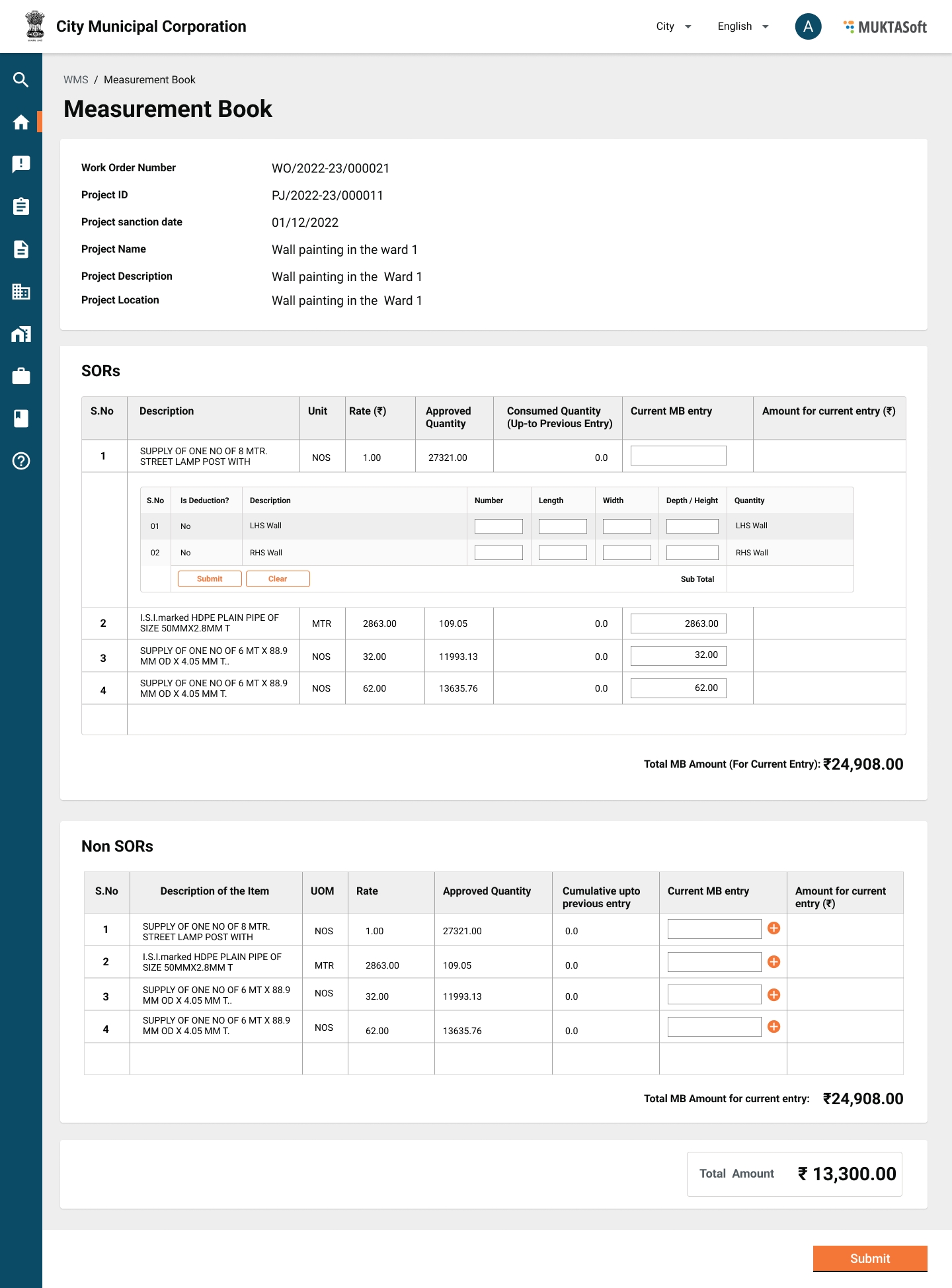
The attributes defining detailed measurement are given in below table.
Save - It is to save the details captured for detailed MB and keeping MB with editor.
Generate Utilization- Generate the utilization statement out of saved detailed MB details.
Submit - It is to allow the user to forward the MB for verification/ next action.
View Utilization Statements - It will take the user to view utilization statement HTML page.
View MB History - To display all the MBs created so far as per the detail provided in the table above.
Changes gets save successfully.
No change in workflow state.
Toast success message is displayed.
Page gets refreshed and opened in editable mode.
Changes saved successfully.
Changes gets saved.
Utilization statements are revised.
MB is forwarded to next user in the workflow.
Toast message is displayed with success message based on the workflow state transition.
Changes gets saved.
The utilization is generated and success toast message is displayed.
Utilization statements are generated successfully.
Utilization statements generation failed.
Not applicable.
Not applicable.
Not applicable
MB can be edited during the workflow only.
Once approved it can not be edited.
Actions and messages are to be taken care.
Skill migration to SOR
Muster roll Service
Added MDMS-v2 Config
Rates Migration to SOR
Expense Calculator Service
Added MDMS-v2 Config
Muster rolls not created
The same KPI definition from Action Items.
Issue Date
Due Date
Work order amount
Status
View Details - Link to view the complete details of the work order.
Request Time Extension - Action button. [This action is shown only when at least one muster roll is submitted and approved]
The estimate proposal contains high-level details like the name of the project, a brief description, a few line items that constitute the project and the multiple budget heads to finance the project.
Detail Estimate:
A detailed Estimate is prepared mostly after the estimate proposal is approved. (In most cases, these start simultaneously, as the concerned engineer would already know the chances for approvals).
A detailed Estimate is generally prepared using offline tools supporting advanced functionalities and methods of doing scope estimation. For example, in the case of Civil Projects, an estimation tool/process already has a Plinth Area Estimate, Service Unit Method, Floor Area Method, Carpet Area Method, Typical Bay Method, and Cost Comparison Method. It is possible to do a very detailed analysis using these inputs.
Abstract Estimate:
An abstract estimate is a grouping and summary of the bill of quantities that evolved from a detailed estimation process.
The concerned engineer enters the abstract estimate details into WMS. This goes through an approval process with necessary stakeholders and departments depending on the nature of the work and the estimated cost.
Sub Estimate:
An Estimate is sometimes divided into sub-estimates (For large or multi-location projects etc) for better management purposes.
Sub-estimates are later grouped into work packages for an easy tendering process.
Spill Over Estimate:
For a project that spreads into multiple financial years, a spillover estimate is created for that year. Hence no new request for assetisation is needed.
Revised Estimate:
Under circumstances where the scope & finances of the project go beyond the estimated amount and the set buffer, a revised estimate needs to be created and moved through the approval process.
The Authority issues a Letter of Intent (LOI) to enter into a contract with the contractor.
The contractor issues a Letter of Acceptance in response to the LOI.
Milestones are set up during the contracting phase and before the project starts. These milestones describe the timeline for each phase and the percentage of work that will be completed in various stages.
As a milestone is reached, the completion status can be tracked on the WMS.
All milestones should be in the completed stage to process the final contractor bill.
Tracking Measurement Book:
MBook is also set up for detailed project tracking. MBook measurements are derived from abstract estimates and track the day-to-day progress of completed work.
MBook measurements can be entered by the vendor and verified by employees or can be entered by ground inspectors/ field staff regularly.
Bill that is raised before the commencement of work. For example, to buy construction materials or to procure labour.
Part Bill:
Bills that are raised during work.
In an ideal scenario, these bills are tightly coupled with the amount of work that is done (MBook measurements)
Final Bill:
The last bill that is raised before completing the project.
Contractor feedback submitted etc
Contractor bill report
Works utilisation report
Retention money recovery register
Each report is available for download in PDF or Excel.
Migration of skills master to SOR master present in mdmsV2 - refer to this page for the steps for data migration.
Below is the list of known issues that need to be addressed as part of the platform roadmap:
Multiple measurements can not be created at the same time for one contract.
Integrated error queue implementation for all services along with the necessary measures for addressing issues, is required. In situations of unrecoverable failures, this setup will provide a means to trigger prompt alerts and implement corrective actions.
Establishing alert mechanisms for critical errors, particularly in the context of billing, is required.
Managing offline & low connectivity use cases as a best practice.
The services should include the workflow as part of the payload and push it into the Kafka topic for persistence.
Separate SMS-related localization from all services and migrate it to a dedicated service.
Performance testing and benchmarking of services.
Security audit.
Multiple mdms-v2 calls in services are needed because mdms-v2 returns only one master response.
Code refactoring of works-services like
Remove unused models
Change package names
Remove duplicate validation logic
Username/ password based login to be provided.
Option to enter username, password, and city selection is provided.
On successful login, user is taken to home page.
On failure, invalid username/ password toast message is displayed.
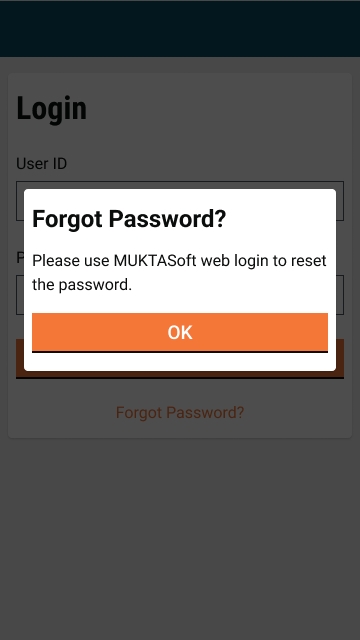
On forgot password, an info dialog box is displayed, asking user to reset password using web application.
On successful login, Home is displayed.
On failure, toast message is displayed.
Invalid username or password!
Info dialog box is displayed.
Please use MUKTASoft web login to reset the password.
System has to validate username and password and allow user to login if found correct.
None
None
User is able to enter username, password and select city.
On successful login, user is allowed to login.
ULB Employees
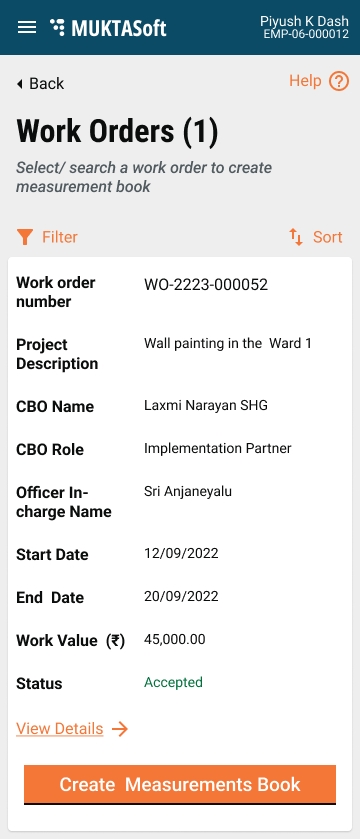
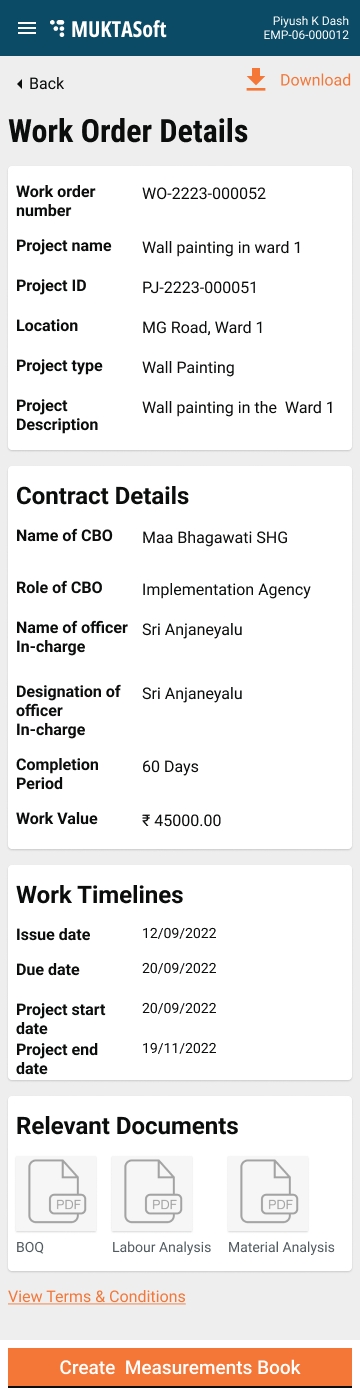
This page list all the work orders of the status “Accepted”.
Limited work order information is displayed on the card as given below.
Work Order Number
Project Description
CBO Name
CBO Role
Officer In-charge Name
Project Start Date
Project End Date
Work Value
Status
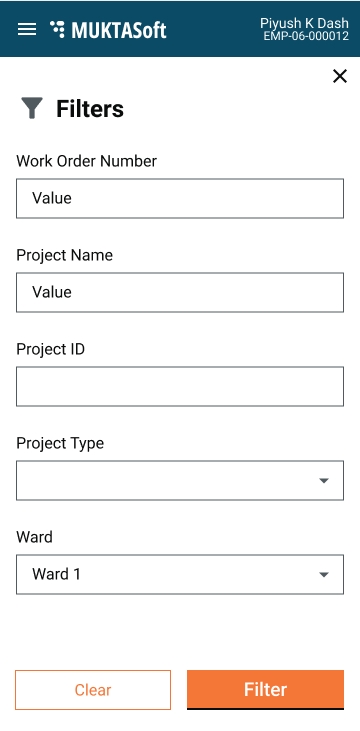
Filter - It allows the user to filter the listed work orders by the values provided.
Work Order Number
Project Name
Project ID
Project Type
Ward
None
None
None
All the work orders with status accepted are listed.
Option to sort and filter the work order is provided.
Option to view the complete Work Order details is provided.
Option to initiate new MB creation is provided.
Generate a pdf copy of the work order.
Employees
The Work Order PDF has 6 main sections.
Header - Municipality Info and Work Order No. and Amount.
Work order is addressed to either JE/AE or CBO.
The subject section
The content of the work order body
Conditions
In case the CBO role is defined as the Implementation Agency
The work order is addressed to CBO only.
<Officer Incharge/ CBO> ---> <CBO Name>
<Implementation Agency/ Implementation Partner> ---> <Implementation Agency>
Other variables -
SLA Days - maximum days are given to CBO to accept the work order.
Due Date - Work order approval date + SLA Days
Home Page
Employee Mobile Application
ULB Employees
Upon successful login Home Page is displayed.
The menu displayed as given below.
Work Orders
Work Orders - Take the users to card views of the list of all accepted work orders.
Measurement Book - Take the users to card view of the MBs which are in workflow.
None
None
None
User is able to enter username, password and select city.
On successful login, user is allowed to login.
Closure Requests/ Time Extension Request
CBO
Role: CBO ADMIN
To be view the closure requests Closure Requests feature is provided.
Closure Requests lists all the closure requests which are created for the works assigned to logged-in CBO user and are segregated by In Progress and Approved closure requests.
Each closure request card will have below attributes displayed
Closure Request No.
Work Order No.
Work Description
Location - Locality + Ward
Work Start Date
Work End Date
Work Amount
Status [Submitted, Sent Back, Verified, Approved]
View Details/ Edit - Action button to see the muster roll details./ Edit action is enabled when service request is send back for correction.
On View Details, the details of closure request is displayed with the attributes as given below.
Project Details
Closure Request No.
Project ID
Project Sanction Date
Project Type
Project Name
Project Description
Location
On View Details, the details of time extension request is displayed with the attributes as given below.
Request ID
Work Order No.
Project ID
Work Description
Completion Days
Work Start Date
Work End Date
Extension required in days
Extended End Date
Extension Reason
Status
Not applicable
Not applicable
View Details - To view the closure request details.
Edit - In case closure request is sent back for correction.
Not applicable.
My service request to list all the request raised for project assigned to him.
Details in the card view is displayed as provided.
Details for detailed view is displayed as provided.
CBO can edit the closure request when it is sent back to CBO.
The work order issue detail
Footer - Terms and Conditions
In case the CBO role is defined as Implementation Partner
The work order is addressed to JE and CBO both, JE’s name comes first.
<Officer Incharge/ CBO> ---> <Officer In-charge Name>
<Implementation Agency/ Implementation Partner> ---> <Implementation Partner>
1
Design should be as per Figma.
2
Conditions are fulfilled.
Measurement Books
Inbox page for employees to be developed duly taking care of the MUKTA branding aspect.
The inbox of employees is divided into 4 sections.
Menu Title
Product Name
Menu Links
Create Work Order - It will take the user to the search estimate page.
Search Work Order - It will take the user to search work order.
Search Parameters
Work order number
Project ID
Project type
Filters
Assigned to me - It displays the work orders in the inbox which are assigned to the logged-in user.
Assigned to all - Selected by default, It displays the work orders in the inbox which are pending for action of role(s) logged-in users have.
Ward - Multi-select
Locality - Multi-select
Workflow state - state of the workflow of the work order.
Result Display Area
Work order number
Project name
CBO name
Assignee
Workflow state
Work Order Amount
SLA days remaining
It should be a DIGIT standard Inbox that allows to configure based on a request from the implementation.
Not applicable.
Not applicable.
Menu links and Search, Filter apply and Numbers h.yperlinks.
Not applicable.
1
It should be a service-wise inbox for all the employee users.
2
Following the DIGIT standard inbox design.
Assignee name- Drop-down - Non Mandatory - The next user in the workflow i.e. work order verifier hence the employees having the role Work_Order_Verifier are displayed in drop-down with the Name and Designation. E.g. Suresh K working as Junior Assistant Executive Engineer and having the role of work order verifier will be displayed ‘Suresh K - Assistant Executive Engineer’.
Comments - Text area - Non-Mandatory - In case any comments to be added.
Forward - Action Button
Cancel - Action Button
On Forward,
The pop-up window is closed, a toast success message is displayed and the view work order page is refreshed.
The action menu is loaded according to the role-action mapping of the currently logged-in user.
The work order is forwarded to the next user in the workflow and shown in its inbox.
The workflow state changes accordingly and timelines show the current state of the estimate.
Work order is removed from the currently logged-in user’s inbox.
Submit/ Forward
Work Order Creator
Pending for verification
Submitted
Re-submit/ Forward
Work Order Creator
Pending for correction
On cancel, a pop-up window is closed, toast cancel message is displayed on the view work order page.
Not applicable.
Not applicable.
1
On submission, the application is forwarded to the next user in the flow.
2
The pop-up window gets closed and the application page is refreshed. A toast success message is displayed.
3
On cancel pop-up window is closed. A toast cancel message is displayed.
4
Workflow states change and based on the role the existing user has view work order page refreshes.
The Verify and Forward action is provided with a pop-up window to capture the below-given details.
Assignee name- Drop-down - Non Mandatory - The next user in the workflow i.e. Approver, hence the employees having the role Work_Order_Approver are displayed in drop-down with the name and the designation. E.g. Mahesh K working as EO and having the role of Work_Order_Approver will be displayed as ‘Mahesh K - Executive Officer’.
Comments - Text area - Non-Mandatory - In case any comments to be added.
Attach Supporting Document - Non-Mandatory - Any document to be uploaded as a supporting document.
Verify and Forward - Action Button
Cancel - Action Button
The pop-up window is closed, toast cancel message is displayed on the view work order page
On Verify and Forward,
A pop-up window is closed, the toast success message is displayed and the view work order page is refreshed.
The action menu is loaded according to the role-action mapping of the currently logged-in user.
Work Order Verifier
Pending for verification
Pending for approval
Verified
Not applicable.
1
Verify and forward pushes the work order to the next user in the flow.
2
The pop-up window is closed and the view work order page is refreshed. A toast success message is displayed.
3
Workflow states change, and based on the existing role the user can view the work order page on refresh.
4
On cancel pop-up window is closed. A toast cancel message is displayed.
It is provided to send the work order back to the originator’s inbox for any correction required. Below given detail is captured.
Comments - Text area - Non-mandatory - It is provided to add any remarks/ instructions to be passed to the originator of the work order.
Attach Supporting Document - Document upload - Non-mandatory - In case any documents are to be attached while sending the work order back to the originator.
Send Back - Action Button
Cancel - Action Button
On Send Back -
The pop-up window is closed and a toast success message is displayed.
The view work order page is refreshed and the actions menu is loaded according to the role the logged-in user has.
The work order is placed into the work order creator’s inbox.
<roles having access to send back to originator>
<Current Status>
Pending for correction
Sent Back
On cancel, the pop-up window is closed, toast cancel message is displayed on the view work order page.
Not applicable.
1
The work order is moved to Work Order Creator’s inbox.
2
Work Order Creator- Edit Work Order action is enabled to edit the work order.
3
Workflow state changes as mentioned in the ticket.
To reject the work order, action is provided to capture the below-given detail and reject the work order.
Comments - Text area - Mandatory
Attach Supporting Document - Document upload
Reject - Action Button
Cancel - Action Button
On Reject,
The pop-up window is closed, toast reject message is displayed.
The work order page is refreshed. No actions are enabled for the rejected work order.
The work order creator is informed about the rejection of the work order through SMS notification.
<the role having access of reject action>
<Current State>
Rejected
Rejected
3. On cancel, a toast cancel message is displayed on the view work order page.
SMS to the creator’s mobile
Work order <work order no.> for the project <project name> of the location <location> has been rejected by <username+designation>. For more detail please login to MUKTASoft to view the work order details.
1
On reject, the work order is rejected and the workflow state/status changes accordingly.
2
No further actions can be performed on a rejected work order.
3
Notification is sent to the work order creator.
For the approval of the work order, action Approve is provided and the below given detail is captured in a pop-window on approval.
Comments - Text area - Non-mandatory
Attach Supporting Document - Document upload - Non-mandatory
Approve - Action Button
Cancel - Action Button
On Approve,
The work order is approved.
Approve pop-up window is closed, a toast success message is displayed and the view work order page is refreshed.
Workflow timelines are displayed accordingly.
Work Order Approver
Pending for approval
Approved
Approved
On cancel, the toast cancel message is displayed.
SMS to the Work Order Creator
Work Order <work order no.> for the project <projectname> of the location <location> has been approved and sent to <CBOName> for acceptance. For more detail please login to MUKTASoft to view the estimate details.
SMS to the CBO
Dear <contactpersonname>, <organisationname> has been chosen as the <IA/IP> for the project <project name>. Please accept the work order <WO_NUMBER> before <duedate> to avoid auto cancellation. To login please click on <Organization Login URL>.
1
On approve, work order workflow state changes accordingly.
2
On approve, notification is sent to work order creator.
No change.
There is no change in existing search estimate.
Changes are for the attributes added newly.
Estimate Number
Estimate Type
Project ID
Project Sanction Date
Project Name
Project Description
Project Details [*The project details is shown as view project detail in a separate TAB*]
Estimation Details
SORs - Below information is displayed in the grid.
Type
Code
Description
Not applicable.
Not applicable.
For In Workflow Estimates, actions in Action Menu, workflow actions based on the role of logged-in user.
Save as Draft
Verify and Forward,
Technical Sanction
Approve
Send Back
Send Back To Originator
Edit Estimate
Reject
Not applicable.
Same as create estimate in real only mode.
Estimate details is displayed as described in the story.
Actions are enabled as per the estimate workflow state and role logged-in user has.
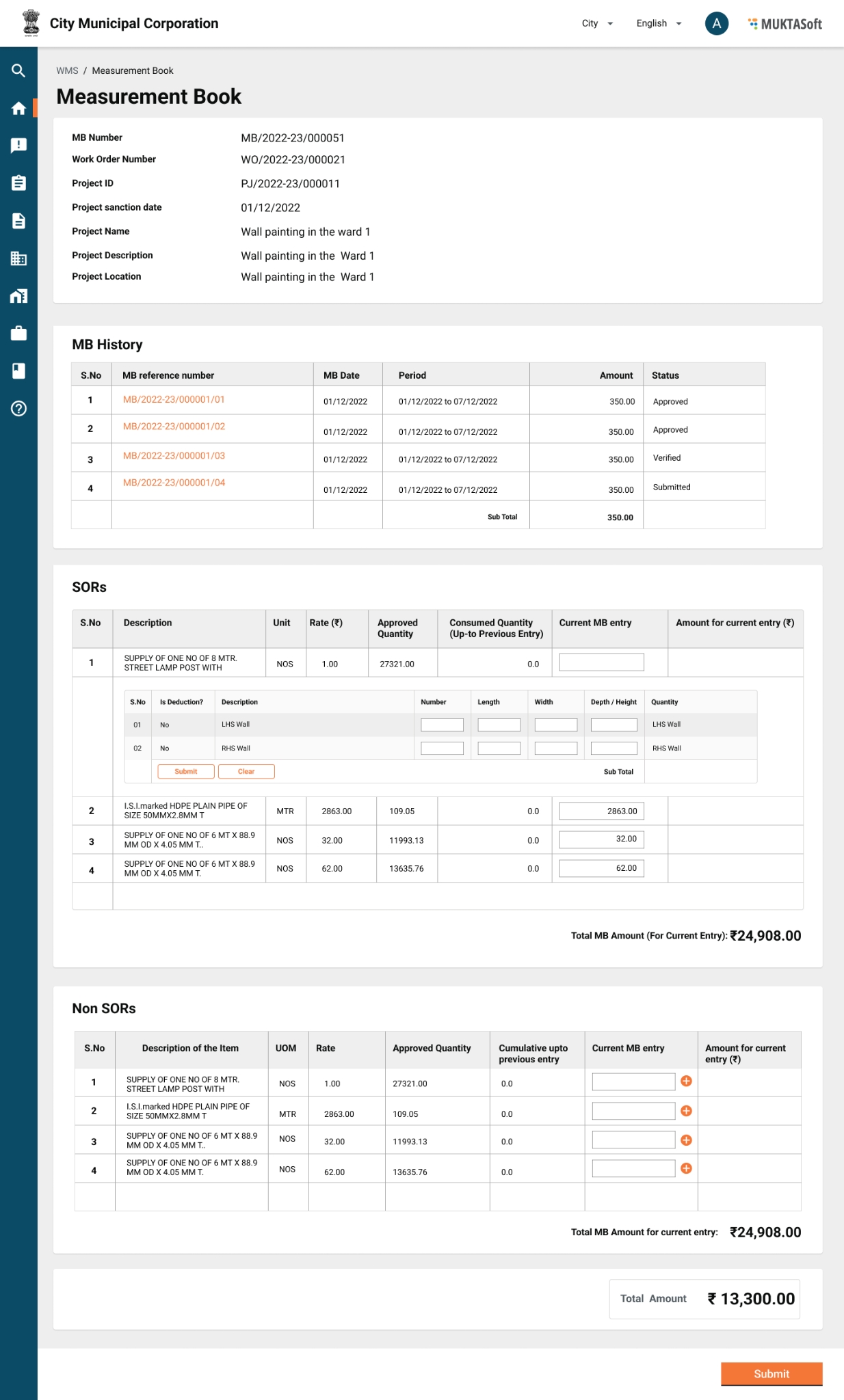
Measurement book is searched and opened to view the details.
Below are the attributes which are displayed.
MB Reference Number
MB Number
Work Order Number
Project ID
Project Sanction Date
Project Location
Project Name
Project Description
View Measurement History
Measurement History
Sr. No
MB Reference Number
Not applicable.
Not applicable.
For In Workflow MB, actions in Action Menu, workflow actions based on the role of logged-in user.
Save as Draft
Verify and Forward
Approve
Send Back
Send Back To Originator
Edit MB
Reject
Not applicable.
MB details is displayed as described in the story.
Actions are enabled as per the estimate workflow state and role logged-in user has.
ULB Employees
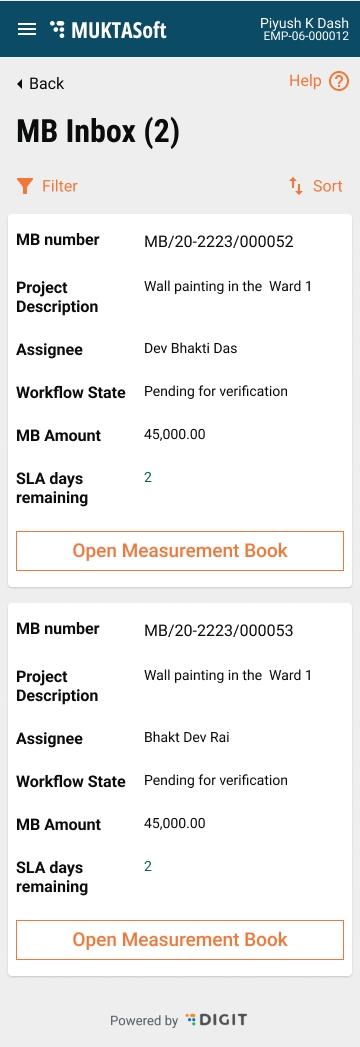
This page list all the measurement books which are under workflow.
Limited MB details is displayed on the card as given below.
MB Number
Project Description
Assignee
Workflow State
MB Amount
SLA days remaining
Filter - It allows the user to filter the listed MBs by the values provided.
MB Number
Project ID
Project Name
Ward
Workflow State
None
None
None
All the MBs which are in workflow are listed.
Option to sort and filter the MB is provided.
Option to view the complete MB details is provided.
Option to initiate new MB creation is provided.
Send the work order back to the previous user in the workflow.
Employees
Send Back action is provided with the below details to be captured.
Comments - Text area - Non-mandatory - It is provided to add any remarks/instructions to be passed on to the previous user in the workflow.
Attach Supporting Document - Document upload - Non-mandatory - In case any documents are to be attached.
On cancel, the toast cancel message is displayed on top of the view work order page.
Not applicable.
View Measurement Book
Employee Mobile Application
ULB Employees
This page is to view MB details.
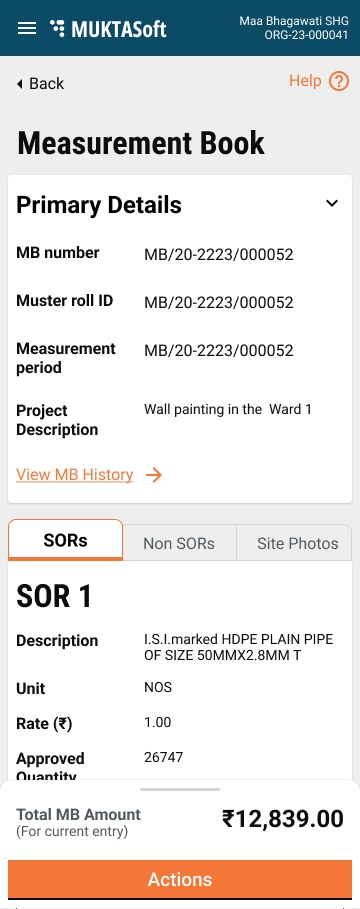
The details are as given below.
Measurement Book Primary Details Details
Actions - It will open up with the workflow actions according to role user is having.
Save as Draft - It will save the MB and assigned to creator.
Edit - It will open the MB in editable mode.
Submit - It will open the submit and forward workflow pop-up window.
Verify and Forward - It will open the verify and forward workflow pop-up window.
None
None
None
Details to be displayed as per figma.
UOM
Rate
Quantity
Amount
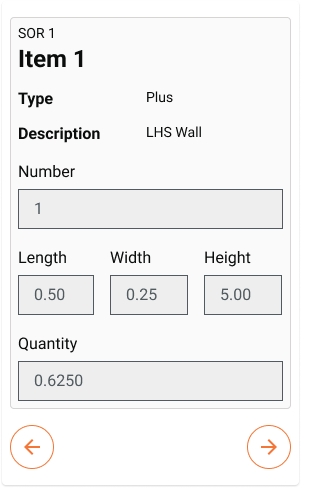
Measurements
Type
Description
Numbers
Length
Breath
Height/ Depth
Quantity
Total
MB Date
MB Period
MB Amount
Status

The workflow state changes accordingly and timelines show the current state of the work order.
Work order is removed from the currently logged-in user’s inbox.
The ‘Edit Work Order’ option is provided to Work Order Creator to edit the work order and attached the new documents files and Re-submit it.
Workflow state changes as given below.
Workflow state changes as given below.
Workflow state changes as given below.
Send Back - Action Button
Cancel - Action Button
On Send Back,
The pop-up window is closed, and a toast success message is displayed.
The view work order page is refreshed and the action menu is loaded according to the role of the logged-in user.
The work order is sent back to the previous user’s inbox.
Workflow states change as per the flow.
Work Order Verifier
Pending for verification
Pending for correction
Sent Back
Work Order Approver
Pending for approval
Pending for verification
Sent Back
1
On send back, the pop-up window is closed and a toast success message is displayed. The view work order page is refreshed.
2
The work order is sent back to the previous user in the workflow and the workflow timeline gets updated.
3
Workflow state changes based on the role as mentioned in the story above.
4
On cancel, the pop-up window is closed and a toast cancel message is displayed.
Work Order Number
Muster Roll ID
Project Description
Measurement Period
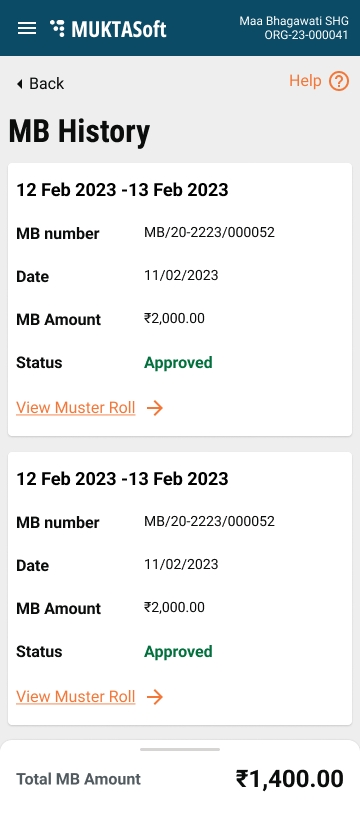
MB History (Cards) - In case of first MB, this information is not displayed.
MB Number
Period
Date
MB Amount
Status
Send Back - It will open the send back workflow pop-up window.
Send Back To Originator - It will open the send back to originator workflow pop-up window.
Approve - It will open the approve workflow pop-up window.
Reject - It will open the reject workflow pop-up window.
View Utilization Statement - It will open the utilization statement in a pop-up window.
There is change in wage registration mobile screens to accommodate the AADHAAR validation and make it more user friendly.
Entire registration process is divided into 4 steppers as it was there in earlier and the screens provided as given below.
Individual’s Identification Details
Individual’s Personal Details
Individual’s Skills Details
Individual’s Photo
Location Details
Financial Details
Summary
On validate, API is called and AADHAAR is validated.
On valid AADHAAR, a inline success message is displayed and “Next” button is enabled to move to next page.
On invalid AADHAAR, a inline invalid message is displayed and “Next” button is kept disabled.
On failure, a inline invalid message is displayed and “Next” button is kept disabled.
On selection of any other identity document, other than AADHAAR, “Validate” action is not displayed and user is allowed to move to next scree if case all the required detail is entered.
Takes the user to next page, when all the required details of current page entered.
Save the record in system.
All existing validation
Validation button is displayed only when identity document selected as AADHAAR.
None
Change in Individual Details Page to accommodate AADHAAR validation.
AADHAAR validation is implementation only when identity document selected AADHAAR.
Pending for verification
Re-submitted
A mobile application for the employees will be developed to enable the users to take measurements on the ground and capture them in the system.
It will support the below-listed features.
The login screen enables the users to log into the mobile version of the MUKTASoft application.
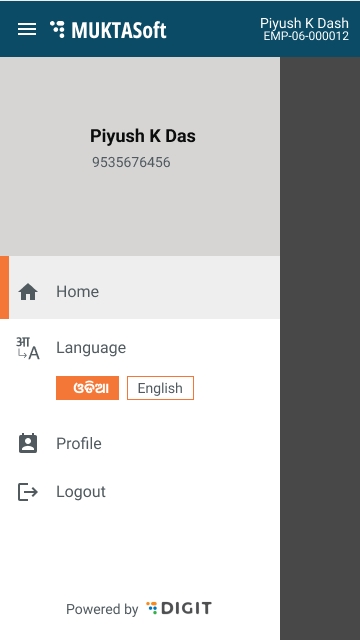
The home page enables the users to view the service menus and the menu icon to explore them.
The work orders screen lists the accepted and in-progress work orders to initiate the Measurement Book. Closed project work orders are excluded from the view list.
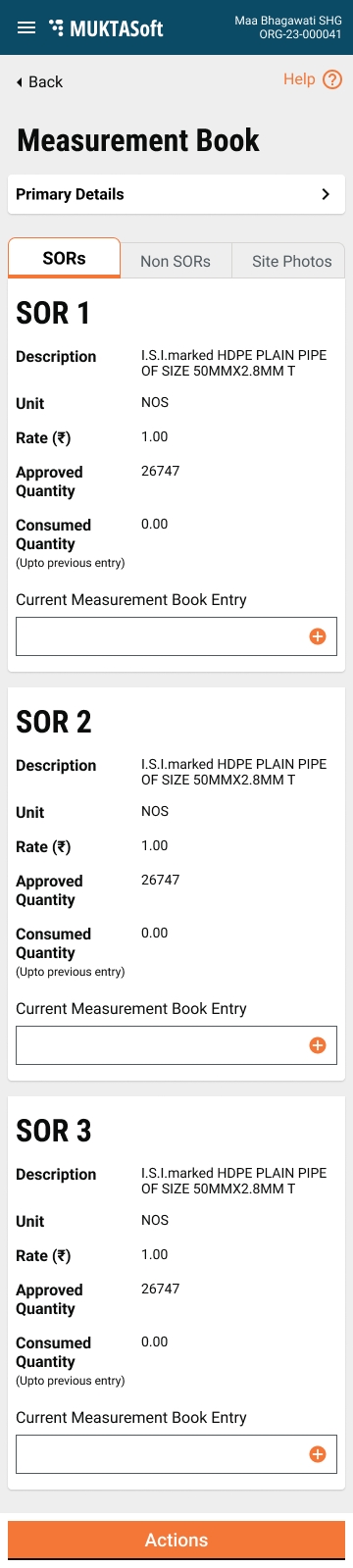
The mobile version of the measurement book allows the user to record the measurement from the ground.
The view measurement books are the same screens in read-only mode.
Workflow screens are available below.
Create Measurement Book
Employee Mobile Application
ULB Employees
This page is to create a new MB for a project or edit an existing MB in workflow.
A MB would be either first MB, intermediate MB or a last MB for a project.
First MB will not have any used quantity and MB history associated with it while the subsequent MBs will have used quantity as well as a associated MB history. Complete MB details of previous MB can be seen using view MB details.
Actions - It will open up with the workflow actions according to role user is having.
Edit
Submit
Verify and Forward
Send Back
All the validations applied while creating/ editing a MB in Web application.
All the validation applied during workflow available in web.
None
All the notification during workflow as per web application.
Create MB Page is developed as per figma.
All the validations existing to web application are applicable here.
All web workflow actions are applicable and displayed as per the role user has.

AADHAAR provide is valid! AADHAR provided is invalid, enter a valid AADHAAR or choose any other idetity document!Validation process failed, try again or choose any other idetity document!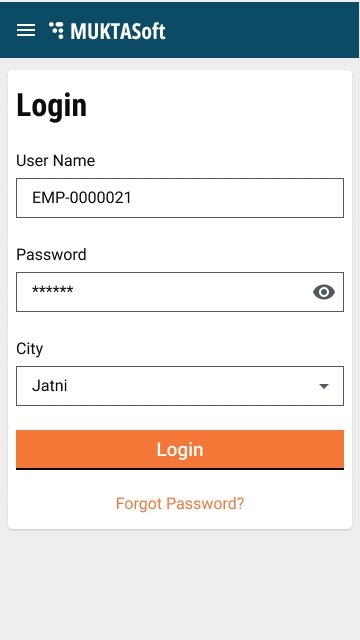
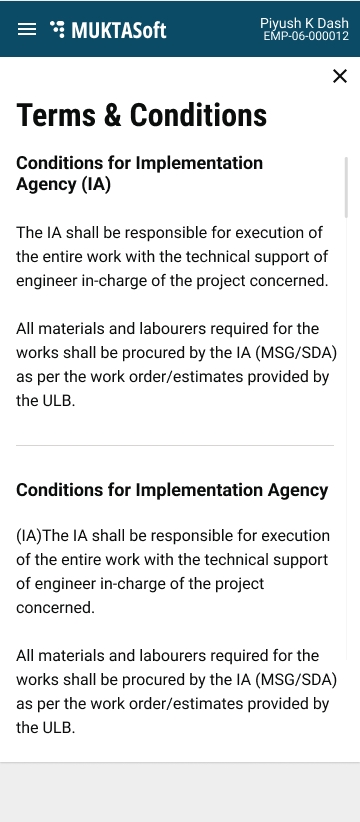
Measurement Book Primary Details Details
MB Number
Work Order Number
Muster Roll ID
Project Description
Measurement Period
MB History (Cards) - In case of first MB, this information is not displayed.
MB Number
Period
Date
MB Amount
Status
Send Back To Originator
Approve
Reject
Search Project action has to be configurable and allow mapping with a role on demand.
Search Project is provided to allow the users to search Work and view its details/ create estimates.
#
Field Name
Data Type
Description
1
Ward
Drop-down
List of ward boundaries for logged-in user ULB with search by entering name.
2
Project Type
Drop-down
Values of work type from MDMS configuration.
3
The search result is shown as given below.
Pagination is displayed to handle the big result set. 10 records are displayed per page.
The option to download the result set in Excel/ PDF is provided.
#
Field
Data Type
Comments
1
Project ID
Display Only
A hyperlink to open the project details in view mode.
2
Project Name
Display Only
Name of project having project description displayed as tool-tip on mouseover.
4
All the actions are displayed based on role action mapping and the user role assignment.
Search - It will perform the search based on the values supplied for search parameters and the logic defined.
Clear Search - It will clear the values filled for searched parameters.
Project ID - It will take the user to the View Project Details Page.
Not applicable.
1
Search Parameters/ Search Logic should be as stated in the story above.
2
Search result is shown as described in the story.
3
Pagination is provided to handle more results and 10 records per page is displayed.
Payment Instruction
Search Payment Instruction to Generate Revised PI
Employee
Role: Accountant
Home Page > Payment Instructions > Search Payment Instruction
Search Payment Instruction to be provided to list all the PIs which have the failed transaction and the revised PI to be generated for them.
Two types of searched to provided with 2 different tabs.
Pending for Action
Open Search
Below are the search parameters to search such payment instructions.
#
Parameters
Description
1
Ward
Drop-down, with the ward name as values.
2
Project Type
Project Types
3
Project Name
Name of project
4
“Pending for Action” tab is displayed by default with the search result of PIs which are pending for action. It means.
The payment instructions which have the status Completed, Declined, and Pending.
Additional condition for Completed PI, It should have at least one beneficiary payment status as Payment Failed .
Open Search, it will allow users to search any payment instruction and view the details.
In this case, at least one parameter is must to search.
For name, fuzzy search is enabled.
Created from and To are considered as one parameters as date range.
#
Parameter
Description
1
Payment Instruction ID
Original/ Revised Payment Instruction ID. It is a hyperlink which opens the payment instruction to view the complete details.
2
Payment Instruction Date
Original/ Revised Payment Instruction Date.
3
No. of beneficiaries
Total number of beneficiaries for which payment is getting processed.
4
Not applicable
Not applicable.
Not applicable.
Not applicable.
Not applicable.
Not applicable
Search enables users to see the pending correction PI by default.
Search for any PI is also provided to search and view the details.
Role: Work Order Creator, Work Order Verifier, Work Order Approver.
Search Work Order- It has to be configurable and is mapped with a role on demand.
Search Work Order is provided to allow the users to search for a work order and view its details.
1
Ward
Drop-down
Auto-complete, matching search. The values populated from ward boundary master data.
2
Project type
Drop-down
Project type masters value
3
At least one parameter is required to perform the search.
The date range From Date/ To Date is considered one parameter.
An exact search is performed for the values entered/selected except the project name.
For project name fuzzy search to be enabled.
In case multiple parameter values are supplied AND are applied for searching record.
The search result is shown as given below.
1
Work order number
Display Only
A hyperlink to open the work order in view mode.
2
Project name
Display Only
Project name with project description displayed as tool-tip on mouseover
3
At least one parameter is required to perform the search.
Search - To search the result upon supplying the values of the parameters.
Clear Search - To clear the search parameters supplied.
Not applicable.
1
At least one parameter is required to perform the search.
2
Search results are displayed on matching records found else no record found message is displayed.
3
Pagination is applied if more than 10 records are found.
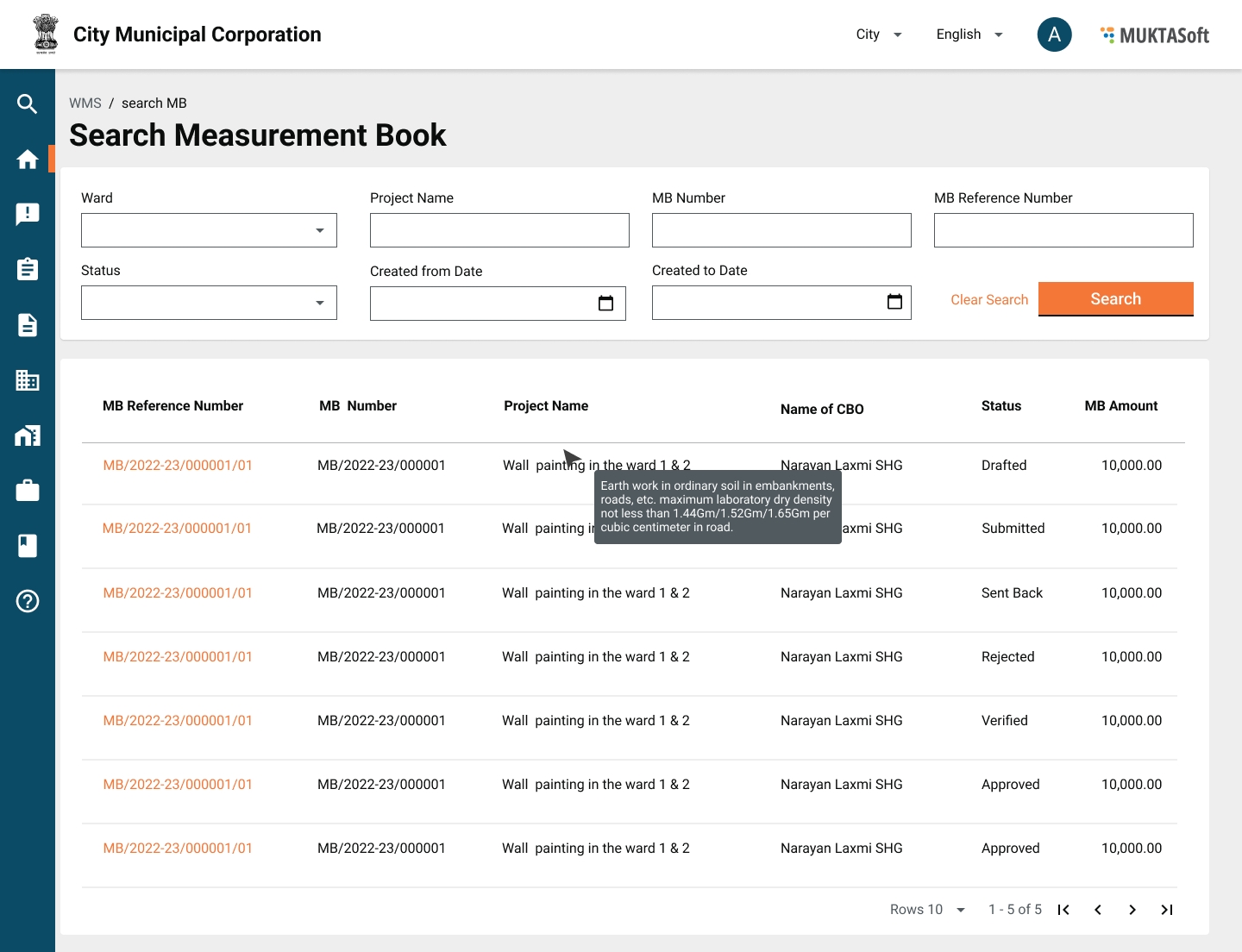
Search Measurement Book to be provided to search a MB and view the details.
Search is provided based on various parameters.
Sr. No.
Field Name
Data Type
Description
1
Ward
Drop-down
Name of the ward from the configured boundary data.
2
Project Name
Text
Project name
3
At least one parameter’s value is required to perform the search.
Date range From Date/ To Date is considered one parameter.
Exact search is performed for the values entered/selected other than Project Name.
For Project Name, fuzzy search to be provided.
In case multiple parameters values are supplied AND is applied for searching record.
Search result is shown as given below.
Pagination is displayed to handle the big result set. 10 record per page are displayed.
Option to download the result set in Excel/ PDF is provided.
Sr. No.
Field Name
Description
1
MB Reference Number
MB reference number, a hyperlink to open the MB.
2
MB Number
MB number
3
Project Name
Project name, with the option to see the project description as tool-tip.
4
At least one parameter’s value is required to perform the search.
Search - It will perform the search and display the result. In case, no result found appropriate message is displayed.
Clear Search - It will clear the search parameters.
MB Reference Nbmer - Hyperlink will take the user to MB detail page.
Not applicable.
At least one parameter is required to perform the search.
Search result displayed on matching records found else no record found message is displayed.
Pagination is applied if more than 10 records are found.
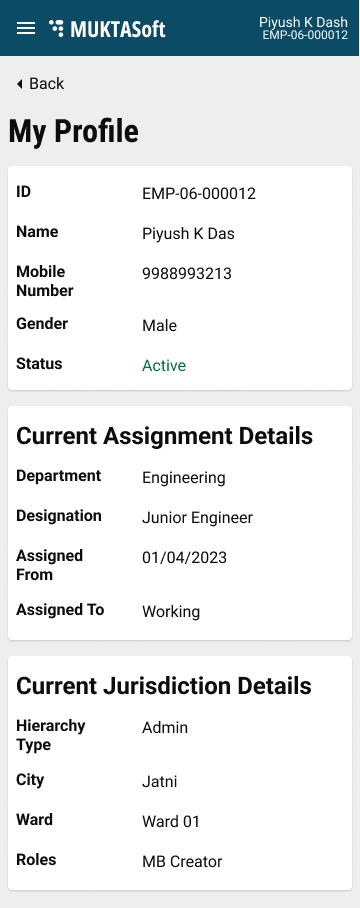
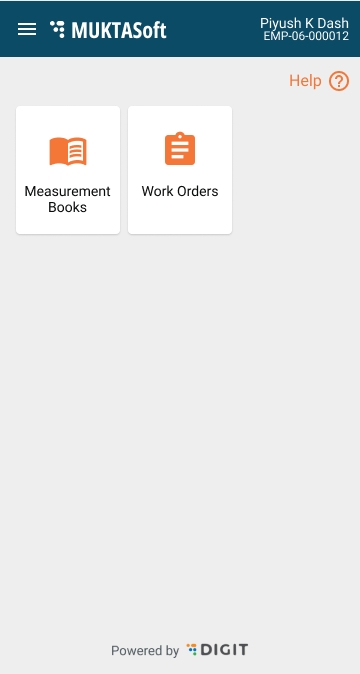
DIGIT - Projects functional details
Projects are the first work entity defined by the State/Department/ULB or any executing authority. This consists of basic details like IDs, descriptions, addresses, sub-project details, project types, start and end dates etc.
Projects may not focus on just construction or civil works. Examples of projects - a health campaign, office decoration, a pre-contractual phase with an IT vendor for new software, new service delivery initiatives etc.
Users: Junior Engineer or Assistant Engineer who creates Works Projects for the ULB/Department
JE creates projects with the below-mentioned attributes.
A project can have sub-projects as well depending on the way of executing the project.
When a project is divided into sub-projects, each will have the same attributes to be captured as the main project.
The table below provides the list of project attributes.
The following primary masters are defined by this module and used for validations. Other common masters such as department, tenant etc..are also used by this module.
A project can be divided into multiple sub-projects, each with its own workflows/business requirements defined.
- for MuktaSoft
- for MuktaSoft
Skills data is stored as SOR in MDMSv2 and needs mapping. After mapping, update the skills info in individuals' details and muster rolls with SOR. Use the provided migration script to help with this data update.
To migrate data follow the steps given below:
Create Labour-Sor Mapping:
Add the following mapping to the expense.sor.migration.mapping field in the application properties: `{"UNSKILLED.CARPENTER":"SOR_000016", "SKILLED.CARPENTER":"SOR
You can also override it in the Helm ().
Fund Allocation Register
Reports → Fund Allocation Register
Employee
Role: Fund Allocation View
Virtual Allotment Details (VA) is the API to fetch the fund allocation details.
MUKTA as a scheme has multiple HOAs for which fund is sanctioned and allocated.
Fund Allocation Register has to be developed to see and download the details.
For Request/ Response parameters, please refer the .
Search Parameters
Note: Financial Year is mandatory to select, by default current financial year is selected and records are searched.
Search Result
While fetching the details, from date should be taken care properly.
The records/transactions are sorted in chronological order.
The master data which needs to be configured.
Special Spending Unit
SSU ID
SSU Name
Grantee Code
221705789358641045908 (MUKTA - SC Component)
221705800358641045908 (MUKTA - General Component)
221705796358641045908 (MUKTA - ST Component)
Not applicable.
Not applicable.
Search - Fetch and display the records based on the search parameters.
Clear - Clear the search parameters.
Download - Option to download the report into PDF format is provided as per the attached format.
Not applicable
Data fetched is stored for reporting and reference purpose.
Report is developed with the option to download the it into PDF.
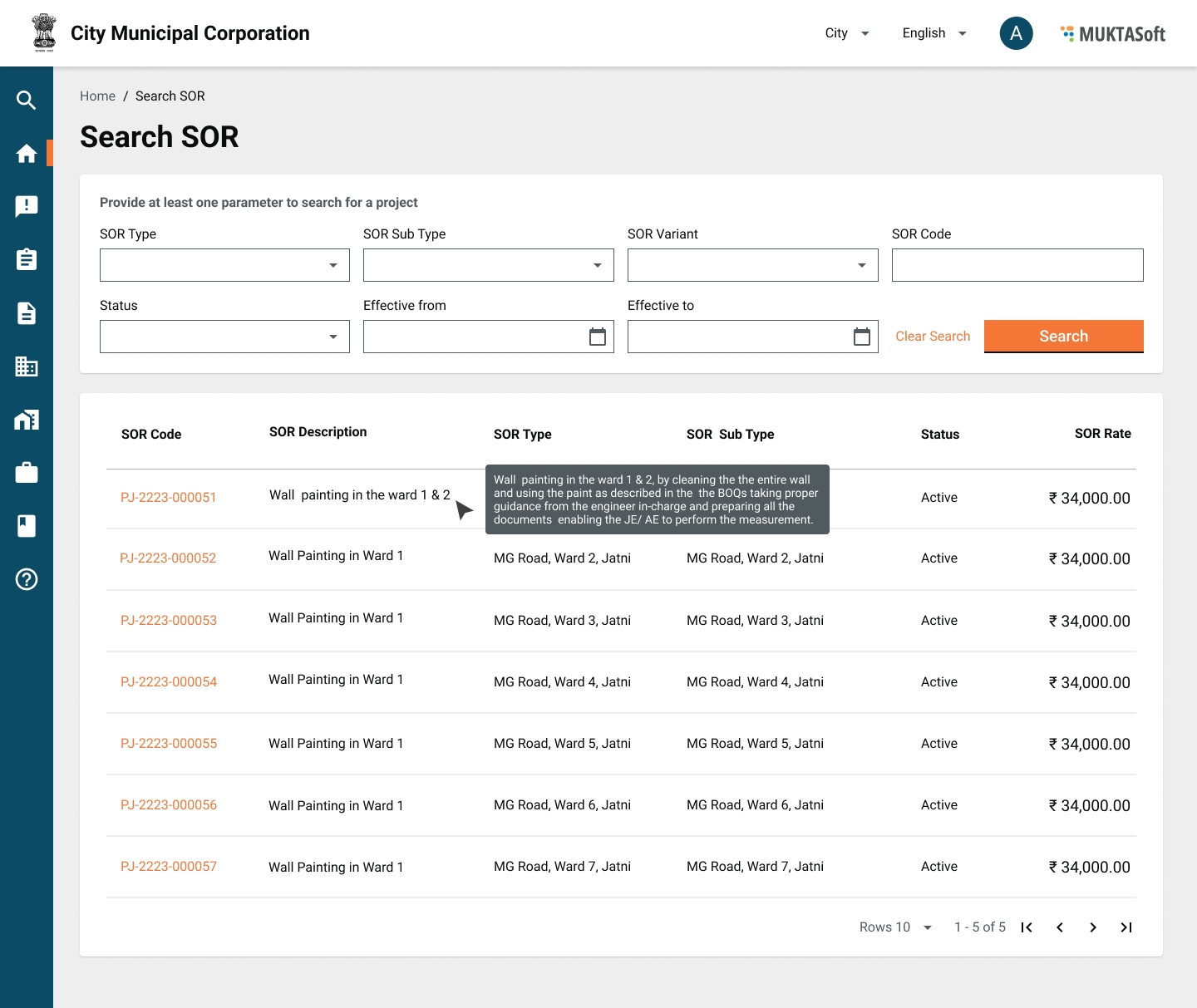
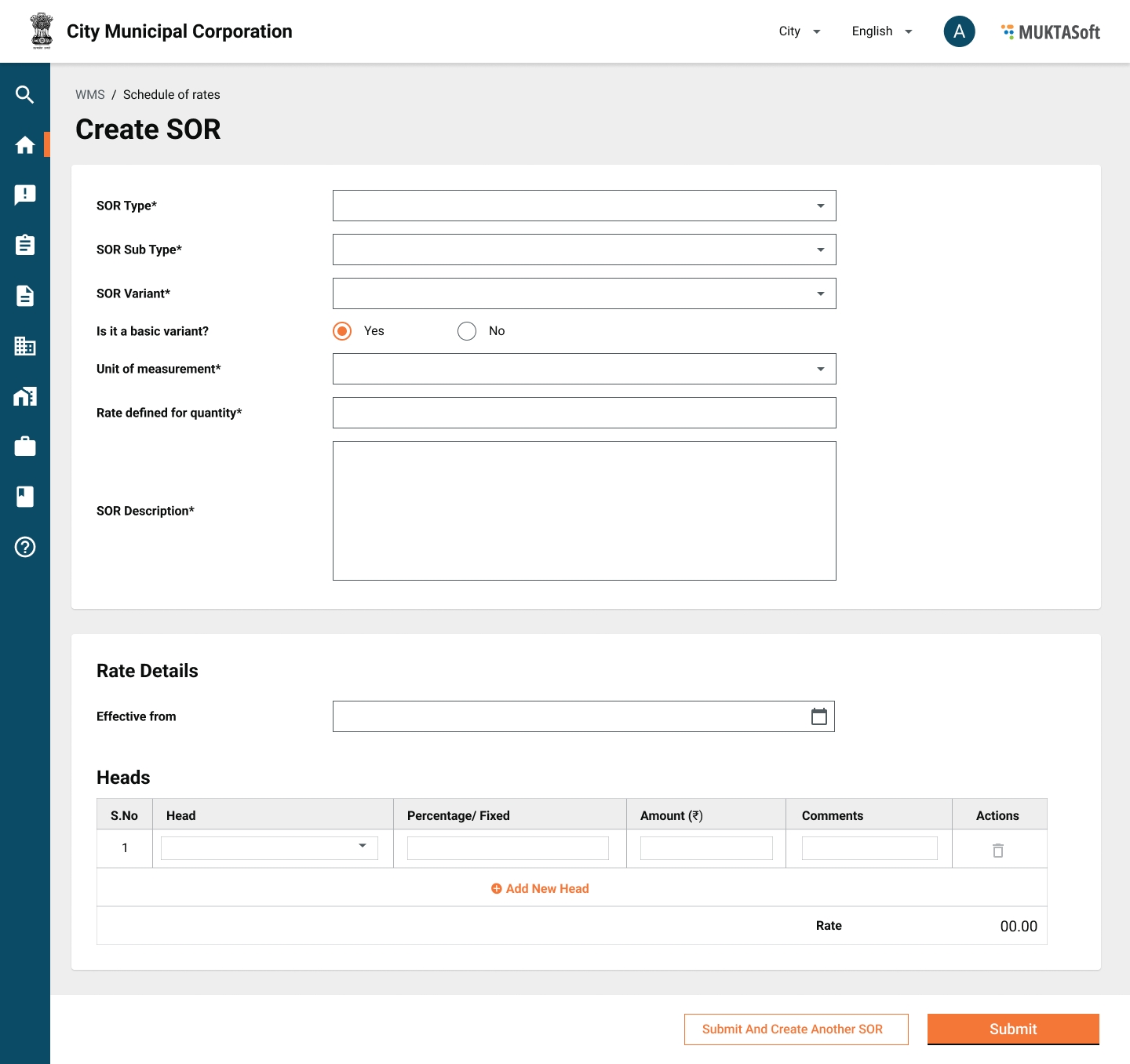
Search Schedule of Rates
Home > Schedule of Rates > Search SOR
State: STATE_MUKTA_ADMIN
ULBs: MUKTA_ENG_ADMIN
Search SOR to be provided to list all the SORs.
There are various search parameters to search such a SOR.
At least one parameter is required to perform the search.
Consider From Date and To Date as a Date Range single parameter.
Exact search is performed for the values entered/selected.
In case multiple parameters values are supplied AND is applied for searching record.
Search - To perform the search based on the parameters entered.
Clear - To clear the values entered for search.
SOR Code - Hyperlink to view the SOR detail on mouse click. View SOR display the searched rate with SOR details on View Page.
Search result is displayed.
Option to download search result in excel is provided.
Pagination is provided to displayed 10 record at a time.
Not applicable.
Not applicable.
Not applicable.
Search is provided with the search parameters mentioned and the result is displayed as mentioned.
On click of SOR code, searched rate is displayed with SOR details on View SOR Page.
Pagination and option to download the searched result into Excel is provided.
View Schedule of Rates
Home > Search SOR > SOR Code (Hyperlink) > View SOR
State: STATE_MUKTA_ADMIN
ULBs: MUKTA_ENG_ADMIN
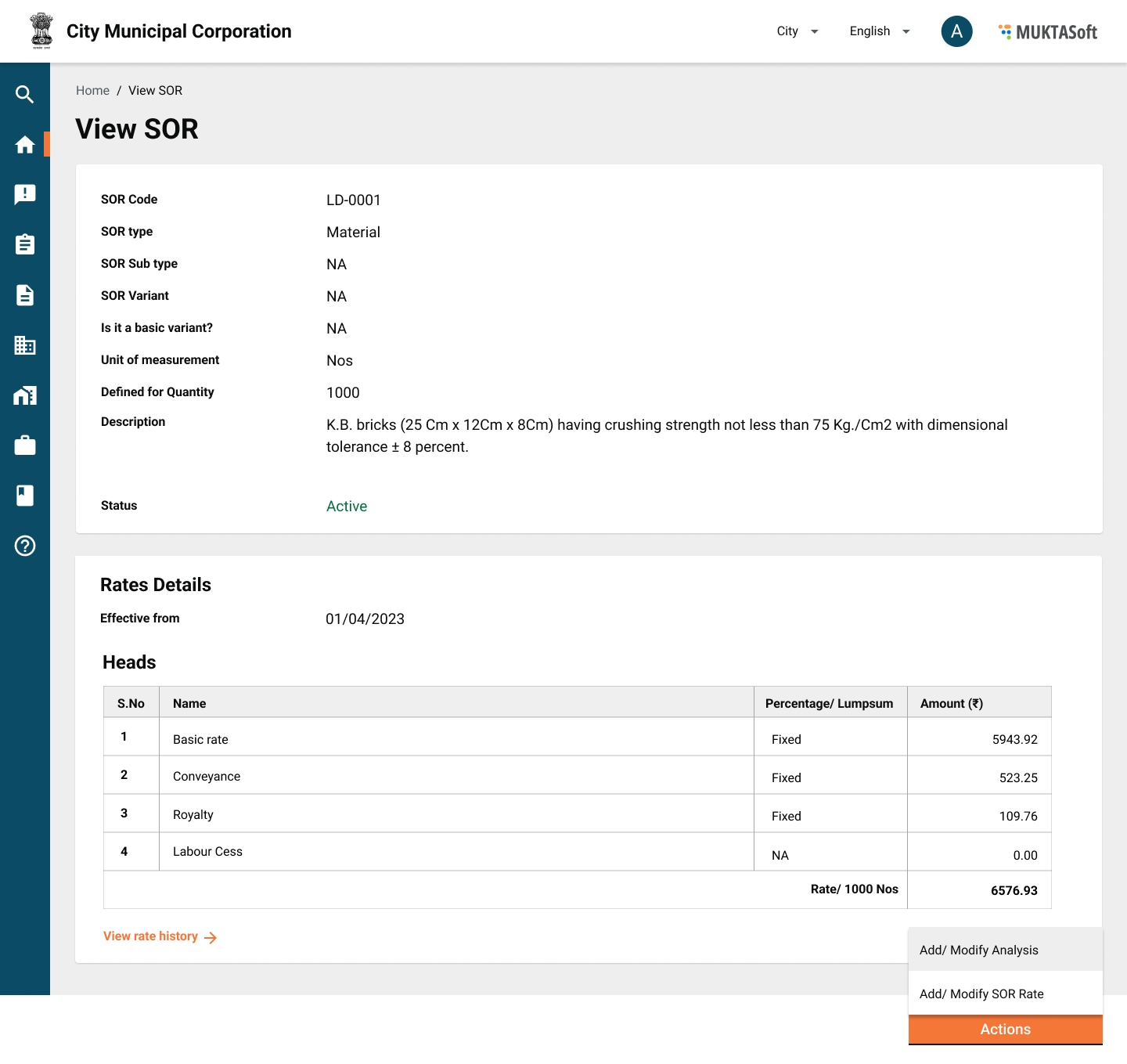
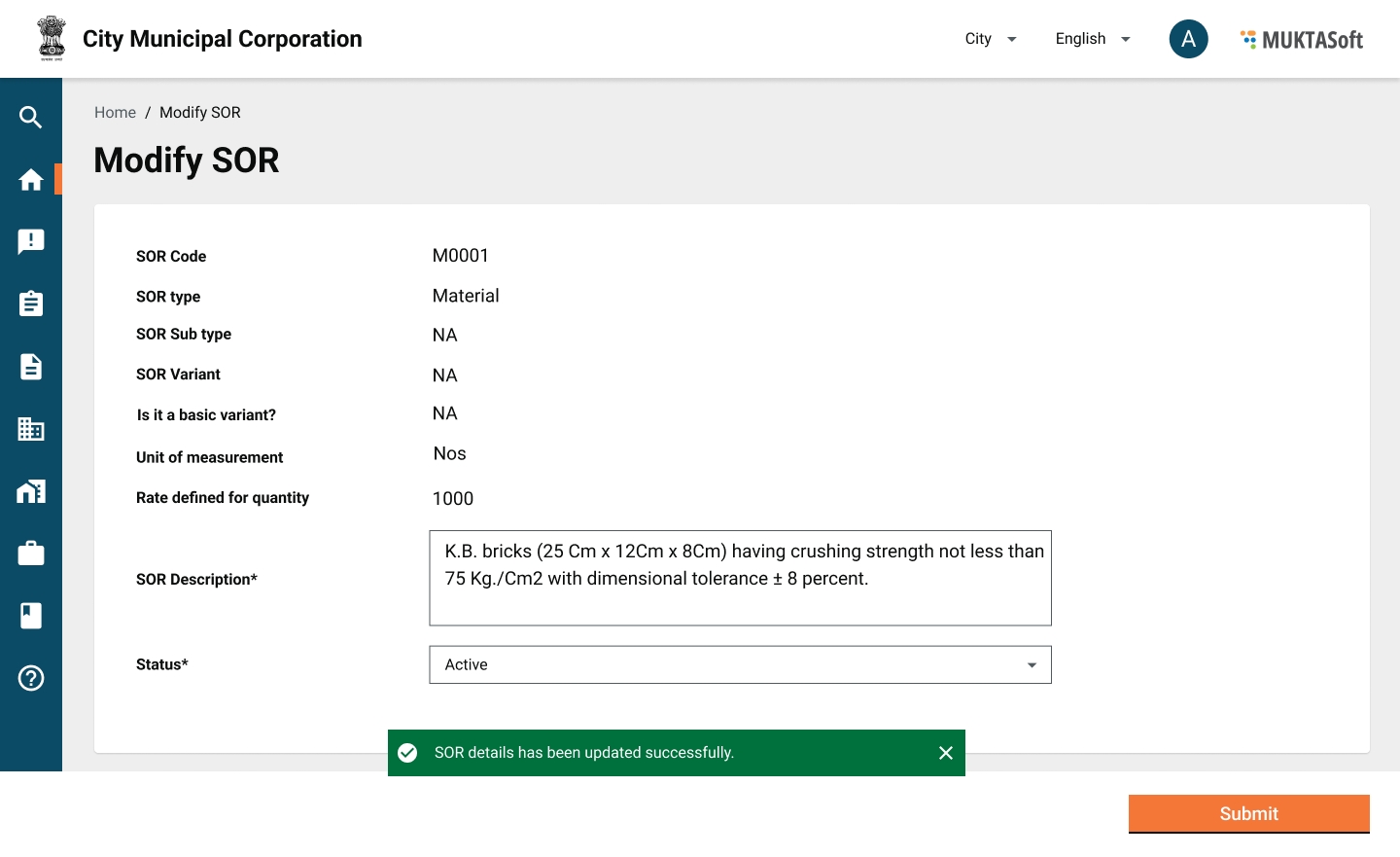
View SOR is provided to view the details of created active/inactive SOR.
Search a SOR using the search SOR and then open to view the details.
The details displayed as given below.
Modify SOR - It is applicable to all type of SOR and enable the user to change of SOR description and status.
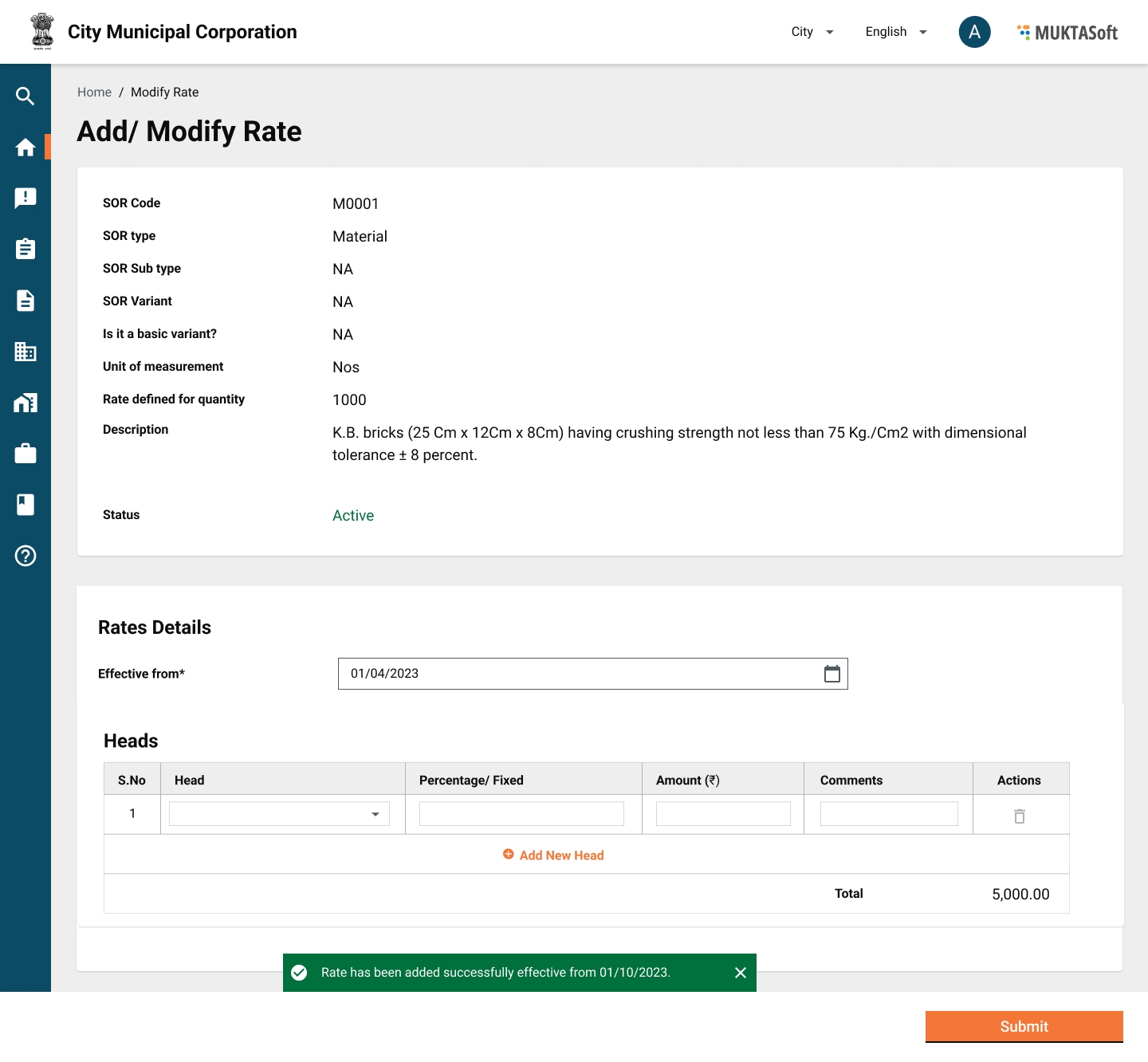
Add/ Modify Rate - It is applicable to all type of SOR other than Works and enable the user to add new rate or modify existing rate.
Add/ Modify Analysis - It is applicable to Works type of SOR only and enable the user to add rate analysis or modify existing rate analysis.
View Rate Analysis - It is applicable to Works type of SOR only and enable the user to view the currently linked rate analysis.
Not applicable.
Not applicable.
Not applicable.
SOR details is displayed as per the attribute provided in the story.
Rate is displayed as per the search result.
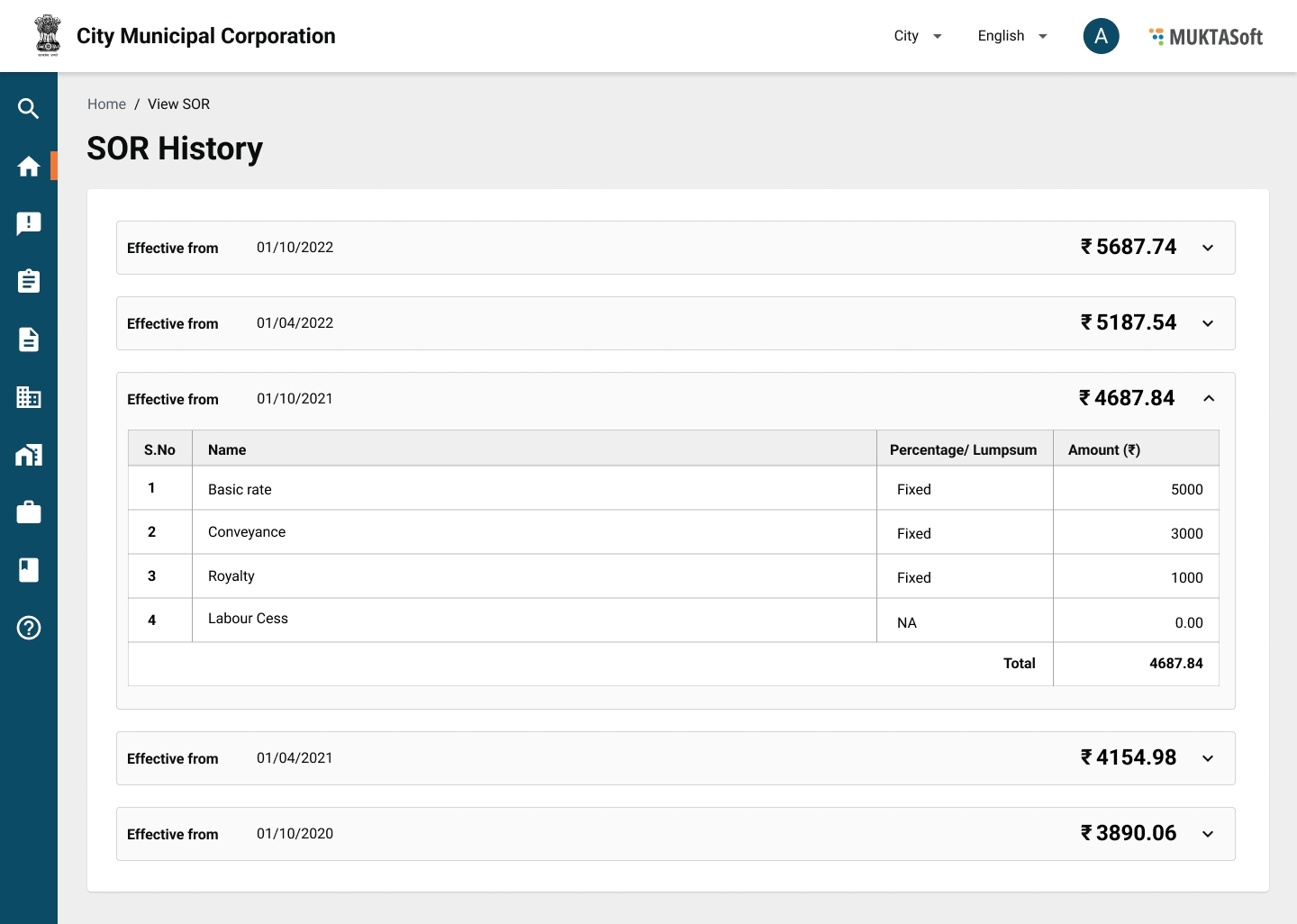
View history displayed the history of rates.
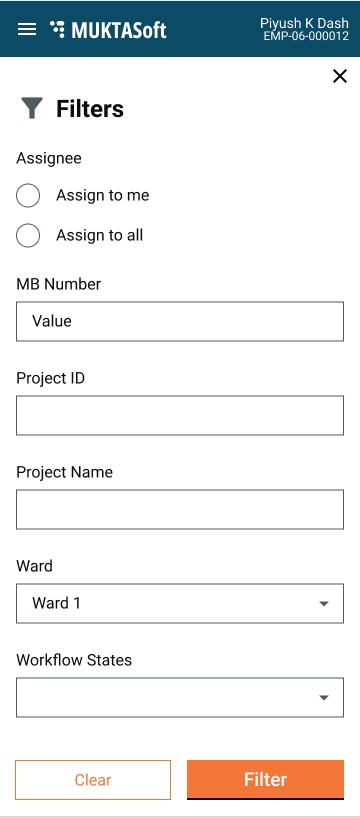
Bill Number
Bill number
5
Status
Status of payment instructions. This parameter is not applicable for “Payment Instruction Pending for Correction”
6
Created from date
Payment instruction created date. This parameter is not applicable for “Payment Instruction Pending for Correction”
7
Created to date
Payment instruction created date. This parameter is not applicable for “Payment Instruction Pending for Correction”
No. of successful Payments
Total number of successful payments.
5
No. of failed Payments
Total number of failed payments
6
Total Amount
Total amount of payment instruction which is to be paid.
7
Status
Status of payment instruction
MB Number
Text
MB number
4
MB Reference Number
Text
MB reference number
5
Status
Drop-down
Workflow statuses, Drafted, Submitted, Verified, Approved.
6
Created From
Date
MB created date
7
Created To
Date
MB created date
CBO Name
Name of CBO to whom work order is awarded.
5
Status
Status of MB.
6
MB Amount
MB amount.
Drop-down
SOR variant, the values from the SOR Variant Master.
4
SOR Code
Text
The system generated unique code of the SOR.
5
Status
Drop-down
Active/ Inactive.
6
Effective From
Date
The rate effective from date, can be a future date too.
7
Effective To
Date
The rate effective from date, can be a future date too.
By default active SORs are searched and currently effective rates are displayed.
SOR sub types, the values from SOR Sub Type Master.
5
Status
The status of SOR, Active/ Inactive.
6
Rate
The current effective rate of the SOR.
#
Field Name
Data Type
Description
1
SOR Type
Drop-down
SOR types, the values from SOR Type Master.
2
SOR Sub Type
Drop-down
SOR sub types, the values from SOR Sub Type Master.
3
#
Field Name
Description
1
SOR Code
It is system generated unique code to identify the SOR uniquely.
2
SOR Description
It is the description of SOR upto 64 characters only and end with a (…) with an option to display the complete text in tool-tip on mouse-click.
3
SOR Type
SOR types, the values from SOR Type Master.
4
SOR Variant
SOR Sub Type
SOR variant, the values from the SOR Variant Master.
5
Unit of Measurement
The unit of measurement.
6
Rate Defined for Quantity
The quantity of SOR for which rate is provided.
7
SOR Description
It is the description of SOR to describe the SOR.
8
Status
The status of SOR Active/ Inactive. Active means active for usage.
Rate Details
SOR rate, based on the search performed.
9
Effective From
The date from which the rate is effective.
Heads
A grid to select the head which ever applicable is provided.
10
Basic Rate
Basic rate of the SOR, provided by the state PWD.
11
Conveyance
Conveyance cost defined for the unit of quantity given in SOR.
12
Royalty
Royalty defined for the unit of quantity given in SOR.
13
Labour Cess
The amount of labour cess, it is applicable to SOR of type Works only.
14
Rate
The final rate of SOR.
Rate History
History of rates which were effective in the past.
1
Serial No.
Serial number of the record.
2
Effective From
The rate effective from date.
3
Rate/ Unit
The net effective rate.
4
View Details
Button to view the break-up of rate.
5
Actions
Modify SOR - Applicable to all type of SOR. (State Users Only)
Add/ Modify Rate - Applicable to other than Works (State/ ULB Users)
Add/ Modify Rate Analysis - Applicable to Works type of SOR. (State Users Only)
View Rate Analysis - Applicable to Works type of SOR. (State/ ULB Users)
#
Field Name
Description
1
SOR Code
It is system generated unique code to identify the SOR uniquely.
2
SOR Type
SOR types, the values from SOR Type Master.
3
SOR Sub Type
SOR sub types, the values from SOR Sub Type Master.
4
SOR Variant
egovio/expense-calculator-db:sor-migration-8007f0108-142
Click here to access the branch and change details.
Build and Deploy:
Deploy the build provided above or build and deploy from the code linked above if custom changes are required.
Use the curl below to migrate the data.
Create table eg_sor_migration( id character varying(128), is_migration_successful boolean) ;
Query the eg_wms_attendance_summary table and check if “skillCode” in additionalDetails has been migrated from UNSKILLED.CARPENTER -> SOR_000016
Example:
Old data: additionalDetails : { …… skillCode : UNSKILLED.CARPENTER …… }
New data: additionalDetails : { …… skillCode : SOR_000016 …… }
Verification in DB for an individual: Query the individual_skill table and check if “type” and “level” are migrated to “SOR” and “SOR_code” respectively.
Example.:
Old data:
Type: CARPENTER
Level: UNSKILLED
New data:
Type: SOR
Level: SOR_000016
Once the migration is complete remove the environment variables added for migration.
curl --location 'http://localhost:8090/expense-calculator/_migrate/musterRoll' \
--header 'Content-Type: application/json' \
--data '{
"RequestInfo": {
"apiId": "Rainmaker",
"authToken": "e1da5b9d-e9d5-4798-bd25-f5d8fbbd7cc8",
"userInfo": {
"id": 176,
"uuid": "488c2a00-e33f-49f5-932d-239b1ae33e88",
"userName": "Product UAT",
"name": "Product UAT",
"mobileNumber": "7200990110",
"type": "EMPLOYEE",
"roles": [
{
"name": "System",
"code": "SYSTEM",
"tenantId": "statea.cityone"
},
{
"name": "MUKTA Admin",
"code": "MUKTA_ADMIN",
"tenantId": "statea.cityone"
},
{
"name": "BILL_VIEWER",
"code": "BILL_VIEWER",
"tenantId": "statea.cityone"
},
{
"name": "MUSTER ROLL APPROVER",
"code": "MUSTER_ROLL_APPROVER",
"tenantId": "statea.cityone"
},
{
"name": "MUSTER ROLL VERIFIER",
"code": "MUSTER_ROLL_VERIFIER",
"tenantId": "statea.cityone"
},
{
"name": "Organization viewer",
"code": "ORG_VIEWER",
"tenantId": "statea.cityone"
},
{
"name": "WORK ORDER APPROVER",
"code": "WORK_ORDER_APPROVER",
"tenantId": "statea.cityone"
},
{
"name": "ESTIMATE VERIFIER",
"code": "ESTIMATE_VERIFIER",
"tenantId": "statea.cityone"
},
{
"name": "OFFICER IN CHARGE",
"code": "OFFICER_IN_CHARGE",
"tenantId": "statea.cityone"
},
{
"name": "WORK ORDER CREATOR",
"code": "WORK_ORDER_CREATOR",
"tenantId": "statea.cityone"
},
{
"name": "Employee Common",
"code": "EMPLOYEE_COMMON",
"tenantId": "statea.cityone"
},
{
"name": "TECHNICAL SANCTIONER",
"code": "TECHNICAL_SANCTIONER",
"tenantId": "statea.cityone"
},
{
"name": "PROJECT VIEWER",
"code": "PROJECT_VIEWER",
"tenantId": "statea.cityone"
}
],
"tenantId": "statea.cityone"
},
"msgId": "1684664105678|en_IN",
"plainAccessRequest": {}
}
}'
curl --location 'http://localhost:8090/expense-calculator/_migrate/individual' \
--header 'Content-Type: application/json' \
--data '{
"RequestInfo": {
"apiId": "Rainmaker",
"authToken": "e1da5b9d-e9d5-4798-bd25-f5d8fbbd7cc8",
"userInfo": {
"id": 176,
"uuid": "488c2a00-e33f-49f5-932d-239b1ae33e88",
"userName": "Product UAT",
"name": "Product UAT",
"mobileNumber": "7200990110",
"type": "EMPLOYEE",
"roles": [
{
"name": "System",
"code": "SYSTEM",
"tenantId": "statea.cityone"
},
{
"name": "MUKTA Admin",
"code": "MUKTA_ADMIN",
"tenantId": "statea.cityone"
},
{
"name": "BILL_VIEWER",
"code": "BILL_VIEWER",
"tenantId": "statea.cityone"
},
{
"name": "MUSTER ROLL APPROVER",
"code": "MUSTER_ROLL_APPROVER",
"tenantId": "statea.cityone"
},
{
"name": "MUSTER ROLL VERIFIER",
"code": "MUSTER_ROLL_VERIFIER",
"tenantId": "statea.cityone"
},
{
"name": "Organization viewer",
"code": "ORG_VIEWER",
"tenantId": "statea.cityone"
},
{
"name": "WORK ORDER APPROVER",
"code": "WORK_ORDER_APPROVER",
"tenantId": "statea.cityone"
},
{
"name": "ESTIMATE VERIFIER",
"code": "ESTIMATE_VERIFIER",
"tenantId": "statea.cityone"
},
{
"name": "OFFICER IN CHARGE",
"code": "OFFICER_IN_CHARGE",
"tenantId": "statea.cityone"
},
{
"name": "WORK ORDER CREATOR",
"code": "WORK_ORDER_CREATOR",
"tenantId": "statea.cityone"
},
{
"name": "Employee Common",
"code": "EMPLOYEE_COMMON",
"tenantId": "statea.cityone"
},
{
"name": "TECHNICAL SANCTIONER",
"code": "TECHNICAL_SANCTIONER",
"tenantId": "statea.cityone"
},
{
"name": "PROJECT VIEWER",
"code": "PROJECT_VIEWER",
"tenantId": "statea.cityone"
}
],
"tenantId": "statea.cityone"
},
"msgId": "1684664105678|en_IN",
"plainAccessRequest": {}
}
}'Usually, the administrative sanction is done on projects by EO. Post approval, detailed and abstract estimates are done.
Once the admin sanctions the project, the fund is also blocked for the respective heads of accounts.
Project status -
Created
In progress
Approved
Rejected
Cancelled
Once a project is created on the UI, the system generates a unique ID for each project/sub-project.
ID: PROJ/<ULB/Department Code>/<Year>/<month>/<Date>/<running sequence number>
The project details capture the financial information such as the funding source for the project. These details, however, are not part of the Project Service but are captured as part of the Program Service.
Y
Should be pre-defined master data Ex - Building
Project Sub Type
MDMS Data
N
Should be pre-defined master data. Estimate templates are linked to a project subtype Ex - School Building
Project Group
MDMS Data
Y
Should be pre-defined master data. Contract & Assetisation terms are defined based on this value. Ex - Capital Works
Address
Y
Address of the main project.
Proposed Start date
Date
N
Proposed End date
Date
N
Parent
ID
N
Parent Project ID
Status
MDMS Data
Y
Created, Rejected, Cancelled, In-progress, Completed
Owning Department
MDMS Data
Y
Reference No
Alphanumeric
N
MinChar 2 - Max Char - NA Reference No to Offline File if any
Description
Alphanumeric
N
MinChar 2 - Max Char - NA Description of the Project
Documents
Attachments
N
Upto 5 Documents each of 5 MB Document Attachments
Inbox Table
Employee user manual on using the Project module - for MuktaSoft
Id
NA
Y
System generated UUID
Name
Alphanumeric
Y
MinChar 2 - Max Char - NA Ex - Construction of School Building
Project Type
works
ProjectType
Create Project with no sub projects
Create Project with Sub projects
Capturing Financial details of project (Part of Program service)
Capturing Sub Project Details
Project Created Successfully
View Project
MDMS Data
Projects Inbox
This data is stored and maintained at MUKTASoft for every financial year and used for reporting and reference purposes.
APIs to be triggered daily at 10 PM.
A transaction type would be anything from the options given below.
Initial Allotment
Additional Allotment
Withdrawal
5
Transaction Amount
It is transaction amount.
6
Sanctioned Balance
It is the balance remaining from the sanctioned amount and calculated as given below. Sanctioned Balance = Total Sanctioned Amount - Sum of all the allotments.
7
Fund Available
It the fund available for the expenditure and calculated as given below. Fund Available = Sum of all the allotments - (Sum of all the expenditure + Sum of all the withdrawal)
DDO Code
Tenant ID
Head of Accounts
Code
Name
#
Field
Description
1
Financial Year
Financial year, by default current financial year is selected.
2
Head of Account
HOAs from the configuration.
3
Transaction Type
Allotment types are, 1) Initial Allotment 2) Additional Allotment 3) Withdrawal 4) Expense 5) Expense Reversed
#
Field
Description
1
HOA
Head of accounts of MUKTA
2
Transaction Number
Transaction number of the transactions fetched from JIT or created in MUKTASoft.
3
Transaction Date
Date of transaction received from JIT-FS in a response of API call or the MUKTASoft PI creation date. Date to be taken care when calling the API again.
4
Transaction Type
State: STATE_MUKTA_ADMIN
Modify SOR is provided to enable the users to make the correction in the existing SOR.
The attributes which are allowed to modify are as given below table.
#
Field Name
Data Type
Is Mandatory?
Description
1
SOR Code
Display
Yes
The SOR code.
2
SOR Type
Display
Yes
Submit - On Submit.
SOR detailed gets updated successfully.
View SOR Page is displayed with updated details.
Success toast message is displayed.
In case SOR is getting inactivated.
The status of SOR is get updated inactive in case no other active SOR is referencing it.
Otherwise a validation message is displayed and system doesn’t update the status to inactive.
SOR details has been updated successfully.
Validation message a reference SOR is getting inactivated.
This SOR can not be inactivated as there are active SORs exists referencing it.
Not applicable.
Not applicable.
On successful update, View SOR Page is displayed.
Toast success message is displayed.
System doesn’t allow to change the status to inactive in reference SORs exists.
Project Name
Textbox
Project Name
4
Project ID
Textbox
Work identification no. generated for a work in works proposal
6
From Date
Date Picker
Proposal creation date, entered by user while creating works proposal.
7
To Date
Date Picker
Proposal creation date, entered by user while creating works proposal.
Location
Display Only
Locality name along with ward name.
5
Estimated Cost
Display Only
The project cost from the project details
Project name
Textbox
Project name
4
Work order number
Textbox
Work Order number, unique identification no.
5
Status
Drop-down
Workflow state of a work order.
6
Created From Date
Date Picker
Work Order creation date.
7
Created To Date
Date Picker
Work Order creation date.
Name of CBO
Display Only
Name of the organization to whom Work Order is awarded.
4
Role of CBO
Display Only
Role of CBO, IA/IP
5
Location
Display Only
Locality name along with ward name. (Locality + Ward)
6
Status
Display Only
Workflow status of the work order.
7
Work order amount
Display Only
Total WO amount.
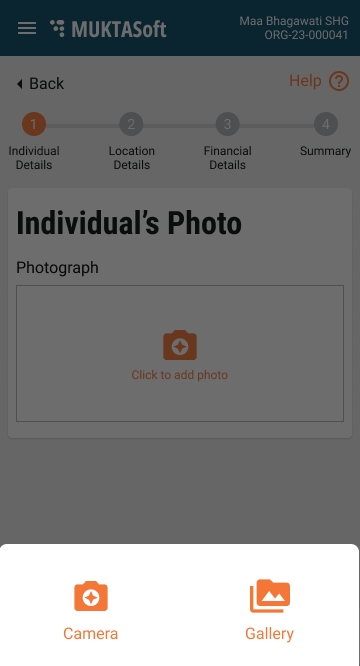
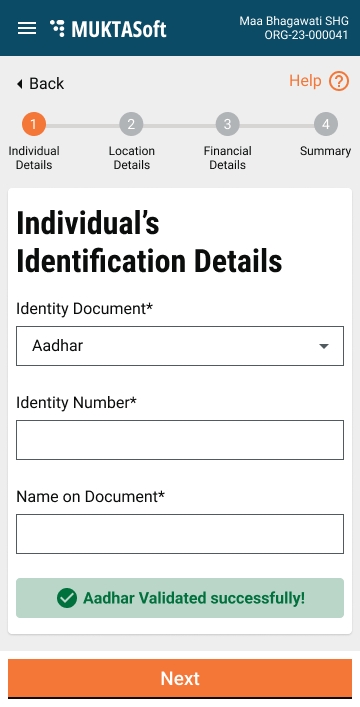
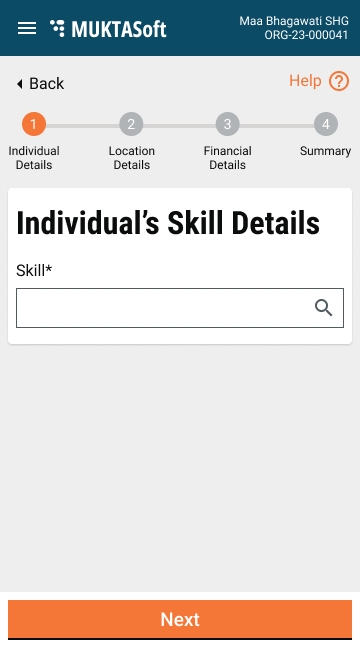
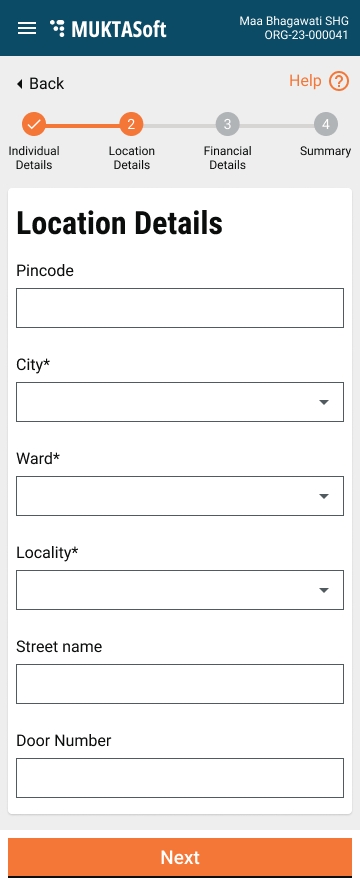
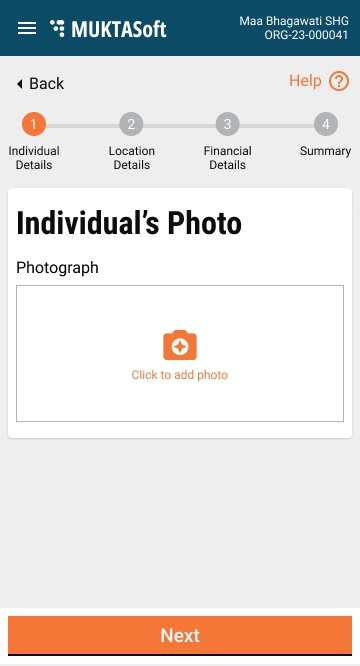
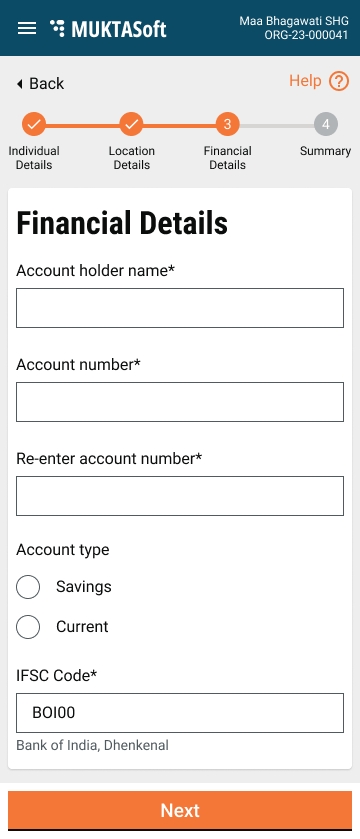
Creating a time extension request by employee
A work order is created for an approved estimate in order to award the work to CBO. CBO starts the work to complete it within a given time period.
In case the organization comes to know that they are not in a position to complete the work within the given time frame due to various reasons, they need to inform the same to officer-in-charge of the project and apply for a time extension which is then subject to approval/ cancelling of work order based on the analysis done by the ULB.
Expense (Reversed) First 3 are received from JIT-FS system through API call while the last one is from MUKTASoft when a PI is pushed. A reverse entry of the Expense is made in the case PI is canceled or failed to create.
Material, Labour, Machinery, Works.
3
SOR Sub Type
Display
Yes
Applicable for SOR type Works only.
4
SOR Variant
Display
Yes
Applicable for SOR type Works only.
5
Is it a basic variant?
Display
Yes
Applicable for SOR type Works only.
6
Unit of Measurement
Display
Yes
Unit of measurement for the item.
7
Rate Defined for Quantity
Display
Yes
Quantity of items for which basic rate is defined.
8
SOR Description
Alphanumeric
Yes
Name of item as per the standard definition of OPWD
9
Status
Drop-down
Yes
The status of SOR, Active/ Inactive.
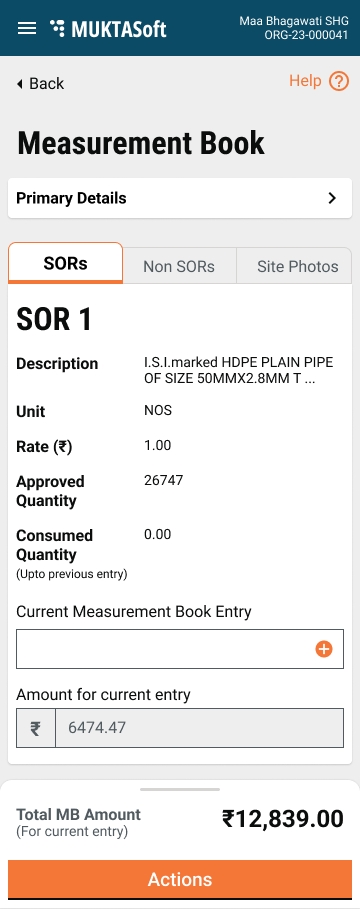
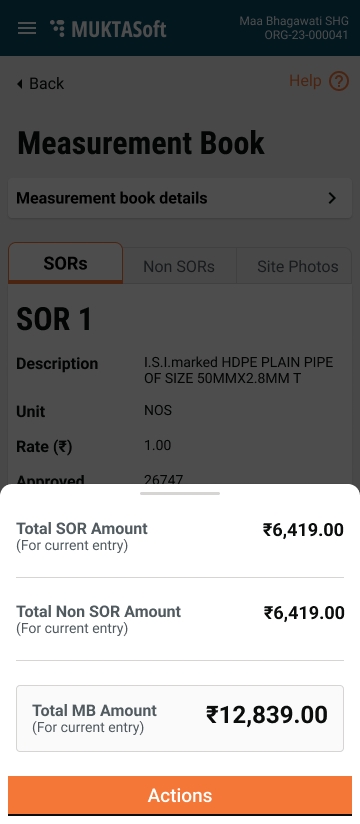
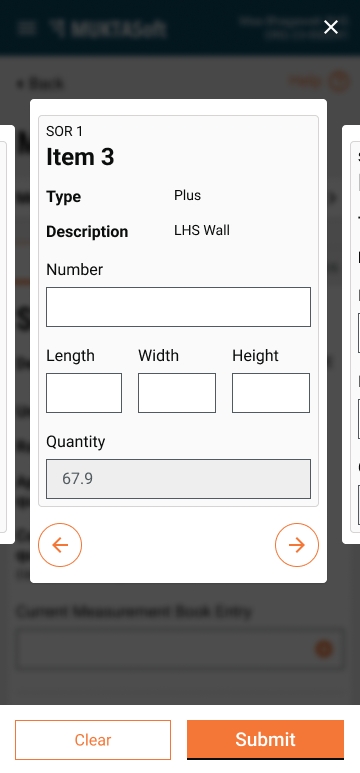
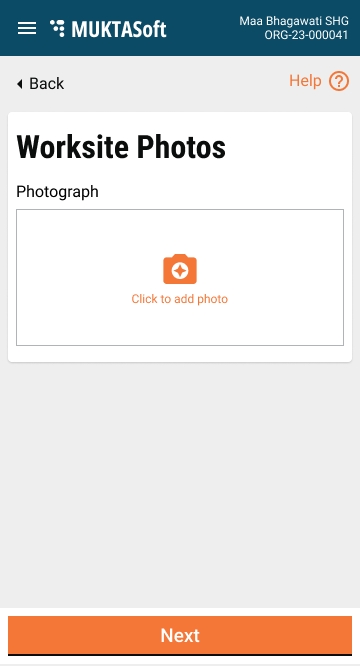

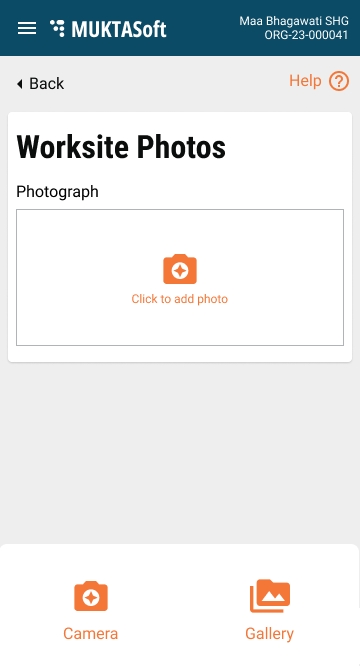
The same Search Work Order feature is used to search for revised work orders.
Clicking to view the details of a revised work order will open the "View Revised Work Order Page," showing the following information:
1
Revised work order number
Display Only
NA
Revised work order number
2
Work order number
Display Only
Not applicable.
In Workflow Time Extension - Workflow actions based on roles logged in user has.
For Workflow Completed Time Extension - No Actions
Revised work details are displayed as per the details provided in the story.
Request for time extension can be directly raised by CBO using the mobile application and by the officer-in-charge of the project on behalf of CBO using a web application. Once a request is raised it goes for verification and approval.
Home > Work Orders > Inbox > Search Work Order > View Work Order > Request Time Extension (From Action Menu)
Work order to be revised to extend the completion period.
The request to revise the work order for the extension of time can be created by the CBO/officer-in-charge.
1
Work order number
Display Only
NA
Work order no.
2
Project ID
Display Only
On Request Time Extension
In case the first muster roll is pending to submit for approval.
Time extension request can not be created. Please ensure that no muster roll is pending for submission.
2. In case the first muster roll itself is not created.
Time extension request can not be created. Please ensure that the first muster roll is submitted for approval.
3. In case a project closure request is already created.
Time extension request can not be created. A closure request has already been created for the selected project.
Not applicable.
On submit, create and forward workflow pop-up window is displayed.
On Create and Forward,
The success page is displayed.
The time Extension request number is generated as per the specified format. TE/2022-23/000021.
The time extension request is forwarded to the verifier in the workflow.
Modification of work order is allowed to extend the time.
A time extension request number is generated to identify the request.
The link between original and revised work orders is maintained.
Work order preparation for a work by the Work Order Creator and then its verification and approval by other users (actors) in the workflow.
1
WORK ORDER CREATOR
Create
Search
View
Edit/ Re-submit
Junior Engineer/ Assistant Engineer
2
WORK ORDER VERIFIER
Search
View
Verify and Forward
Send Back
Executive Officer
3
1
Submit
Work Order Creator
Pending for verification
Submitted
2
Work Order
Edit/ Re-submit
Pending for correction
1
Edit/ Re-submit
Pending for re-assignment
1
UI design is going to be the same as the estimate workflow. Only the workflow states will be displayed as per the table given above.
1
Actions are configured based on role-action mapping.
2
Workflow states are defined as provided and the state transition is done accordingly.
ULB: MUKTA_ENG_ADMIN
Add Rate is provided to enable the users add new rate or modify an existing rate.
Add/ Modify rate is allowed to only non works SORs only.
On add new rate, modify page is opened with the existing details and rates.
The attributes which are allowed to modify are as given below table.
#
Field Name
Data Type
Is Mandatory?
Description
1
SOR Code
Display
Yes
The SOR code.
2
SOR Type
Display
Yes
In case new rate is added.
A new rate is created with new effective date.
The previous rate is closed with the previous day date.
View SOR Page is displayed with newly added rate.
A success toast message is displayed for new rate creation.
Success Message - New Rate Added
Rate has been added successfully effective from <effective date>.
Success Message - Existing Rate Modified
The rate effective from <effective date> has been modified successfully.
Alert! On Modify
Do you want to update existing rate effective from <effective date>? Please confirm to complete the action.
On Modify (In no change in rate details)
Modification to existing SOR rate is failed as there were no changes done.
Adding new rate to the SOR is failed.
Modification to existing SOR rate is failed.
Effective date should not be a date before current rate effective date.
Effective from time is always start of the day i.e. 00:00. The time in between in the day is not allowed.
Effective to date, the time is always 11:59:59.
Not applicable.
Not applicable.
Modification of existing rate is allowed.
Adding new rate with a new effective date is allowed.
On modification, alert message is displayed.
On successful add/modify rate, success toast message is displayed.
#
Role (Actors)
Actions
User Persona
1
ESTIMATE_CREATOR
Create
Submit
Search
View
Junior Engineer/ Assistant Engineer/ MUKTA Implementation Expert
2
ESTIMATE_VERIFIER
Search
View
Verify and Forward
Send Back
Executive Engineer
3
There is minor change in the workflow.
The option to save the estimate as draft to be provided at first before submitting it to verifier and the same is reflected in the below table.
#
Action
Role
From State
To State
Status
1
Save as Draft
Estimate Creator
Saved as draft
Drafted
2
Submit
No change. In the UI, the workflow will start displaying from Submitted state.
Roles are created as given provided.
Actions are configured based on role - action mapping.
Workflow states are defined as provided and the state transition done accordingly by updating the status appropriately.
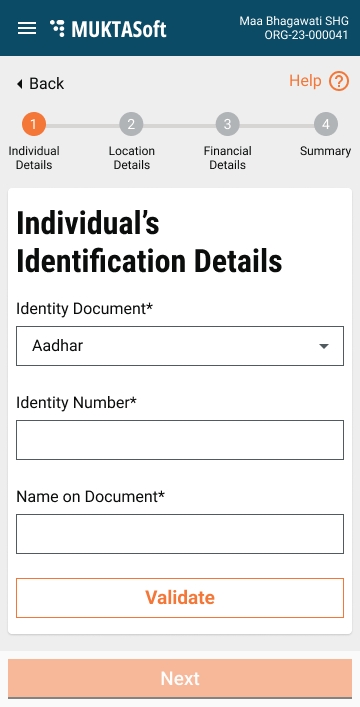
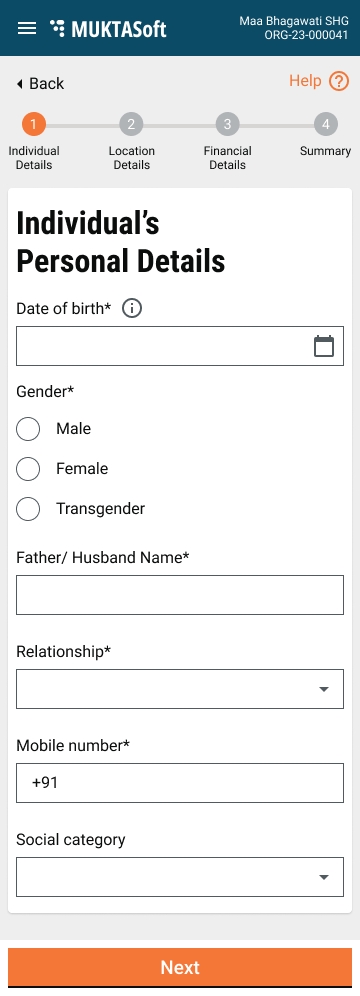

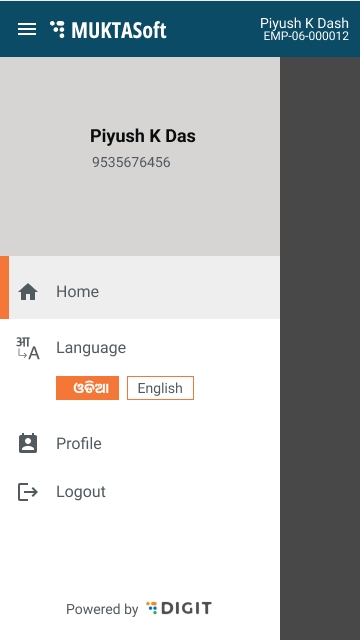
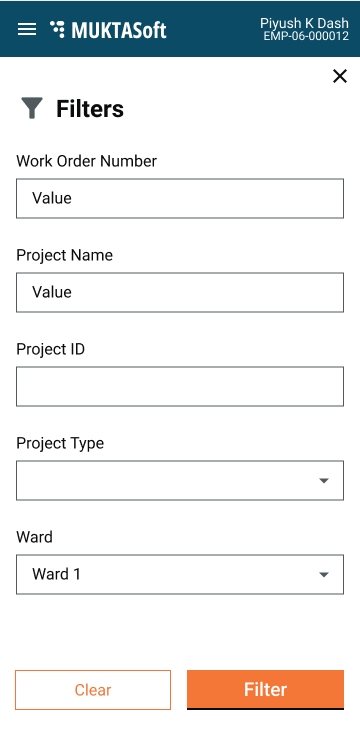
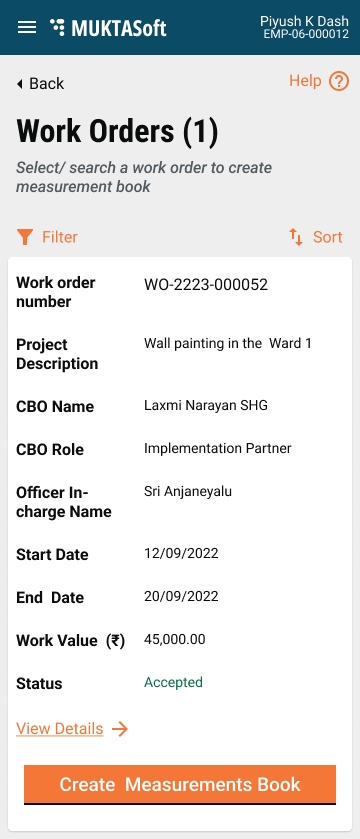
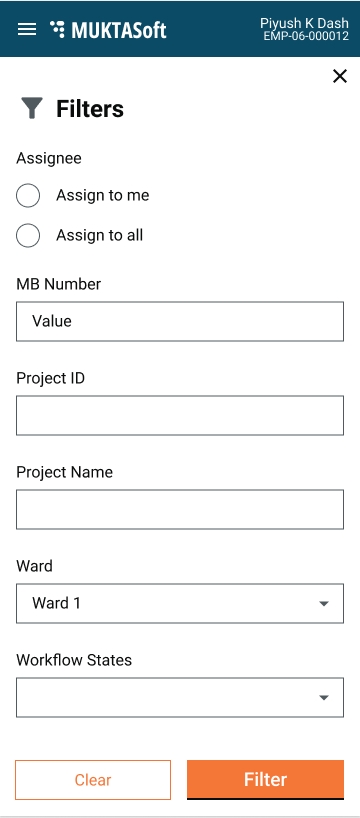
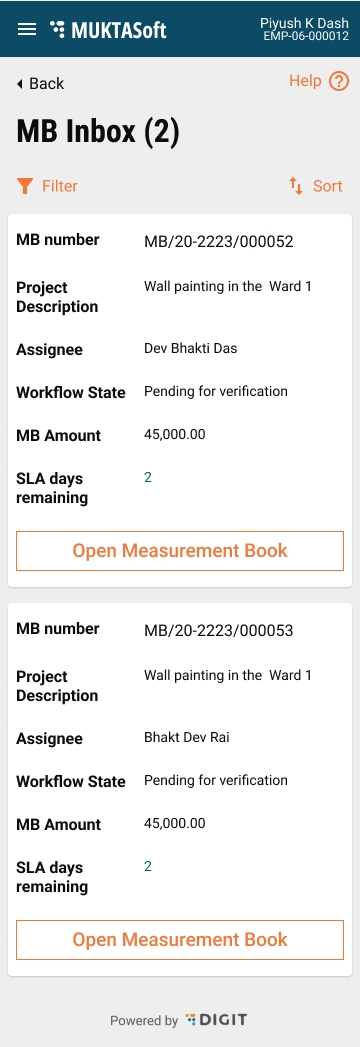
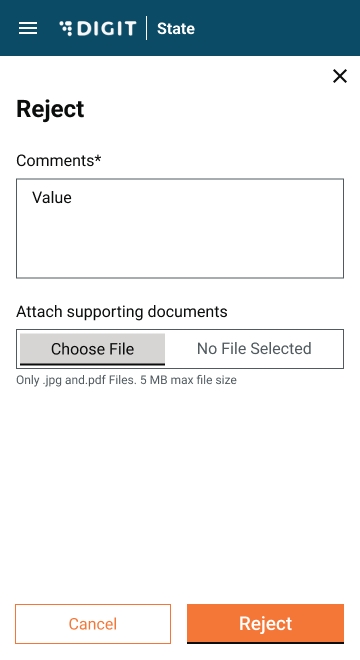
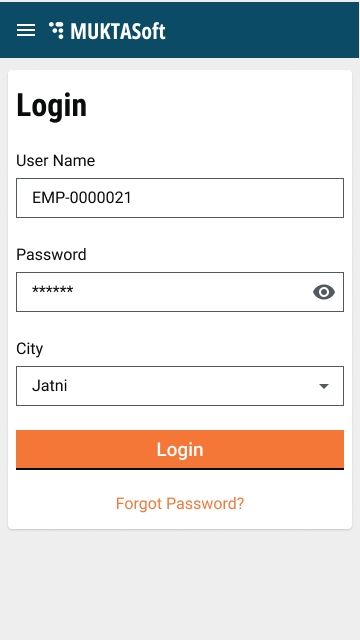
The workflow to process the time extension request
A work order is created for an approved estimate to award the work to CBO. CBO starts the work to complete it within a given period.
In case the organization come to know that they are not in a position to complete the work within the given time frame due to various reasons, they need to inform the same to officer-in-charge of the project and apply for a time extension which is then subject to approval/ cancelling of work order based on the analysis done by the ULB.
NA
Work order no.
3
Project ID
Display Only
NA
Project ID of the project.
4
Project sanctioned date
Display Only
NA
Date of the proposal from the project.
5
Project name
Display Only
NA
Project name
6
Project description
Display Only
NA
Project description
7
Work Order Details
Tab
8
Name of CBO
Display Only
NA
The name of the CBO
9
CBO ID
Display Only
NA
The CBO ID
10
Role of CBO
Display Only
NA
The role of the CBO IA/ IP.
11
Name of the officer in-charge
Display Only
NA
Name of the officer in-charge as provided in original WO.
12
Designation of officer in-charge
Display Only
NA
Designation of the officer in-charge as provided in original WO.
13
Project completion period
Display Only
NA
Number of days work to be completed as provided in original WO.
14
Work Start Date
Display Only
NA
Work start date as provided in original WO.
15
Work End Date
Display Only
NA
Revised work end date as provided in original WO.
16
Work order amount
Display Only
NA
Total estimated cost as provided in original WO.
17
Extension requested
Display Only
NA
Time requested to extend in days.
18
Revised End Date
Display Only
NA
The revised End Date as per the time requested as extension.
19
Reason for Extension
Display Only
NA
Reason for time extension provided entered by CBO.
20
Terms and Conditions
Tab
As provided in original WO.
21
Workflow Timelines
Section
As per the the workflow of revised work order.
NA
Project ID of the project.
3
Project sanction date
Display Only
NA
Date of the proposal from the project.
4
Project name
Display Only
NA
Project name
5
Project description
Display Only
NA
Project description
8
Work Order Details
Tab
9
Name of CBO
Display Only
NA
The name of the CBO as per original WO.
10
CBO ID
Display Only
NA
The CBO ID as per original WO.
11
Role of CBO
Display Only
NA
The role of the CBO IA/IP as per original WO.
12
Name of the officer in-charge
Display Only
NA
Name of officer in-charge as per original WO.
13
Designation of officer in-charge
Display Only
NA
Designation of officer in-charge as per original WO.
14
Project completion period
Display Only
NA
Number of days work to be completed as per original WO.
15
Work Start Date
Display Only
NA
Work start date as per original WO.
16
Work End Date
Display Only
NA
Work end date as per original WO.
17
Work order amount
Display Only
NA
Total estimated cost as per original WO.
18
Extension requested
Numeric
Y
Time requested to extend in days.
19
Reason for Extension
Text-area
Y
The reason of time extension to be captured here, it should not be more than 250 characters.
20
Terms and Conditions
Display Only/ Tab
NA
Terms and conditions as per original WO.
Submit
Reject
WORK ORDER APPROVER
Search
View
Approve
Send Back
Send Back To Originator
Reject
Municipal Engineer
4
CBO ADMIN
Accept
Decline
Community based organization contact person (President/ Secretary)
Verify and Forward
Work Order Verifier
Pending for verification
Pending for approval
Verified
3
Send Back
Work Order Verifier
Pending for verification
Pending for correction
Sent Back
4
Send Back
Work Order Approver
Pending for approval
Pending for verification
Sent Back
5
Send Back To Originator
<any roles having access>
<Current Status>
Pending for correction
Sent Back
6
Edit/ Re-submit
Work Order Creator
Pending for correction
Pending for verification
Re-submitted
7
Approve
Work Order Approver
Pending for approval
Approved
Approved
8
Reject
<any roles having access>
<Current Status>
Rejected
Rejected
9
Accept
CBO Admin
Approved
Accepted
Accepted
10
Decline
CBO Admin
Approved
Pending for re-assignment
Declined
11
Edit/ Re-submit
Work Order Creator
Pending for re-assignment
Pending for verification
Re-submitted
Verify and Forward
Pending for verification
2
Approve
Pending for approval
1
Accept
Approved
7
Material, Labour, Machinery, Works.
3
SOR Sub Type
Display
Yes
Applicable for SOR type Works only.
4
SOR Variant
Display
Yes
Applicable for SOR type Works only.
5
Unit of Measurement
Display
Yes
Unit of measurement for the item.
6
Rate Defined for Quantity
Display
Yes
Quantity of items for which basic rate is defined.
7
Description
Display
Yes
Name of item as per the standard definition of OPWD
8
Status
Display
Yes
The status of SOR, Active/ Inactive.
Rate Details
9
Effective From
Date
Yes
The date from which rate is become effective.
Heads
Grid
Yes
Rate of other than works SORs can only be added.
10
Basic Rate
Numeric
Yes
The basic rate of the item defined by the OPWD.
11
Conveyance
Numeric
No
The conveyance charges applicable.
12
Royalty
Numeric
No
The royalty amount on the items.
13
Rate
Display
Yes
A calculated value.
14
Submit
Button
Yes
It saves the changes into system.
Edit/ Re-submit
TECHNICAL_SANCTIONER
Search
View
Technical Sanction
Send Back
Send Back To Originator
Reject
Municipal Engineer
4
ESTIMATE_ APPROVER
Search
View
Approve
Send Back
Send Back To Originator
Reject
Executive Officer/ Municipal Commissioner
5
ESTIMATE_VIEWER
Search
View
MUKTA Program Coordinator
Estimate Creator
Saved as draft
Pending for verification
Submitted
3
Verify and Forward
Estimate Verifier
Pending for verification
Pending for technical sanction
Verified
4
Technical Sanction
Technical Sanctioner
Pending for technical sanction
Pending for approval
Technically Sanctioned
5
Send Back
Estimate Verifier
Pending for verification
Pending for correction
Sent Back
6
Send Back
Technical Sanctioner
Pending for technical sanction
Pending for verification
Sent Back
7
Send Back
Estimate Approver
Pending for approval
Pending for technical sanction
Sent Back
8
Send Back To Originator
<roles having access>
<Current Status>
Pending for correction
Sent Back
9
Edit/ Re-submit
Estimate Creator
Pending for correction
Pending for verification
Re-submitted
10
Approve
Estimate Approver
Pending for approval
Approved
Approved
11
Reject
<any roles having access>
<Current Status>
Rejected
Rejected
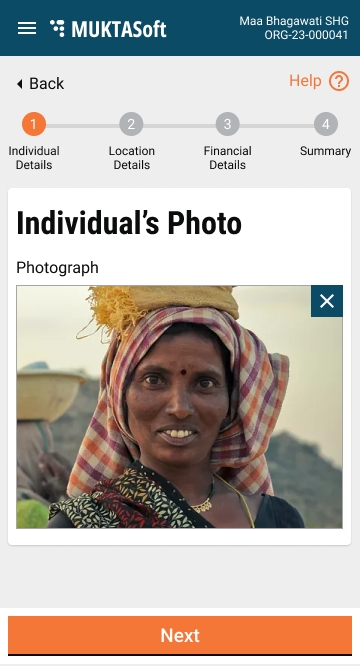
Request for time extension can be directly raised by CBO using the mobile application and by the officer-in-charge of the project on behalf of CBO using a web application. Once a request is raised it goes for verification and approval.
The work order inbox is used to complete the revised work order workflow.
Workflow is the same as the workflow of the original work order with the same workflow levels (except/ decline are excluded) and actions.
1
WORK ORDER CREATOR/ CBO Admin
Create
Search
View
Edit/ Re-submit
Junior Engineer/ Assistant Engineer/ CBO User
2
WORK ORDER VERIFIER
Search
View
Verify and Forward
Send Back
Municipal Engineer
3
1
Submit
Work Order Creator/ CBO Admin
Pending for verification
Submitted
2
Work Order
Edit/Re-submit
Pending for correction
1
Edit/ Re-submit
Pending for re-assignment
1
The revised work order is forwarded to the approver.
A revised work order is sent back to the previous user in the workflow.
The revised work order is sent back to CBO for correction.
The revised work order is edited and re-submitted. It goes to the verifier for verification.
The revised work order is approved.
The time extension comes into effect and the CBO user is allowed to track the attendance of wage seekers for an extended period.
The revised work order is rejected.
Send Back To CBO
CBO
Time extension request {timeextensionrequestid} is sent back to you for correction. Login to MUKTASoft for details. MUKTA - Govt. of Odisha.
Reject
CBO
Time extension request {timeextensionrequestid} for the project {projectid}
is rejected. Login to MUKTASoft for detail. MUKTA - Govt. of Odisha.
Approve
CBO
Time extension request {timeextensionrequestid}
for project
{projectid}
is approved. Login to MUKTASoft for detail. MUKTA - Govt. of Odisha.
UI design is going to be the same as the work order workflow. Only the workflow states will be displayed as per the table given above.
The workflow pop-up windows for every action are going to be the same as for the work order workflow.
The same work order inbox is used.
The workflow pop-up windows are used as per the standard.
Actions are configured based on role-action mapping.
Workflow states are defined as provided and the state transition is done accordingly.
SMS notifications are sent.
Payment Instruction
Status Update API Call
Employee
Role: System
Payment instruction status (PIS) is the API to fetch the PI status from JIT.
Once a PI is accepted at JIT, it is then approved with a digital sign by SSU in JIT.
The approved ones only has the Payment Instruction ID and Date available in response.
For Request/ Response parameters, please refer the integration approach document.
The response data is stored and maintained at MUKTASoft for every PIS call.
The API call to be scheduled once in a day at 10:00PM every day for the Payment Instructions Initiated, and the Payment Instructions Declined having error “Duplicate Payment Information Id”.
#
Parameter
Is Mandatory?
Description
1
jitBillNo
Yes
Payment Instruction ID of the payment instruction created in MUKTASoft and then pushed to JIT.
2
jitBillDate
Yes
Payment Instruction date of the payment instruction created in MUKTASoft and then pushed to JIT.
3
#
Parameter
Description
1
pmtInstId
The unique id of payment instruction that’s been generated at JIT.
2
payInstDate
The date of payment instruction created.
3
jitBillNumber
Payment Instruction ID of the payment instruction created in MUKTASoft and then pushed to JIT.
4
Error message displayed on View Payment Instruction Page. [Message: On call of PIS API: No response is received.]
PI status at MUKTASoft remain unchanged to Initiated.
All beneficiaries payment status remain unchanged to Payment Initiated.
Option is given to user to refresh the status. On refresh API call is triggered.
Error message is stored at MUKTASoft.
Error message displayed on View Payment Instruction Page. [Message: On call of PIS API: <JIT error message>]
PI status at MUKTASoft remain unchanged to Initiated.
All beneficiaries payment status remain unchanged to Payment Initiated.
Option is given to user to refresh the status. On refresh API call is triggered.
If the PI is rejected by SSU user, the same is received in error message.
Error message displayed on View Payment Instruction Page. [Message: On call of PIS API: <JIT error message>]
PI status at MUKTASoft changes to Rejected.
All beneficiaries payment status changes to NA.
A reverse expense transaction is recorded under Fund Allocation Register.
Option to generate new PI is provided from View Payment Instruction Page.
Success message is received and same is stored at MUKTASoft.
Info message displayed on View Payment Instruction Page. [Message: On call of PIS API: Response is received and updated successfully]
PI status at the MUKTASoft changes to Approved.
All beneficiaries payment status remain unchanged to Payment Initiated.
Option to refresh the status is provided. It triggers call of PAG.
#
Response
PI Status (From)
PI Status (To)
Payment Status
User Action
API Call
1
No Response
Initiated
Initiated
Payment Initiated
Refresh
PIS
Not applicable.
Not applicable.
Not applicable.
Not applicable.
Not applicable.
Not applicable
View Payment Advice
There is scheduler running to fetch the PI status and updated at MUKTASoft.
Status is updated based on response received.
Both the statuses are reflected in View Payment Instruction.
Option to Generate Revised PI is given to user through View Payment Instruction Page.
The response is captured in MUKTASoft for debugging and error reporting.
Technical glitched in the integration are defined as error and captured.
System keep trying based on schedule until a response is received. The latest response is recorded in the log.
Payment Instruction
Status Update for Payment Advice
Employee
Role: System
Payment Advice Status (PAG) is the API to fetch the payment advice status from JIT.
Once a PI is accepted at JIT, it is then approved with a digital sign by SSU in JIT.
For approved PI then payment advice is generated.
For Request/ Response parameters, please refer the integration approach document.
The response data is stored and maintained at MUKTASoft for every PAG call.
The API call to be scheduled once in a day at 10:15 PM every day for the Approved payment instructions.
#
Parameter
Description
1
pmtInstId
Payment instruction ID of the payment instruction generated at JIT
2
pmtInstDate
Payment instruction date of the payment instruction generated at JIT
3
billNo
Payment Instruction ID of the payment instruction created in MUKTASoft and then pushed to JIT.
4
#
Parameter
Description
2
billNo
Bill number of the bill created in MUKTASoft and then pushed to JIT-FS as payment instruction.
3
ssuIaId
Special spending unit ID. A master value maintained in JIT-FS.
4
finYear
The financial year for which bill was created.
5
Error message displayed on View Payment Instruction Page. [Message: On call of PAG API: No response is received.]
PI status at MUKTASoft remain unchanged to Approved.
All beneficiaries payment status remain unchanged to Payment Initiated.
Option to refresh the status is provided. It triggers call of PAG.
Error message is stored at MUKTASoft.
Error message displayed on View Payment Instruction Page. [Message: On call of PAG API: <JIT error message>]
PI status at MUKTASoft remain unchanged to Approved.
All beneficiaries payment status remain unchanged to Payment Initiated.
Option to refresh the status is provided. It triggers call of PAG.
Success message is received and same is stored at MUKTASoft.
Info message displayed on View Payment Instruction Page. [Message: On call of PAG API: Response is received and updated successfully]
PI status at the MUKTASoft changes to In Process.
All beneficiaries payment status remain unchanged to Payment In Process.
Option to refresh the status is provided. It triggers call of PD.
#
Response
PI Status (From)
PI Status (To)
Payment Status
User Action
API Call
1
No Response
Approved
Approved
Payment Initiated
Refresh
PAG
Not applicable.
Not applicable.
Not applicable.
Not applicable.
Not applicable.
Not applicable
View Payment Instruction
Status is fetched and update in MUKTASoft for both PI and Beneficiary.
The response is captured in MUKTASoft for debugging and error reporting.
Technical glitched in the integration are defined as error and captured.
System keep trying until a response is received. The latest response is recorded in the log.
State: STATE_MUKTA_ADMIN
Create SOR feature is provided to enable the users create a SOR with its rate.
There are 4 types of SOR defined. Material, Labour, Machinery, and Works.
The rates of first 3 type of SORs are directly added by user on creation of SOR.
The rate for the SOR of type Works is calculated using rate analysis and added to SOR.
The attributes defining SOR are given in below table.
Sr. No.
Field Name
Data Type
Is Mandatory?
Description
1
SOR Type
Drop-down
Yes
Material, Labour, Machinery, Works.
2
SOR Sub Type
Drop-down
Yes*
Submit - On Submit
Save the details into system and SOR is created with the status active.
Generate a unique code as per given format.
Success page is displayed with the success message and below actions.
a) Create SOR
b) Add Rate Analysis
c) Go To Search SOR
c) Go To Home Page
On Submit and Create Another SOR
Save the details into system and SOR is created with the status active.
Toast success message is displayed.
Create SOR Page is opened to create another SOR.
Success Message
SOR has been created successfully. SOR Code: <>
Duplicate record of same type, sub type, and variant is not allowed.
Effective from time is always start of the day i.e. 00:00.
Effective from date while creating SOR can be any date.
Duplicate Message
This SOR already exists. SOR Code:<code>.
These are the masters which are configured into MDMS to enable SOR creation.
SOR Type
SOR Sub Type
SOR Variant
Unit of Measurement
Heads/ Charges
(Separate tickets are created for each of them to configure into MDMS)
SOR Code format.
Sr. No.
SOR Type
Format
1
Material
LD-<5 digit running sequence>. E.g. LD-00001
2
Labour
LD-<5 digit running sequence>. E.g. LD-00001
3
Machinery
LD-<5 digit running sequence>. E.g. LD-00001
4
Not applicable
SOR can be created without having rate associated with it.
It covers all 4 types of SORs. Works SOR are created without rate.
Effective from time is always 00:00:00.
SOR code is generated as per the format provided.
Payment Instruction
View Payment Instruction
Employee
Role: Accountant
View Payment Instruction to be provided to view the detail and track the status of Original/ Revised Payment Instructions.
Below is the details which is displayed for a payment instruction.
#
Parameter
Description
1
Bill Number
Hyperlink to view the bill details.
2
Payment Instruction Type
Payment instruction type, Original or Revised.
3
Parent Payment Instruction ID
Parent payment instruction id, i.e. original PI ID. It is a hyperlink to view the Original Payment Instruction Details.
4
Not applicable.
Not applicable.
Not applicable.
Not applicable.
For Pending and Declined Payment Instruction.
Re-submit - Payment instruction is re-push again.
A success toast message is displayed on successful submission and the status of PI changes to Initiated. [*The payment instruction is submitted successfully.*]
In case, the PI is decline again, the toast message is displayed with the error message and the status of PI remain Declined. [*Submission failed, <error message>*]
2. For Completed Payment Instruction which has at least one failed payment.
Generate Revised PI - A revised PI is generated and push to JIT after clearing all the errors.
A success toast message is displayed on successful submission with the PI ID displayed in message. [*Revised payment instruction <PIID> generated and submitted successfully.*]
In case revised PI is declined, a failure toast message is displayed with the PI ID generated for revised PI. [*Revised payment instruction <PIID> generated successfully, but failed to submit.*]
Not applicable
Payment instruction details is displayed as described in the story.
Actions are enabled based on the status of current payment instruction.
Payment instruction id is generated according to format defined in case revise PI is generated.
Appropriate messages are displayed with each action.
Sr. No.
Role (Actors)
Actions
User Persona
1
MB_CREATOR
Create
Submit
Search
View
Junior Engineer/ Assistant Engineer/ MUKTA Implementation Expert
2
MB_VERIFIER
Search
View
Verify and Forward
Send Back
Executive Engineer
3
#
Action
Role
From State
To State
Status
1
Save as Draft
MB Creator
Drafted
Drafted
2
Submit
Workflow State/ Event
Current State
SLA (In Days)
Edit/ Re-submit
Pending for correction
1
Verify and Forward
Pending for verification
2
Approve
Pending for approval
1
On Approve To Creator
MB Entry {refno} for the project {projectid} is approved. Login to MUKTASoft to view estimate details. MUKTA - Govt. of Odisha.
On Reject To Creator
MB Entry {refno} for the project {projectid} is rejected. Login to MUKTASoft to view estimate details. MUKTA - Govt. of Odisha.
The same UIs which are being used for other flows.
Roles are created as given provided.
Actions are configured based on role - action mapping.
Workflow states are defined as provided and the state transition done as provided.
SMS notifications are sent accordingly.
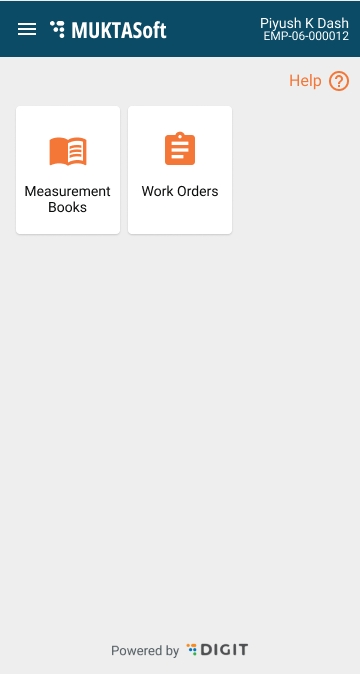
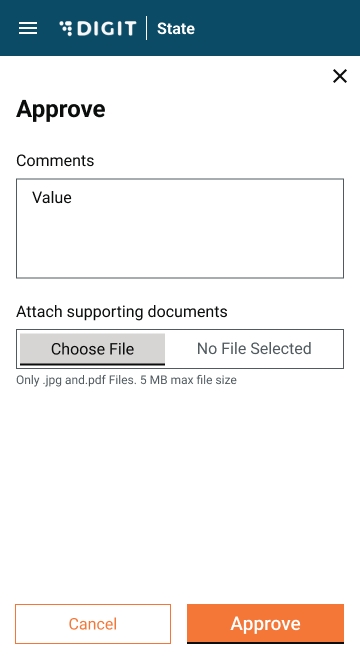
Payment Instruction
Status Update for Payment Status
Employee
Role: System
Payment Details (PD) is the API to fetch the payment details from JIT.
For Request/ Response parameters, please refer the .
The response data is stored and maintained at MUKTASoft for every PD call.
The API call to be scheduled once in a day at 10 PM for In Process payment instruction.
Error message displayed on View Payment Instruction Page. [Message: On call of PD API: No response is received.]
PI status at MUKTASoft remain unchanged to In Process.
All beneficiaries payment status remain unchanged to Payment In Process.
Option to refresh the status is provided. It triggers call of PD.
Error message is stored at MUKTASoft.
Error message displayed on View Payment Instruction Page. [Message: On call of PD API: <JIT error message>]
PI status at MUKTASoft remain unchanged to In Process.
All beneficiaries payment status remain unchanged to Payment In Process.
Success message is received and same is stored at MUKTASoft.
Info message displayed on View Payment Instruction Page. [Message: On call of PD API: Response is received and updated successfully]
PI status at the MUKTASoft changes to Completed.
The beneficiaries payment status is changed to “Payment Successful”.
Not applicable.
Not applicable.
Not applicable.
Not applicable.
Not applicable.
To all the beneficiaries:
Payment of Rs. {amount} for MUKTA, transaction <UTRNO> is made to your registered bank account. Contact your bank if not credited within 72 hours. MUKTA - Govt. of Odisha.
View Payment Instruction
API is called and status is fetched and updated for both PI and Beneficiary.
SMS notification is sent to all the beneficiaries.
Status is reflected in View Payment Instruction Page.
The response is captured in MUKTASoft for debugging and error reporting.
Payment Instruction
Status Update for Payment Failed Status
Employee
Role: System
Failed Details (FD) is the API to fetch the failed payment details from JIT.
For Request/ Response parameters, please refer the .
The response data is stored and maintained at MUKTASoft for every FD call.
The API call to be scheduled once in a day at 10 PM for Completed payment instructions.
Error message displayed on View Payment Instruction Page. [Message: On call of FD API: No response is received.]
PI status at MUKTASoft remain unchanged to Completed.
Beneficiaries payment status remain unchanged to Payment Successful.
No action is enabled.
Error message is stored at MUKTASoft.
Error message displayed on View Payment Instruction Page. [Message: On call of FD API: <JIT error message>]
PI status at MUKTASoft remain unchanged to Completed.
Beneficiaries payment status remain unchanged to Payment Successful.
Success message is received and same is stored at MUKTASoft.
Info message displayed on View Payment Instruction Page. [Message: On call of FD API: Response is received and updated successfully]
PI status at the MUKTASoft remain unchanged to Completed.
The beneficiaries for which details is received in response, the payment status changes to Payment Failed.
Not applicable.
Not applicable.
Not applicable.
Not applicable.
Not applicable.
To beneficiary for which failure details is received:
Payment of Rs. {amount} for MUKTA, transaction <UTRNO> is failed. Contact MUKTA Cell at ULB for more detail. MUKTA - Govt. of Odisha.
View Payment Instruction
API is called and status is fetched and updated for beneficiaries.
SMS notification is sent to beneficiary for failed transaction.
Status is reflected in View Payment Instruction Page.
The response is captured in MUKTASoft for debugging and error reporting.
Payment Instruction
Status Update for Successful Payment Details of Revised PIs
Employee
Role: System
Success Payment Details (FTPS) is the API to fetch the payment details of revised PI from JIT.
For Request/ Response parameters, please refer the .
The response data is stored and maintained at MUKTASoft for every FTPS call.
The API call to be scheduled once in a day at 10 PM for In Process payment instruction.
Error message displayed on View Payment Instruction Page. [Message: On call of FTPS API: No response is received.]
PI status at MUKTASoft remain unchanged to In Process.
All beneficiaries payment status remain unchanged to Payment In Process.
Option to refresh the status is provided. It triggers call of FTPS.
Error message is stored at MUKTASoft.
Error message displayed on View Payment Instruction Page. [Message: On call of FTPS API: <JIT error message>]
PI status at MUKTASoft remain unchanged to In Process
All beneficiaries payment status remain unchanged to Payment In Process
Success message is received and same is stored at MUKTASoft.
Info message displayed on View Payment Instruction Page. [Message: On call of FTPS API: Response is received and updated successfully]
PI status at the MUKTASoft changes to Completed.
The beneficiaries payment status is changed to Payment Successful.
Not applicable.
Not applicable.
Not applicable.
Not applicable.
Not applicable.
To all the beneficiaries:
Payment of Rs. {amount} for MUKTA, transaction <UTRNO> is made to your registered bank account. Contact your bank if not credited within 72 hours. MUKTA - Govt. of Odisha.
View Payment Instruction
API is called and status is fetched and updated for both PI and Beneficiary.
SMS notification is sent to all the beneficiaries.
Status is reflected in View Payment Instruction Page.
The response is captured in MUKTASoft for debugging and error reporting.
Payment Instruction
Status Update for Payment Failed Status from revised PI
Employee
Role: System
Failed transaction failed payment (FTFPS) is the API to fetch the failed payment details from JIT.
For Request/ Response parameters, please refer the .
The response data is stored and maintained at MUKTASoft for every FTFPS call.
The API call to be scheduled once in a day at 10 PM for Completed payment instructions.
Error message displayed on View Payment Instruction Page. [Message: On call of FTFPS API: No response is received.]
PI status at MUKTASoft remain unchanged to Completed.
Beneficiaries payment status remain unchanged to Payment Successful.
No action is enabled.
Error message is stored at MUKTASoft.
Error message displayed on View Payment Instruction Page. [Message: On call of FTFPS API: <JIT error message>]
PI status at MUKTASoft remain unchanged to Completed.
Beneficiaries payment status remain unchanged to Payment Successful.
Success message is received and same is stored at MUKTASoft.
Info message displayed on View Payment Instruction Page. [Message: On call of FTFPS API: Response is received and updated successfully]
PI status at the MUKTASoft remain unchanged to Completed.
The beneficiaries for which details is received in response, the payment status changes to Payment Failed.
Not applicable.
Not applicable.
Not applicable.
Not applicable.
Not applicable.
To beneficiary for which failure details is received:
Payment of Rs. {amount} for MUKTA, transaction <UTRNO> is failed. Contact MUKTA Cell at ULB for more detail. MUKTA - Govt. of Odisha.
View Payment Instruction
API is called and payment status is fetched and updated for the beneficiaries.
SMS notification is sent to beneficiary for failed transaction.
Status is reflected in View Payment Instruction Page.
The response is captured in MUKTASoft for debugging and error reporting.
Edit Work Order action is to be mapped with Work Order Creator.
It is configurable and can to mapped with other roles too on demand.
The work order which is in the workflow can only be edited.
Rejected, Approved, and Accepted work orders can not be edited.
Edit work orders allows the user to edit the below-given work order detail.
Once the work order is edited, it is re-submitted for approval using the Submit action button.
Not applicable.
Based on the logged-in user role, a workflow pop-up window is displayed on submit.
On respective workflow action, changes get saved and the work order is forwarded to the next user in the workflow.
On Cancel, the pop-up window gets closed and the action gets cancelled.
Accordingly, the messages are shown.
<To be updated>
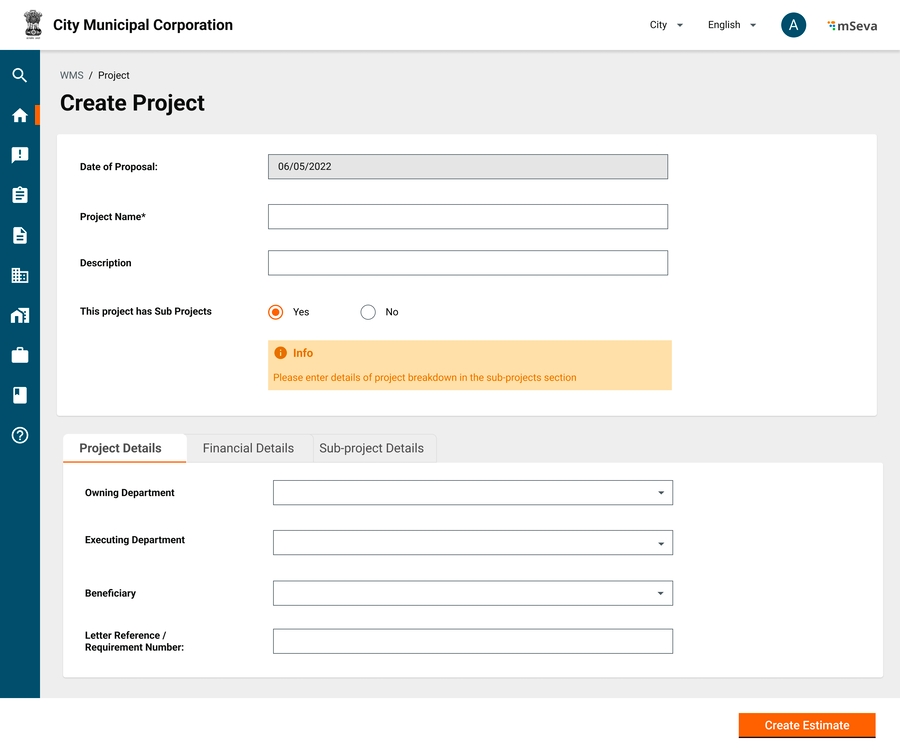
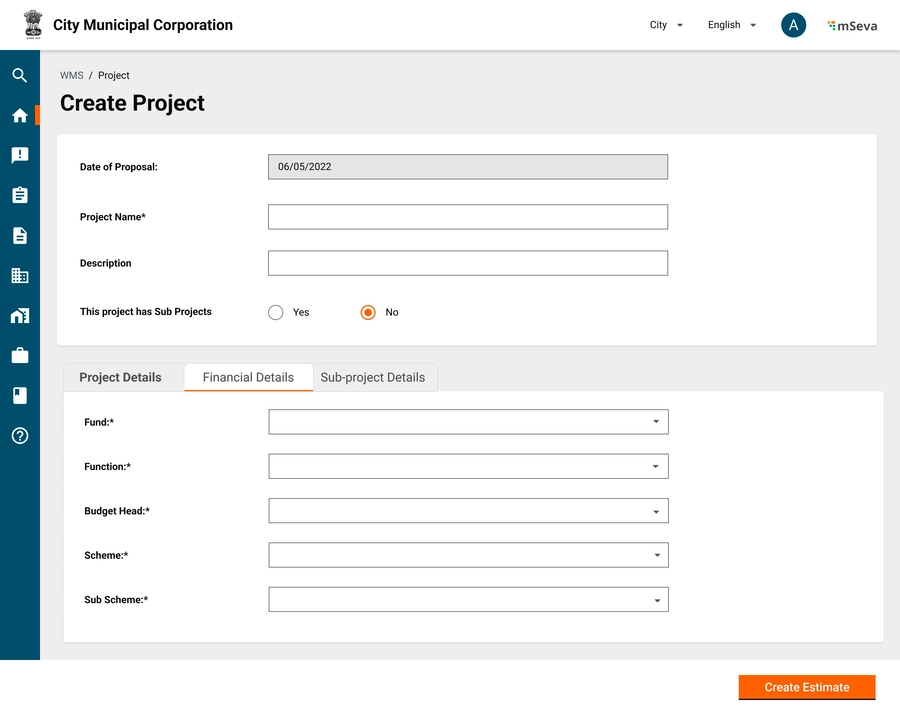
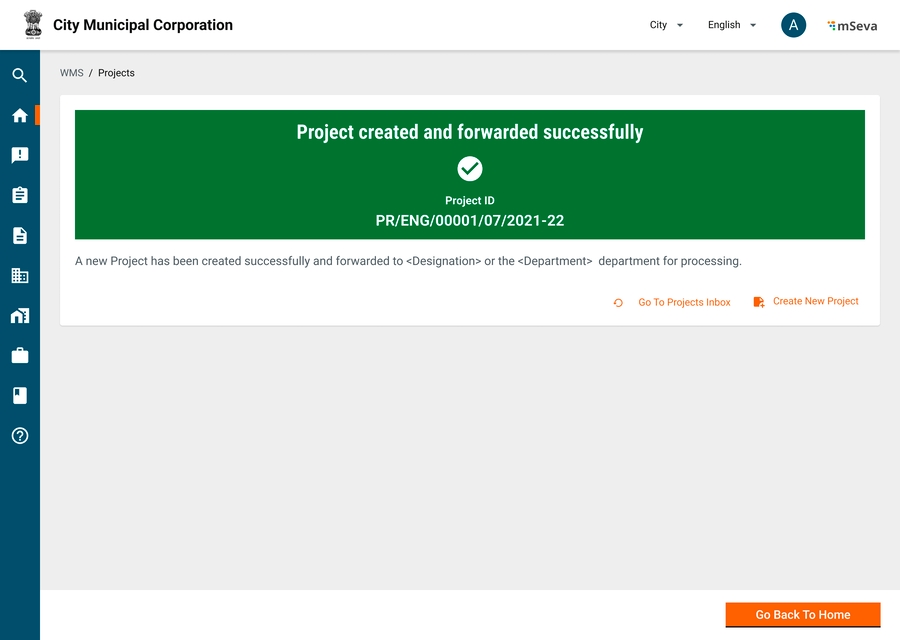
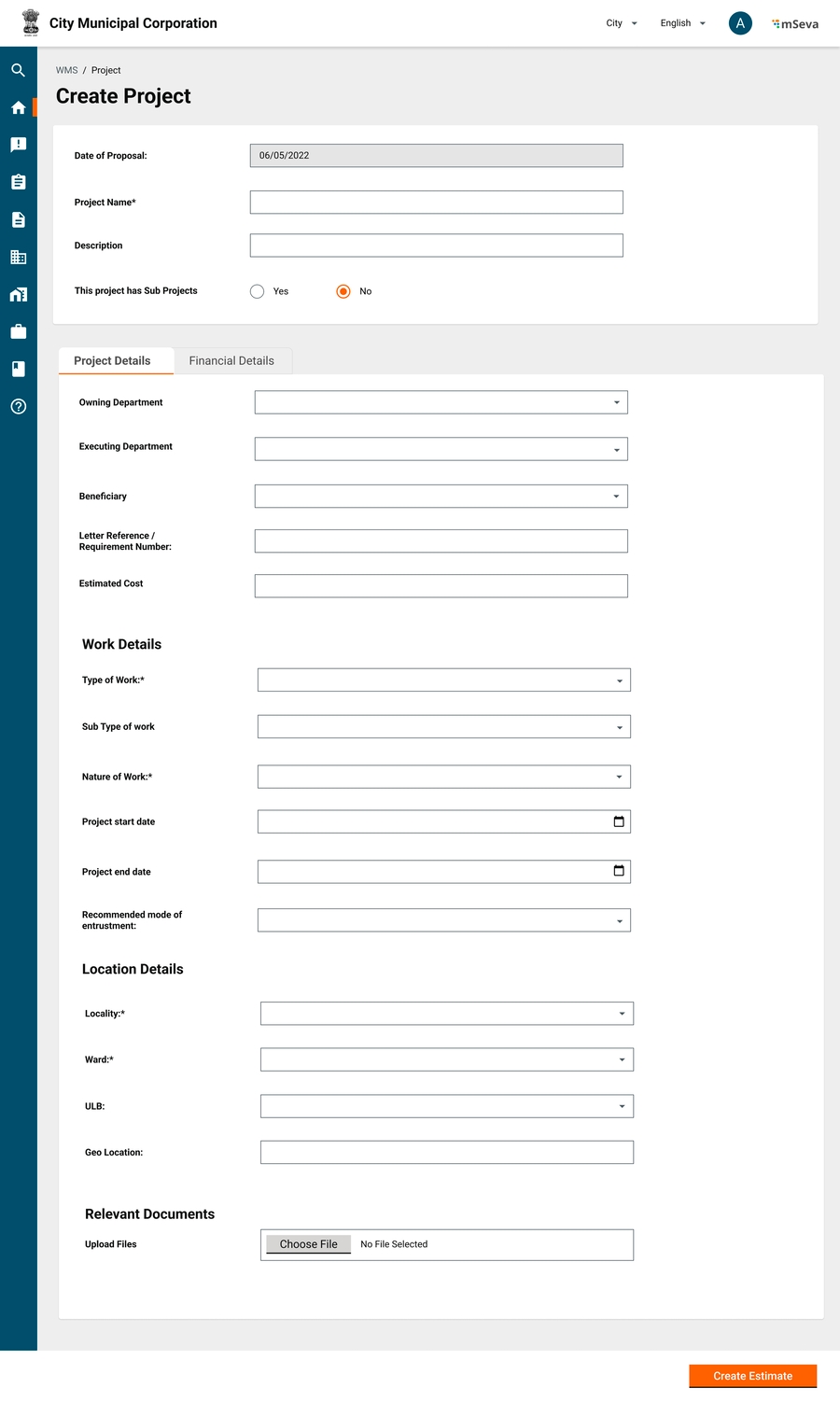
Measurement books or M-Books help track the work progress once the execution of the contract is initiated. The page provides detailed steps on how to use a measurement book.
Measurement Books are legal copies signed and issued by contract_creator to the contractor noting down the Book ID, Number of Pages, and Title (as per project title).
The release chart for this version here.
Submit
WORK ORDER APPROVER
Search
View
Approve
Send Back
Send Back To CBO
Reject
Executive Officer
Verify and Forward
Work Order Verifier
Pending for verification
Pending for approval
Verified
3
Send Back
Work Order Verifier
Pending for verification
Pending for correction
Sent Back
4
Send Back
Work Order Approver
Pending for approval
Pending for verification
Sent Back
5
Send Back To CBO
<any roles having access of action>
<Current Status>
Pending for correction
Sent Back
6
Edit/ Re-submit
Work Order Creator
Pending for correction
Pending for verification
Re-submitted
7
Approve
Work Order Approver
Pending for approval
Approved
Approved
8
Reject
<any roles having access>
<Current Status>
Rejected
Rejected
Verify and Forward
Pending for verification
2
Approve
Pending for approval
1
Reject
Officer In-charge
Time extension request {timeextensionrequestid}
for the project
{projectid} is rejected. Login to MUKTASoft for detail. MUKTA - Govt. of Odisha.
Approve
Officer In-charge
Time extension request {timeextensionrequestid} for project {projectid} has been approved. Login to MUKTASoft for detail. MUKTA - Govt. of Odisha.
ssuIaId
Yes
Special spending unit ID. A master value maintained in JIT-FS.
jitBillDate
Payment Instruction date of the payment instruction created in MUKTASoft and then pushed to JIT.
5
ssuIaId
Special spending unit ID. A master value maintained in JIT-FS.
6
billNetAmount
Net bill amount sent in the PI
7
billGrossAmount
Gross bill amount sent in the PI
8
schemeCode
Scheme code under which PI is created
9
totalNumberOfBeneficiary
Total beneficiary count
2
Response with Error Others
Initiated
Initiated
Payment Initiated
Refresh
PIS
3
Response with Error Rejected
Initiated
Rejected
Payment Initiated
Generate New PI
PI
4
Response Without Error
Initiated
Approved
Payment Initiated
Refresh
PAG
billDate
Payment Instruction date of the payment instruction created in MUKTASoft and then pushed to JIT.
5
ssuIaId
Special spending unit ID. A master value maintained in JIT-FS.
adviceId
Unique Id generated after successfully submission of Advice for payment in JIT.
6
adviceDate
Advice date of payment advice generated in JIT.
7
onlineBillRefNo
Auto generated online bill Reference number in JIT.
8
tokenNumber
Token number generated automatically after auto submitted bill to treasury
9
tokenDate
Token date of the token generated automatically.
Beneficiary List
10
benfName
Beneficiary name
11
benfAccountNo
Beneficiary account number
12
benfBankIfscCode
Beneficiary’s IFSC which was pushed through PI.
13
amount
Amount to be paid to the beneficiary.
14
benfId
Beneficiary unique ID which was generated for PI.
2
Response With Error
Approved
Approved
Payment Initiated
Refresh
PAG
3
Response Without Error
Approved
In Process
Payment In Process
Refresh
PD
Applicable for SOR type Works only.
3
SOR Variant
Drop-down
Yes*
Applicable for SOR type Works only.
4
Unit of Measurement
Drop-down
Yes
Unit of measurement for the item.
5
Rate defined for quantity
Numeric (6,0)
Yes
Quantity of items for which basic rate is defined.
6
Description
Alphanumeric (2048 Chars)
Yes
Name of item as per the standard definition of OPWD
Rate Details
Section
Optional
It is not applicable to Works SOR.
7
Effective From
Date
Yes
The date given rate will become effective, it can be a past and future date. Time is always 00.00
Heads
Grid
Optional
A grid to select the head whichever is applicable.
8
Basic Rate
Numeric (6,2)
Yes
The basic rate of the item defined by the OPWD
9
Conveyance
Numeric (6,2)
No
The conveyance charges applicable based on the distance item is carried.
10
Royalty
Numeric (6,2)
No
The royalty amount on the items as per the state mining department.
11
Labour Cess
Numeric (6,2)
No
It is applicable for works items only and calculated on Basic + Conveyance + Royalty.
12
Rate/ Unit
Display
Yes
A calculated value.
13
Submit and Create Another SOR
Button
Yes
It will allow the user to submit the details and open a new create SOR form.
14
Submit
Button
Yes
It saves the SOR details into system and create SOR record.
Works
<SUBTYPECODE>-<5 digit running sequence>. E.g. EW-00001
Payment Instruction ID
Payment Instruction ID.
5
Payment Instruction Date
Payment Instruction Date.
6
Head of Account
Head of account from which amount to be paid
7
Master Allotment ID
Master allotment ID from which amount to be paid
8
Status
Status of payment instruction. A tool-tip is displayed to display the error message for declined and rejected PIs.
9
Payment Advice Details
10
Payment Advice ID
Payment advice ID generated for the original/ revised PI.
11
Payment Advice Date
Payment advice generation date.
12
Token Number
Token no. generated for the payment instruction
13
Token Date
Token no. generated for the payment instruction
14
Online Bill Number
Online bill number for the online bill generated for the payment advice.
Error/ Info Section
A information display band to display the error message/ info messages
Beneficiary Details
Tabular form
15
Beneficiary ID
It is individual ID of wage seeker/ organization ID for CBOs and vendors, and displayed as hyperlink to view details.
16
Payment ID
Unique beneficiary ID for the payment through JIT. It remain same though the process until the payment becomes successful.
17
Beneficiary Name
Name of the beneficiary.
18
Account Number
Account number of beneficiary, only last 4 digits are displayed. Remaining initial digits of A/C are masked.
19
IFSC
IFSC code of the bank/ branch of beneficiary accounts.
20
Payment Status
The payment status, as per the definition. A tooltip is shown to display the error message for failed payments.
21
Payment Amount
The payment amount of beneficiary.
Info
In case of there are failed payments, an information is displayed. “Please make sure all the necessary corrections are made before generating the revised payment instruction for JIT” .
Edit/ Re-submit
MB_ APPROVER
Search
View
Approve
Send Back
Send Back To Originator
Reject
Municipal Engineer
4
MB_VIEWER
Search
View
MUKTA Coordinator/ MUKTA Accountant
MB Creator
Drafted
Pending for verification
Submitted
3
Verify and Forward
MB Verifier
Pending for verification
Pending for approval
Verified
4
Send Back
MB Verifier
Pending for verification
Pending for correction
Sent Back
5
Send Back
MB Approver
Pending for approval
Pending for verification
Sent Back
6
Send Back To Originator
<roles having access>
<Current Status>
Pending for correction
Sent Back
7
Edit/ Re-submit
MB Creator
Pending for correction
Pending for verification
Re-submitted
8
Approve
MB Approver
Pending for approval
Approved
Approved
9
Reject
<any roles having access>
<Current Status>
Rejected
Rejected
Token number received in the APIs response of PAG.
6
tokenDate
Token date received in the APIs response of PAG.
The voucher creation date of the voucher created in JIT-FS for payment.
5
billRefNo
Online bill reference number generated in JIT and received in PAG response.
6
paymentStatus
Payment status Message Received from RBI at the time of Debit Scroll.
7
tokenNumber
Token number generated in JIT and received in PAG response.
8
tokenDate
Token date of the token generated in JIT and received in PAG response.
Debit Scroll Details
9
benfAcctNo
Beneficiary’s account number.
10
benfBankIfscCode
Beneficiary’s bank / branch IFSC.
11
utrNo
Unique transaction number used by banks to reconcile the transaction.
12
utrDate
The date of transaction which is used by bank.
13
endToEndId
End to end id generated to identify a particular beneficiary for a transaction while it is pushed to CPC for payment clearance.
14
benfId
Beneficiary unique ID, unique to transaction.
Option to refresh the status is provided. It triggers call of PD.
No action is enabled.
SMS notification is sent to all the beneficiaries.
Response With Error
In Process
In Process
Payment In Process
Refresh
PD
3
Response Without Error
In Process
Completed
Payment Successful
No Action
Technical glitched in the integration are defined as error and captured.
System keep trying until a response is received. The latest response is recorded in the log.
#
Parameter
Description
1
finYear
Financial year received in the APIs response of PAG.
2
ExtAppName
The name of the application from which the call is being made.
3
billRefNo
Online bill reference number received in the APIs response of PAG.
4
#
Parameter
Description
1
billNumber
Payment Instruction ID of the payment instruction created in MUKTASoft and then pushed to JIT.
2
billDate
Payment Instruction date of the payment instruction created in MUKTASoft and then pushed to JIT.
3
voucherNumber
Voucher number of the voucher created in JIT to maintain the accounting.
4
#
Response
PI Status (From)
PI Status (To)
Payment Status
User Action
API Call
1
No Response
In Process
In Process
Payment In Process
Refresh
PD
tokenNumber
voucherDate
2
Online bill reference no. generated at JIT and received with PAG response.
6
tokenNo
Token number, generated at JIT-FS
7
tokenDate
Token number, generated at JIT-FS
Voucher date.
6
billRefNo
Online bill reference number generated at JIT and received with PAG response.
7
tokenNumber
Token number generated at JIT-FS
8
tokenDate
Token generation date
benfDtls
10
benfAcctNo
Beneficiary’s account number.
11
benfBankIfscCode
Beneficiary’s bank / branch IFSC.
12
utrNo
Unique transaction number used by banks to reconcile the transaction.
13
utrDate
UTR date.
14
endToEndId
End to end id generated to identify a particular beneficiary for a transaction while it is pushed to CPC for payment clearance.
15
orgBillRefNumber
Original online bill reference number, In first failure case billRefNo and orgBillRefNumber are same.
16
challanNumber
Challan number of the challan created to put the amount into suspense account
17
challanDate
Challan generation date
18
failedReason
Reason for failure
19
benfId
Beneficiary unique ID, unique to transaction.
No action is enabled.
SMS notification is sent to all the beneficiaries.
Option to generate revised PI is enabled. It triggered the COR API call.
Response With Error
Completed
Completed
Payment Successful
No Action
3
Response Without Error
Completed
Completed
Payment Failed
Generate Revised PI
COR
Technical glitched in the integration are defined as error and captured.
System keep trying until a response is received. The latest response is recorded in the log.
#
Parameter
Description
2
billno
Payment Instruction ID of the payment instruction created in MUKTASoft and then pushed to JIT.
3
billDate
Payment Instruction date of the payment instruction created in MUKTASoft and then pushed to JIT.
4
adviceId
Payment advice ID, generated at JIT-FS
5
#
Parameter
Description
2
billNumber
Bill number of the bill created in MUKTASoft and then pushed to JIT-FS as payment instruction.
3
billDate
Bill date of the bill created in MUKTASoft and then pushed to JIT-FS as payment instruction.
4
voucherNo
Voucher generated at JIT-FS for maintaining the accounting.
5
#
Response
PI Status (From)
PI Status (To)
Payment Status
User Action
API Call
1
No Response
Completed
Completed
Payment Successful
No Action
onlineBillRefNo
voucherDate
2
Original online bill reference no. in JIT while payment failed first time.
5
jitOrgBillNo
Original Payment Instruction ID in MUKTASoft while payment failed first time.
6
jitOrgBillDate
Original Payment Instruction Date in MUKTASoft while payment failed first time.
The voucher number of voucher generated in JIT to maintain the accounting.
5
voucherDate
The voucher creation date for the voucher created in JIT for payment.
6
billRefNo
Online bill reference number for revised PI/ Current PI.
7
paymentStatus
Payment status, message received from RBI at the time of Debit Scroll.
8
tokenNumber
Token number generated in JIT.
9
tokenDate
Token date generated in JIT.
Beneficiary Details
10
benfAcctNo
Beneficiary’s account number.
11
benfBankIfscCode
Beneficiary’s bank / branch IFSC.
12
utrNo
Unique transaction reference number used by banks to reconcile the transaction.
13
utrDate
UTR date.
14
endToEndId
It is generated to identify a beneficiary for a transaction while it is pushed to CPC for payment clearance.
15
benfId
Beneficiary unique ID, unique to transaction.
Option to refresh the status is provided. It triggers call of FTPS.
No action is enabled.
Response With Error
In Process
In Process
Payment In Process
Refresh
FTPS
3
Response Without Error
In Process
Completed
Payment Successful
No Action
Technical glitched in the integration are defined as error and captured.
System keep trying until a response is received. The latest response is recorded in the log.
#
Parameter
Description
1
jitCorBillNo
PI ID of revised PI generated in MUKTASoft to re-push failed transactions into JIT
2
jitCorBillDate
PI date of revised PI generated in MUKTASoft to re-push failed transactions into JIT
3
jitCorBillDeptCode
Application code.
4
#
Parameter
Description
1
jitCorBillNo
Revised PI ID generated in MUKTASoft and push failed transactions into JIT
2
jitCorBillDate
Revised PI date generated in MUKTASoft and push failed transactions into JIT
3
jitOrgBillRefNo
Original, the first online bill reference number generated in JIT.
4
#
Response
PI Status (From)
PI Status (To)
Payment Status
User Action
API Call
1
No Response
In Process
In Process
Payment In Process
Refresh
FTPS
jitOrgBillRefNo
voucherNumber
2
Token number generated in JIT.
5
tokenDate
Token date generated in JIT.
Token number generated in JIT.
5
tokenDate
Token date generated in JIT.
Beneficiary Details
7
benfAcctNo
Beneficiary’s account number.
8
benfBankIfscCode
Beneficiary’s bank / branch IFSC.
9
utrNo
Unique transaction reference number used by banks to reconcile the transaction.
10
utrDate
UTR date.
11
endToEndId
It is generated to identify a beneficiary for a transaction while it is pushed to CPC for payment clearance.
12
orgBillRefNumber
Original online bill reference no.
13
challanNumber
Challan number
14
challanDate
Challan date
15
failedReason
Account related errors, Like account that doesn't exist.
16
benfId
Beneficiary unique ID, unique to transaction.
No action is enabled.
Option to generate revised PI is enabled. It triggered the COR API call.
Response With Error
Completed
Completed
Payment Successful
No Action
3
Response Without Error
Completed
Completed
Payment Failed
Generate Revised PI
COR
Technical glitched in the integration are defined as error and captured.
System keep trying until a response is received. The latest response is recorded in the log.
#
Parameter
Description
1
jitCorBillNo
Revised PI ID generated in MUKTASoft and pushed for failed transactions into JIT
2
jitCorBillDate
Revised PI date generated in MUKTASoft and pushed for failed transactions into JIT
3
billRefNo
Online bill reference number for revised/current PI
4
#
Parameter
Description
1
jitCorBillNo
Revised PI ID generated in MUKTASoft and pushed for failed transactions into JIT
2
jitCorBillDate
Revised PI date generated in MUKTASoft and pushed for failed transactions into JIT
3
billRefNo
Online bill reference number for the current revised PI.
4
#
Response
PI Status (From)
PI Status (To)
Payment Status
User Action
API Call
1
No Response
Completed
Completed
Payment Successful
No Action
tokenNumber
tokenNumber
2
Project ID of the project.
3
Date of proposal
Display Only
NA
Date of the proposal from the project.
4
Project name
Display Only
NA
Project name
5
Project description
Display Only
NA
Project description
6
Project Details
Tab
Displayed as per view project details.
7
Estimate Details
Tab
Displayed as per view estimate details.
8
Work Order Details
Tab
9
Name of CBO
Drop-down
Y
The name of the CBO from the organization master maintained at the ULB level. The name is searchable in the drop-down.
10
CBO ID
Display
Y
The CBO ID from the organization registry.
11
Role of CBO
Drop-down
(Auto- selected)
Y
The role of the CBO is decided based on the estimated amount. It is configurable in the system.
IP (Implementation Partner) - If the estimated cost of the works is more than Rs.15 Lakhs
IA (Implementation Agency) - If the estimated cost of the works is up to Rs.15 Lakhs
12
Name of the officer in-charge
Drop-down
Y
The drop-down values are population based on the role assigned. The name is searchable in the drop-down. Name + Designation
13
Designation of officer in-charge
Display
Y
Displayed from the EIS/User’s record saved in the system.
14
Project completion period
Numeric
Y
Number of days work to be completed.
15
Work order amount
Read Only
Y
Total estimated cost of the selected work.
Relevant Documents
Sections
16
BOQ
File Attachment
Y
Allows single file, not greater than 5 MB. Files can be of type doc, xls, pdf, jpg.
17
Labour Analysis
File Attachment
Y
Allows single file, not greater than 5 MB. Files can be of type doc, xls, pdf, jpg.
18
Material Analysis
File Attachment
Y
Allows single file, not greater than 5 MB. Files can be of type doc, xls, pdf, jpg.
19
Terms and conditions
File Attachment
Y
Allows single file, not greater than 5 MB. Files can be of type doc, xls, pdf, jpg.
20
Others
Textbox
N
To capture the file name
21
File Attachment
N
To attach the file file the name entered above in the textbox.
1
Work order number
Display Only
NA
Work order no.
2
Project ID
Display Only
Work Order Creator
Submit pop-up window
Work Order Verifier
Verify and Forward pop-up window
Approver
Approval pop-up window
1
Role-based access based on configuration.
2
The work order which is in the workflow can only be edited.
3
The work order is opened in editable mode.
4
The details given in the table can be edited by the user.
5
On Submit, the work order is again forwarded to the next user for approval.
NA
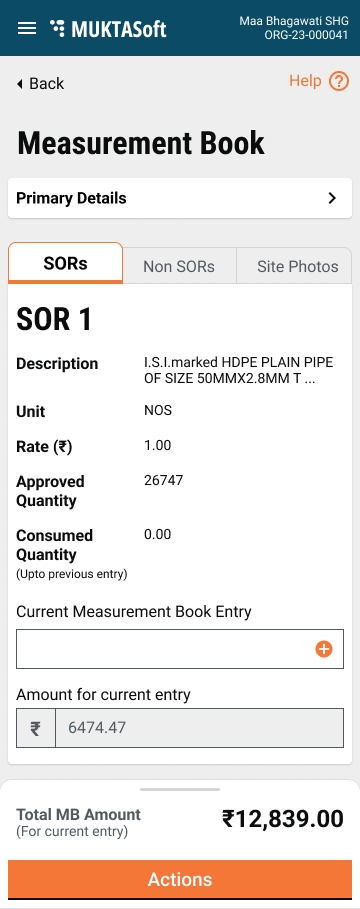
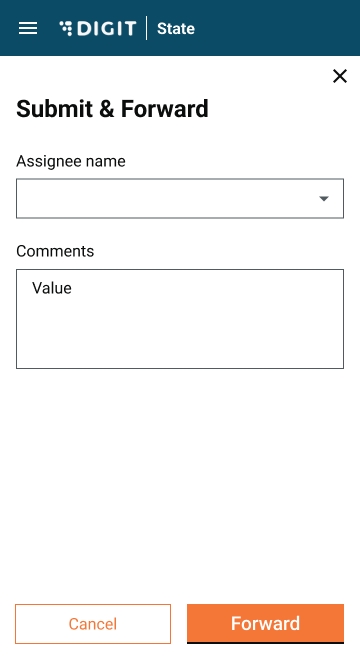
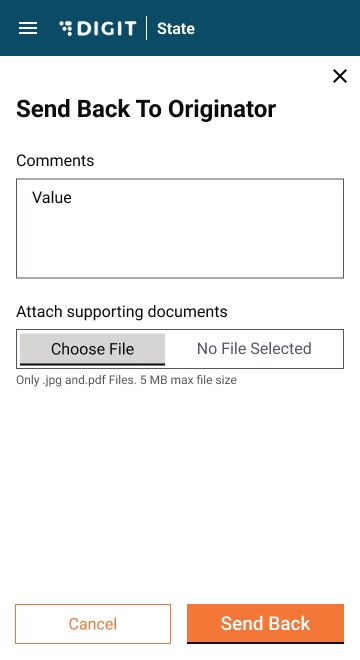
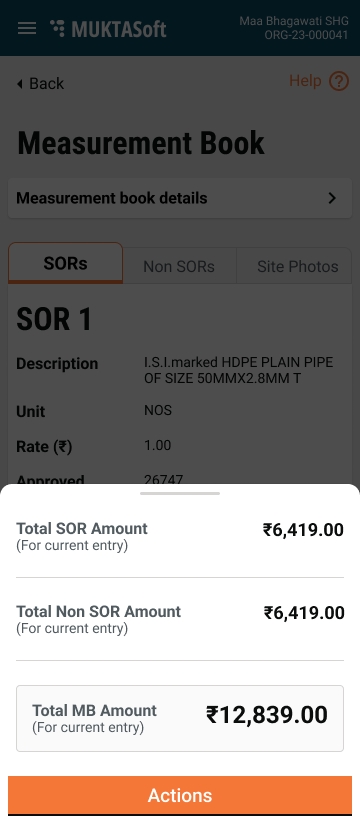
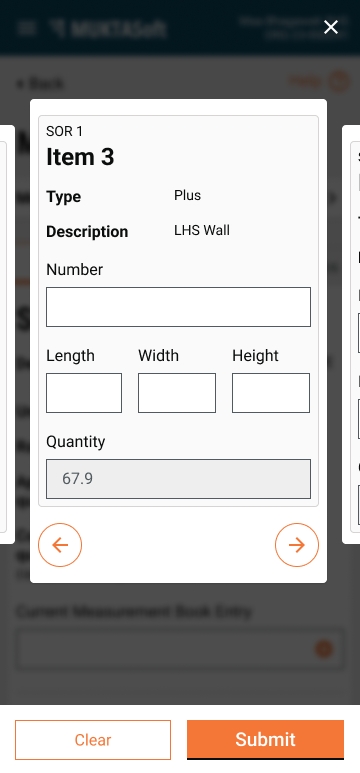
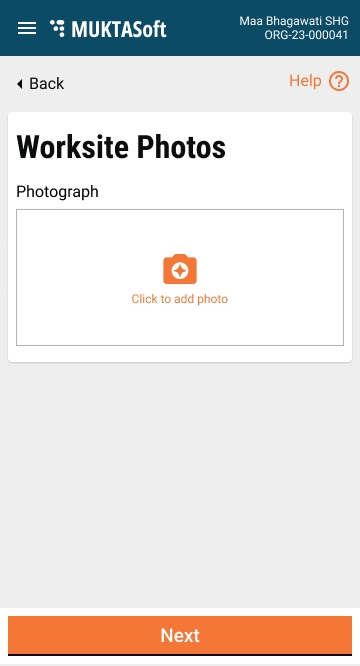
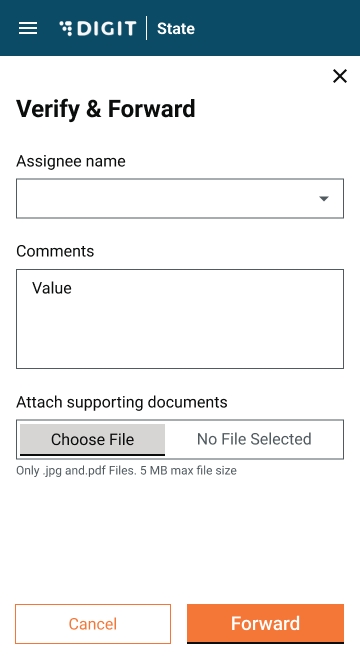
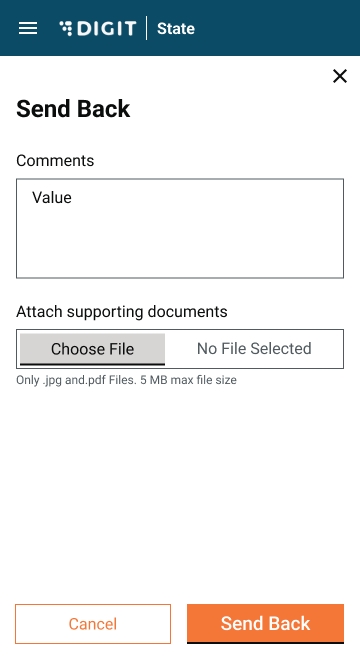
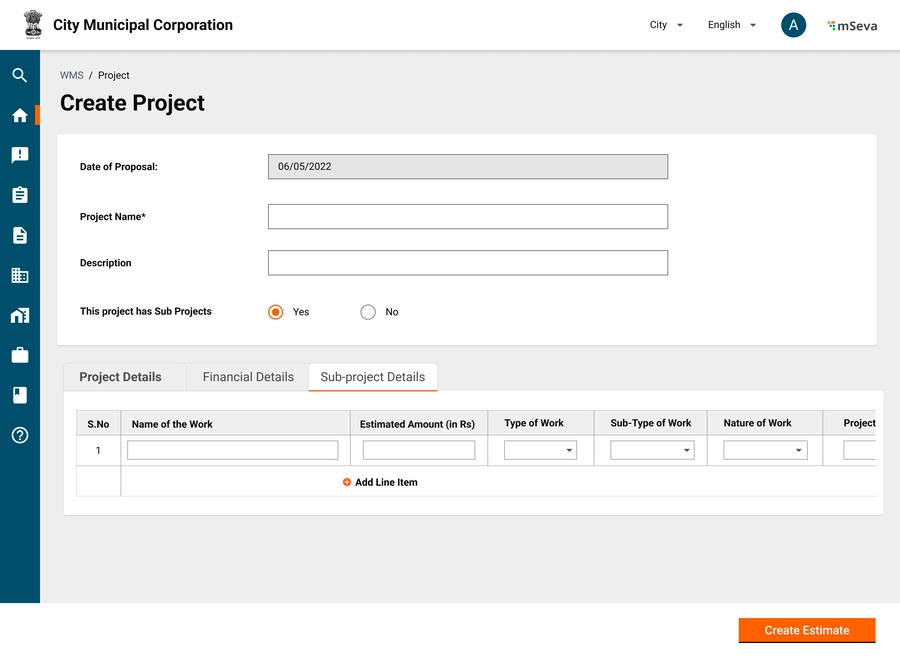
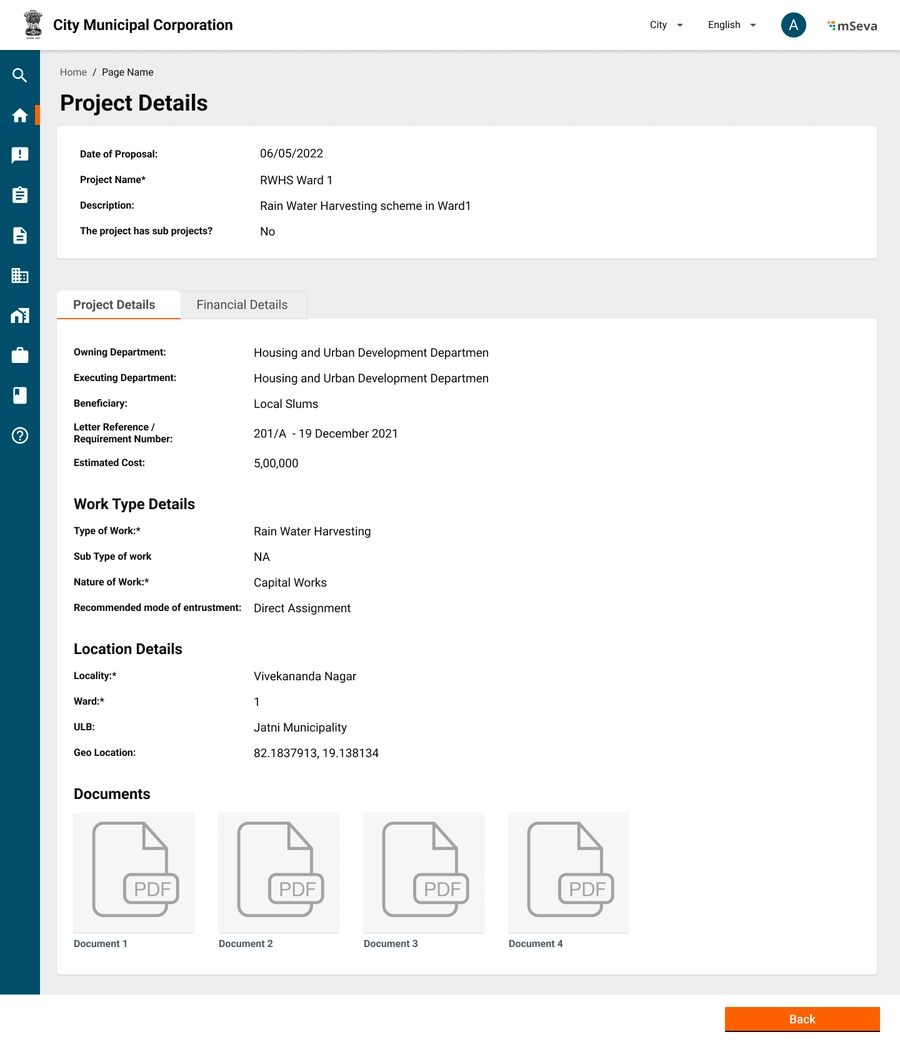
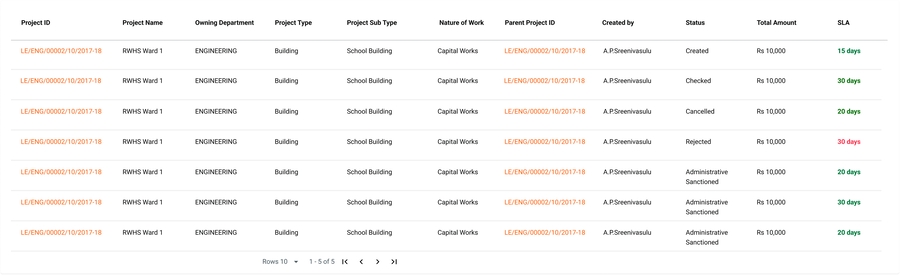
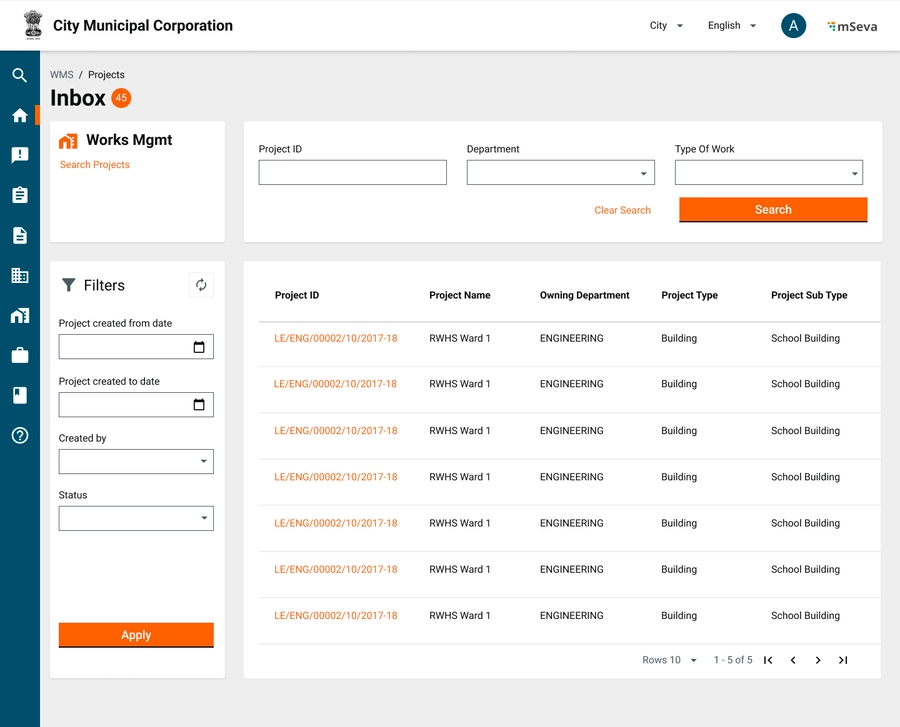
In offline methods, measurements can be filled daily, weekly, monthly or as per demand (usually before the time of bill creation) to raise a bill and attach a copy of the book as a reference document validating the bill information.
Measurement Books are initially empty. The M-Books will be filled with the estimated line items only. Once all the estimated line items are filled/counted in the MBook, they can be submitted along with the final Bill.
The Book is also sent as an attachment to the accountant for bill approval.
Digitising offline measurement books offers several advantages, including:
Faster Measurement Capture: Digital tools allow for quicker and more efficient recording of measurements, reducing the time required for data entry.
Timely Data Capture: Real-time or near-real-time data capture ensures that measurements are recorded promptly, eliminating delays in processing.
Error-Free Calculation: Automated calculations reduce the risk of human errors in measurement calculations, leading to more accurate results.
Automation of Billing: Digital systems can automate the billing process, generating invoices and reports based on the captured measurements, further streamlining operations.
Overall, digitisation enhances efficiency, accuracy, and the overall effectiveness of measurement and billing processes.
The system creates the M-Book automatically while the contract is accepted.
Contractor/MBook-tracker will track M-Book readings
MBook-Checker will check the measurements
MBook-Approver will approve the measurements
While creating an estimate, the estimate creator can add measurement rows for each SOR /Non-SOR line item. It is not mandatory to fill in these measurements unless the user clicks the "+" icon in the Quantity section of the SOR line item row.
Upon selecting the measurement box, an expansion slide-down will appear. Here he/she can enter the measurement details
The user can delete or add multiple measurement items.
The measurement box will contain fields for quantity, length, width, and height/depth and the product of these three values will be automatically calculated and populated in the Quantity box.
In cases where an object's area is not measured using length, width, and height, the user can directly enter the area in the Quantity field. The fields for length, width, and size should be greyed out and not editable in such cases.
The summation of all the measurement quantities will be automatically populated in the SOR/Non-SOR Quantity row. This quantity will then be multiplied by the rate to calculate the final amount.
Measurement Book will be created only when the contract is accepted.
Mbook line items will be SOR line items if while creating an estimate, a sub-line item under SOR is not created.
If SOR sub-line items are created, the M-Book will have to be tracked at the SOR sub-line items level.
There should be an option to capture images of physical mbook and site photos along with m-book readings for each date.
Each M-book entry will go for approval workflow
ID
NA
NA
UUID
MBook ID
Alphanumeric
Y
Mbook ID
MB<Year>/<Mo>/<Running Sequence>
Contract ID
Create an M-Book when the contract is accepted with the start and end dates as per the contract
Measurements can be taken both on the web and mobile (Mobile First).
Measurement books initially will have line items from estimates with zero quantities. These will get filled as the project progresses and cannot go beyond what is estimated.
Measurement Book readings can be sent for approval for any duration/marked period, from the last marked period.
Once approved, that corresponding amount will be allowed for payment to the contractor.
Tracking of MBook will be required to know the project progress and subsequently pay to contractor based on work done
User: Mbook-Tracker
Detail:
Mbook tracking can be done only against the line items that are captured in the estimate.
This can be done at the estimate SOR line item level or sub-line item level.
At least one measurement needs to be filled in to submit an MBook for approval.
Each submission of the measurement book can use the same ID of the MBook with a running sequence number appended at the end.
To add another measurement reading for the same project, users can click on Actions > Add New Measurements, which opens another tab.
The overall measurements cannot exceed the estimated quantities.
A project can have any number of measurement entries.
M Book tracking can only be done until the last date of Mbook.
Each mBook recording will have an approval workflow.
MBook is created by contractor/mbooktracker,
Checked by m-book checker,
Approved by m-book approver.
An Mbook should be able to tell using analysis of rates, how much labour, material and other heads as bifurcated in the estimate under SOR item detail 1.
Upon each mBook entry creation, a labour consumption log and material consumption log should also be generated as to how much material from the last entry till this entry is consumed.
Only based on material consumed, the material supplier is eligible to get paid.
Need:
Cancelling of Mbook is only possible with the cancellation of the contract
Roles: Contract_Canceller
Detail
If a contract gets cancelled Mbook will also get cancel status.
MBook reading entry if is in the approval workflow, will be moved to cancel status as well.
Whatever approvals done so far on Mbook workflows are eligible for payments.
Since we do automatic payments, a bill would have already been created for such mbook entries.
Track Measurement
Detailed measurement input screen
Measurements successfullly submitted
Measurement Inbox
Measurement Book Search
Not changed
Access Control
egov-accesscontrol:v1.1.3-72f8a8f87b-24
Not changed
Encryption
egov-enc-service:v1.1.3-44558a0-3
Not changed
File store
egov-filestore:v1.2.4-72f8a8f87b-10
Not changed
Hrms
egov-hrms:v1.2.5-1715164454-6
Not changed
ID Gen
egov-idgen:v1.2.3-72f8a8f87b-7
Not changed
Indexer
egov-indexer:v1.1.7-f52184e6ba-25
Not changed
Localization
egov-localization:v1.1.3-72f8a8f87b-6
Not changed
Location
egov-location:v1.1.4-72f8a8f87b-6
Not changed
MDMS
egov-mdms-service:v1.3.2-72f8a8f87b-12
Not changed
MDMS-V2
egovio/mdms-v2:mdms-v2-ref-fix-761cd136b7-31
Not changed
SMS Notification
egov-notification-sms:v1.1.3-48a03ad7bb-10
Not changed
User OTP
egov-otp:v1.2.3-e30d33c5ee-13
Not changed
pdf-service
pdf-service:v1.2.1-5ad7ffbc29-42
Not changed
Persister
egov-persister:v1.1.5-6cfa52c1f9-3
Not changed
URL Shortening
egov-url-shortening:v1.1.3-6cfa52c1f9-1
Not changed
User
egov-user:v1.2.7-cb9eb30-5
Not changed
Workflow
egov-workflow-v2:v1.2.2-cae8f24502-3
Not changed
inbox
inbox:v1.3.0-32c61b6-11
Not changed
Ingress Controller
nginx-ingress-controller:0.26.1
Not changed
Oauth2
quay.io/pusher/oauth2_proxy:v5.1.0
Not changed
User OTP
user-otp:v1.1.6-e30d33c5ee-8
Not changed
Zuul - API Gateway
zuul:v1.3.1-96b24b0d72-39
Not changed
Works builds
Attendance
attendance:v1.0.0-743b0814-46
Not changed
Bank Account
bankaccounts:v0.1.4-3292733c8-38
Fixed pagination issue
Contract
contracts:v1.0.0-743b0814-86
Not changed
Estimate
estimates:v1.0.0-743b0814-86
Not changed
Muster Roll
muster-roll:v1.0.1-3292733c8-49
Skills migration to SOR
Project Management
project:v1.0.1-8d350429f4-79
Not changed
Organization
organisation:v0.2.0-ccbd4695-91
Not changed
Individual Service
individual:v1.1.1-6c6afa0a83-155
Not changed
Expense
expense:v1.0.0-743b0814-108
Not changed
Expense-Calculator
expense-calculator:v2.0.1-3292733c8-147
Rate migration to SOR
Measurement Registry
measurement-registry:v1.0.0-743b0814-15
Not changed
Measurement Service
measurement-service:v1.0.0-743b0814-44
Not changed
Works-Pdf
works-pdf:v1.0.2-227a4c3f-48
Not changed
Works MDMS
No Change
Works Config
No Change
Works Devops
Devops Changes is linked
Core Services
Dashboard
dashboard-analytics:works-ce24e33829-11
Signed Audit
audit-service-db:v1.0.0-24873ba-4
Payment Instruction
Re-push revised PI for failed transactions
Employee
Role: Accountant
Home Page → Billing → Search Bills → Open Bill → Generate Revised PI
Failed Transaction Correction (COR) is the API to push revised PI to JIT.
A new PI is generated at MUKTASoft to push it as revised PI.
MUKTA accountant login in MUKTASoft open the bill screen and initiate revised PI.
For Request/ Response parameters, please refer the integration approach document.
The response data is stored and maintained at MUKTASoft for every COR call.
API is called with an action is triggered by user from View Payment Instruction Page.
#
Parameter
Description
2
jitCorBillNo
Revised PI ID of the PI generated at MUKTASoft to re-push failed transactions into JIT
3
jitCorBillDate
Revised PI date of the PI generated in MUKTASoft to re-push failed transactions into JIT
4
jitCorBillDeptCode
Application code, e.g. MUKTA.
5
#
Parameter
Description
2
jitCorBillNo
Revised PI ID, created in MUKTASoft and then pushed to JIT
3
jitCorBillDate
Revised PI date, created in MUKTASoft and then pushed to JIT
4
successCode
0 - Success
5
PI is created and saved at MUKTASoft.
Error message displayed on View Payment Instruction Page. [Message: On call of COR API: No response is received.]
PI status at MUKTASoft updated to Pending.
Beneficiary payment status changes to “Payment Pending”.
Option to re-push the PI is provided, and the same time system will try to push all such PI once in a day at 9PM every day.
Error message is stored at MUKTASoft.
Error message displayed on View Payment Instruction Page. [Message: On call of COR API: <JIT error message>]
PI status at MUKTASoft is updated to Declined.
Beneficiary’s payment status will change to “Payment Pending”.
Option to re-push the PI after clear the error is provided from View Payment Instruction Page.
Success message is received and same is stored at MUKTASoft.
Info message displayed on View Payment Instruction Page. [Message: On call of COR API: Response is received and updated successfully]
PI status at the MUKTASoft changes to In Process.
Beneficiary’s payment status will change to Payment In Process.
#
Response
PI Status (From)
PI Status (To)
Payment Status
User Action
API Call
1
No Response
Pending
Payment Pending
Resubmit
COR
Note: PIS and PAG calls are skipped for revised PI.
Make sure the payment instruction ID is unique and no PI has already been pushed with same PI ID. [Message: Duplicate payment instruction ID.]
Make sure PI doesn’t have duplicate beneficiary. i.e. same a/c and ifsc cannot be repeated. [Message: There are 2 or more than 2 beneficiaries having same account number and IFSC.]
Beneficiaries original account no /IFSC/Bifid is not matching with correction file – Make sure parameter values passed are correct. [Message: The beneficiary <paymentid> was not present in the original payment instruction.]
Not applicable.
Not applicable.
Not applicable.
Not applicable.
Not applicable
The format used for Original Payment instruction is followed.
View Payment Instruction
Revised PI is generated and pushed to JIT.
All the validations are taken care which are applicable to Original PI.
PI ID is generated as per the format defined or original PI.
If the PI is declined, the same one can be modified and re-pushed.
The response is captured in MUKTASoft for debugging and error reporting.
Technical glitched in the integration are defined as error and captured.
System keep trying until a response is received. The latest response is recorded in the log.
Once an estimate is prepared and approved, the next step is to award the work to a contractor, to decide the various methods used like Tendering, Quotation and Nomination. Once a contractor is decided a work order is created in the favor of the contractor.
In MUKTA, it is a nomination method to decide a CBO (community-based organization) and then the work order is created in the name of that organization.
Create Work Order
Search Estimate → View Estimate → Create Work Order.
Employee
Role: Work Order Creator
CBO to whom the work is awarded is decided offline and then the work order is created in the name of CBO.
Create Work Order form is developed as per the UI design provided and the attributes listed below.
To create the work order estimate is searched and opened to view the details. From the action menu Create Work Order is selected.
Field-level validations as mentioned in the attribute tables.
Organization-type community-based organizations from the organization master maintained at the ULB level are only allowed.
Only Active and Valid To >= Work Order Created Date, organization are listed under drop-down or allowed to search. The organization with the status “Inactive” and “Debarred” are not listed irrespective of valid to date.
The amount limit deciding the role of CBO should be configurable. At present it is 15 lakh.
The stories for configuring the workflow are given separately.
On Submit
Submit workflow opens a pop-up window with the Forward option.
The work order record is saved into the system and the workflow state changes to Pending for verification.
The Work Order No. is generated in a specified format, if it is a direct submission.
Not applicable.
jitOrgBillRefNo
Original viz. first (parent) bill reference no. of online bill which was received in the PAG response.
6
jitOrgBillNo
Original viz. first (parent) MUKTASoft PI ID.
7
jitOrgBillDate
Original viz. first (parent) MUKTASoft PI date.
Beneficiaries Details
8
benefId
Beneficiary ID, Beneficiary id of the failed transaction.
9
jitCurBillRefNo
Latest failed transaction bill reference number viz. The PI for which failure is reported (Original/ Revised)
10
orgAccountNo
Original Account Number, The one which was pushed in first PI.
11
orgIfsc
Original IFSC, , The one which was pushed in first PI.
12
correctedAccountNo
Corrected account number, recent corrected account number corrected for this revised PI.
13
correctedIfsc
Corrected IFSC, recent corrected IFSC corrected for this revised PI.
14
curAccountNo
Current account number which was pushed in just previous PI for which failure is reported.
15
curIfsc
Current IFSC which was pushed in just previous PI for which failure is reported.
sucessDescrp
JIT Correction Bill is received successfully ,Forwarded to Treasury officer to generate Return adjust Bill
2
Response With Error
Pending
Declined
Payment Pending
Resubmit
COR
3
Response Without Error
Pending/ Decline
In Process
Payment In Process
No Action
3
Project name
Display Only
NA
Project name
4
Project description
Display Only
NA
Project description
5
Work Order Details
Tab
6
Name of CBO
Drop-down
Y
Organization type community based organization from the organization master maintained at the ULB level are only allowed.
Only Active organizations and the organization valid to date is above work order created date are listed under drop-down or allowed to search.
The name is searchable in the drop-down and search is start with min 3 characters has to be entered.
7
CBO ID
Display
Y
The CBO ID from the organization registry.
8
Role of CBO
Drop-down
(Auto- selected)
Y
The role of the CBO is decided based on the estimated amount. It is configurable in the system.
IP (Implementation Partner) - If the estimated cost of the works is more than Rs.15 Lakhs
IA (Implementation Agency) - If the estimated cost of the works is up to Rs.15 Lakhs
9
Name of the officer in-charge
Drop-down
Y
The drop-down values are population based on the role assigned.
The name is searchable in the drop-down with min 3 characters entered. Name + Designation;
Search is performed within the employees having the role OFFICER_IN_CHARGE.
10
Designation of officer in-charge
Display
Y
Displayed from the EIS/User’s record saved in the system.
11
Project completion period (in days)
Numeric
Y
Number of days work to be completed.
Min Value: 1 day.
12
Work order amount
Read Only
Y
Total estimated Amount - Overhead Amount (Sum of all which are not a work value)
13
Labour and Material Analysis
14
Labour Analysis
View Document
Y
The labour analysis file attached to estimate to be displayed here.
15
Material Analysis
View Document
Y
The material analysis file attached to estimate to be displayed here.
16
Relevant Documents
Sections
17
BOQs
File Attachment
Y
Allows single file, not greater than 5 MB. Files can be of type doc,docx, xls,xlsx pdf, jpg.
18
Terms and conditions
File Attachment
N
Allows single file, not greater than 5 MB. Files can be of type doc,docx, xls,xlsx pdf, jpg.
19
Others
Textbox
N
To capture the file name
20
File Attachment
N
To attach the file file the name entered above in the textbox.Allows single file, not greater than 5 MB. Files can be of type doc,docx, xls,xlsx pdf, jpg.
21
Terms and Conditions
Tab
22
Description
Alphanumeric
N
Grid of textbox to enter the terms and conditions as bulleted list.
The minimum value for the work completion period should not be less than 1 day.
The Role of CBO drop-down is selected automatically by the system based on the configuration provided.
IF the total estimated amount <=15 lakhs THEN the Role of CBO = IA AND the role can be changed by the user.
IF the total estimated amount is >15 lakhs THEN the Role of CBO = IP AND the role can not be changed by the user.
Format for Work Order No. is WO/FY/<6digitrunningno.>. Example: WO/2022-23/000051
6 DIGIT running sequence number is reset to 1 with the start of the new FY.
The work order is available to download in PDF as per the given format. There will be a separate ticket for PDF download.
On cancel, the action is cancelled.
On successful forward the Success Page is displayed else the Failure Page is displayed.
#
Field
Data Type
Required
Description
1
Project ID
Display Only
NA
Project ID of the project.
2
Date of proposal
Display Only
NA
1
The role of CBO is decided based on the logic provided.
2
On Forward, the work order is forwarded to the next user.
3
The work order number is generated as per the specified format.
4
On successful forward Success Page is displayed else Failure Page is displayed.
Date of the proposal from the project.
A works package is typically not seen in all Works Management Products. it is used only where high-complexity projects are executed where packaging is needed to form smaller or larger chunks so as to increase operational efficiency.
The current contract service includes Line items of estimates, Works packaging, Negotiation, Contract Terms, and Milestones.
The Junior Engineer/Assistant Engineer creates the contracts and the Municipal Engineer/Executing Officer approves the contract depending on its value. (Workflow configurations based on amount subject to platform capability in v1).
Story Detail
Contract Inbox
Clicking on the Contracts link on the home screen navigates users to a default contract inbox screen.
Default inbox items will be empty for a contract creator.
Users can filter and search using the following options
Search Estimates to Create Contract
Click on Create Contract in the contract inbox to search for approved Estimates.
Users can multi-select approved estimates to create contracts.
Search parameters
Create Contract - Header & Contractor Details
Users can click on Contract ID in their inboxes to come to view the contract screen.
The View Contract attributes is the same as Create Contract attributes from a UI perspective. All the fields are standard view-only components.
The View Contract screen will additionally have the Contract ID displayed in the header details
Search Contract
Modify Contract
Before the contract is finally approved, all fields should be editable. System-generated Contract ID is non-editable.
By the time contract becomes editable, some of the estimates/estimate line items could possibly be added to other contracts.
The system should ensure the same line items are not part of 2 different created contracts
Ensure that the valid AADHAR is captured.
Validate AADHAAR - the Yes/ No authentication API will be used for the validation.
Since AADHAAR is not supposed to be mandatory, the option to capture any other ID will be provided.
Enter the AADHAAR Number and Name and then click on the Validate button.
In case, the validation fails, the wage seeker can not be registered with the given AADHAAR.
In case of any other ID besides AADHAAR is provided at the time of registration, the wage seeker is registered with the provided ID without validation.
Individual details are divided into the below-given four sections/screens.
Individual Identification Details
Individual identification details cover the identity document details. As AADHAAR is non-mandatory, the system allows accepting other documents to validate the identity. The documents permitted are listed below.
AADHAAR
Election Photo Identity Card (EPIC)
Driving License
Ration Card under TPDS
The remaining system is to be integrated with the AADHAAR system to validate the AADHAAR entered. The rest of the document details are captured without validation.
Attributes
1
Identity Document
Drop-down
Yes
The name of the identity document from the list provided by HuDD.
2
Identity Number
Alphanumeric*
Individual’s Personal Details
Attributes
1
Date of birth
Date Picker
Yes
Date of birth of the individual, the 18 years age eligibility validation is applicable.
2
Gender
Radio
Screen Mock-ups
Individual’s Skill Details
Attributes
A drop-down to select the skills for the individual is provided. An individual can have multiple skills.
Screen Mock-ups
Individual’s Photo
Attributes
The option is provided to click the individual's photo from mobile and upload it, also individual’s photo can be uploaded from the phone gallery as well.
Screen Mock-ups
Attributes
1
Pincode
Textbox
Yes
Pincode of the area the individual belongs to.
2
City
Drop-down
Screen Mock-ups
Attributes
1
Account holder name
Textbox
Yes
Name of account holder/ individual.
2
Account number
Textbox
Screen Mock-ups
A wage seeker can only be modified by a ULB user who has access to do so. While modifying already existing wage seeker’s details proper identity details are captured and in the case of AADHAAR it is validated from the AADHAAR system.
Request
"uid": "9999999999",
"uidType": "A /V /T /E",
"consent": "Y",
"subAuaCode": "0002590000",
"txn": "",
"isPI": "y/n",
"isBio": "y/n",
"isOTP": "y/n",
"bioType": "FMR/FIR/IIR
"name": "XXXXX XXXX XXXXX",
"dob": "XXXX-XX-XX",
"gender":"M",
"rdInfo": "xxxxxx",
"rdData": "xxxxxx",
"otpValue": "xxxxxx”
Response
"ret": "y/n",
"err": null/"xxx",
"status": "SUCCESS/ERROR",
"errMsg": null/"xxxxxx",
"txn": "xxxxxx",
"responseCode": "xxxxxx",
"uidToken": "xxxxxx",
"mobileNumber": null,
"email": null
Autofill
Y
Every Mbook is linked to a contract
MBook Created Date
Date it is created in the system.
Typically date of acceptance of Contract
MBook start Date
Date
Y
Start date of Measurement Book - From this date onwards readings can be taken
MBook end date
Date
Y
End date of Measurement Book - On this date onwards readings capture should stop
[Array for each dated entry]
Mbook reference number
Text
Y
Offline reference number of Mbook, Since this may change after few weeks due to limit in number of pages in each mbook, readings this could be captured with each date
MB Entry Date
Alphanumeric
Y
Default to today's date. Can take dates between mbook start date and today's date. Cannot be future date
MB from page
Alphanumeric
Y
Offline reference of Page numbers in mbook hard copy.
Mb To Page
Date
Y
Offline reference of Page numbers in mbook hard copy.
Attachments
Attachments
N
Photos of site, photos of physical mbook
[Array for each SOR/NON SOR Line Item]
SOR ID
View Only
N
Only for Line items that have SOR ID
Description
View Only
Y
From Estimate
UOM
View Only
Y
From Estimate
Approved Quantity
View Only
Y
From Estimate
Approved Rate
View Only
Y
From Estimate
Current MB Entry
Numeric
Y
Entry from last reading till current reading
Remarks
Alphanumeric
N
Comments if any against that particular reading.
[Array for each Sub Line Item if defined during estimation]
Is Deduction?
Binary
Y
Yes/No.
This is used to measure if any Sub line item has to be measured fully and removed a certain piece. Since payment is done on overall quantity and not based on individual sub line item level measurements this will not affect billing
Description
Alphanumeric
Y
Number
Numeric
Y
Quantity of construction mentioned in the description
Length
Numeric
Y
Length of construction mentioned in the description
Width
Numeric
Y
Width of construction mentioned in the description
Depth/height
Numeric
Y
Depth of construction mentioned in the description

The final bill will be adjusted to the remaining amount
Percentage line item
Each line item will be negotiated and negotiated values will be paid as part of the contract
Running bills will be validated by the measurements of line items in te works package
The final bill will be adjusted to the remaining negotiated amount of each line item.
Rejected (Rejected in Workflow. Comes to the inbox of the creator. Can be edited and resent for approval)
Cancelled (Completely Cancelled. Cannot be edited)
Estimate ID - Show a list of all contracts by each row when a particular estimate falls in all those contracts.
Contractor ID
Contract Type
Contract Created from date
Contract Created To date
Status
Columns in the Table
Contract ID
Estimate ID(s) - If a contract is formed with multiple estimates show an array of estimates.
Contractor
Contract Type
Status
Contract Amount
SLA
Project ID
Department
Status
Estimate created from date
Estimate Created to Date
Table Columns
Estimate ID
Project ID
Department
Status (of the estimate)
Estimated Amount
Select the estimates using checkboxes - a counter shows at bottom of the page.
it should be allowed to search/re-search using the filters while the selection is frozen.
Refreshing the page might lose the selections from UI.
Clicking on create contract will add selected estimates to the respective contract UI to be further actionable(on the next page)
Depending on the user and path selected View Contract will have the call to action options.
For users in the workflow
Approve
Reject
For final users
Approve
Reject
Base Contracts once issued and accepted cannot be modified
Contract creation UI displays the headers and multiple tabs.
Attribute details are added separately in the story
Contract Amount is a display-only field.
Value dynamically changes based on selections in the work details and the negotiation tab
Initially, the contract amount is the sum of selected estimates
But, if in the work details, certain line items are removed from the estimates, then only the remaining amount needs to be displayed in the Contract Amount
In the negotiation tab, only line items that are fixed from the work details tab are shown. These will have negotiated percentage/amount values for each line item.
Only the finalised sum of negotiated values is to be shown as the Contract Amount
Contractor ID is a display-only field. It is shown on searching and selecting a contractor from the contractor select drop-down.
Work Details
The Work Details section shows the list of estimates and estimates for the line items from the selection made before coming to the contract screen.
Estimate line items that are already selected and part of other created contracts should show up as non-selectable line items in this table UI.
Users can select line items from different estimates and the final amount of selected line items will show up in the Contract Amount under header details
Clicking on next will take the user to the Negotiation tab.
Negotiation Details
Negotiation is of two types
Percentage-tender (Lumpsum)
Item rate negotiation
In Lumpsum, the entire contract is negotiated by a certain amount/percentage.
On the UI, we will capture by percentage and calculate the final amount of the contract.
The same will be displayed on Contract Amount in the Header details
For the Item rate negotiation type, line items selected in the Work Details tab only will be shown in a table.
This table will have a column for the users to input either amount or percentage of the line item that is negotiated.
Finalised amount, the sum of all negotiated values is the contract amount.
Milestones Creation
Milestones are tagged to a certain percentage of completion of the project.
There will be milestone templates(v2) based on project type and subtype. Users will only have to fill in start and end dates then.
A contract can have any number of milestones.
The sum of % completion of all these milestones however should add up to 100%
Terms and Conditions
Terms and conditions are an array of upto 100 strings in V1.
Revised Contracts (v2)
Estimates go through revision and also need a revised contract to be issued
A revised contract can be a change in line items (scope) or a change in the amount
Search contract flow helps in searching any contract in the system (Currently in progress or old contracts or rejected contracts)
Users have the option on the contract Inbox to search for contracts. Clicking on that link will get users to the contract search page
Default is an empty page with a set of search options
Contract ID
Estimate ID - Searching for project ID should list all contracts that are part of that project
Contract Type
Contractor ID
Contract Created from Date
Contract Created to Date
Contract search results table -
Contract ID
Estimate ID
Contractor
Clicking on any Contract ID will take the user to the View Contract screen
Yes
Identity number as per the document selected.
3
Name on the Document
Display
Yes
Name of the identity document holder as provided on the document
4
Validate
Action
Yes*
An action button to validate, applicable only in case of document selected AADHAAR.
5
Next
Action
Yes
An action button to go to the next page.
Yes
Gender of the individual.
3
Father/ Husband Name
Textbox
Yes
Father or husband name of the individual.
4
Relationship
Drop-down
Yes
The relationship of the guardian with the individual.
5
Mobile Number
Textbox
Yes
Mobile no. of the individual, multiple individuals can share the same mobile no.
6
Social Category
Drop-down
No
Social category of the individual.
7
Next
Action
Yes
An action button to go to the next page.
Yes
Name of city from where the individual belongs to.
3
Ward
Drop-down
Yes
Name of ward of selected city from where the individual belongs to.
4
Locality
Drop-down
Yes
Name of locality of selected city from where the individual belongs to.
5
Street Name
Textbox
No
Street name
6
Door Number
Textbox
No
Door number/ house number
7
Next
Action
Yes
An action button to go to the next page.
Yes
Account number of the account holder.
3
Re-enter account number
Textbox
Yes
Option to re-enter the account number.
4
Account type
Radio
Yes
Account type, Savings/ Current.
5
IFSC
Textbox
Yes
IFSC of the bank and branch
7
Next
Action
Yes
An action button to go to the next page.

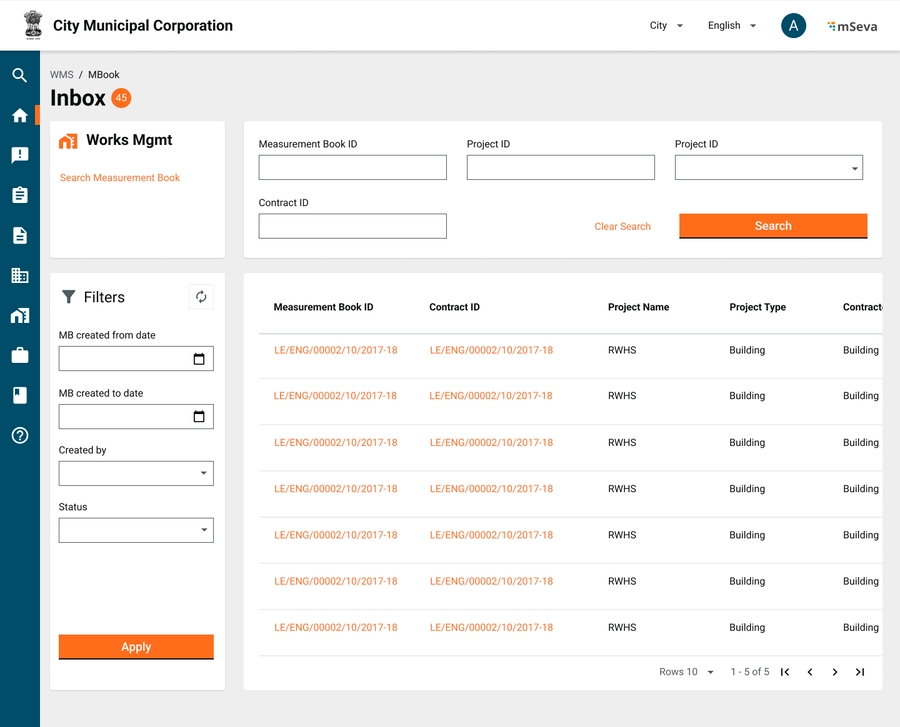
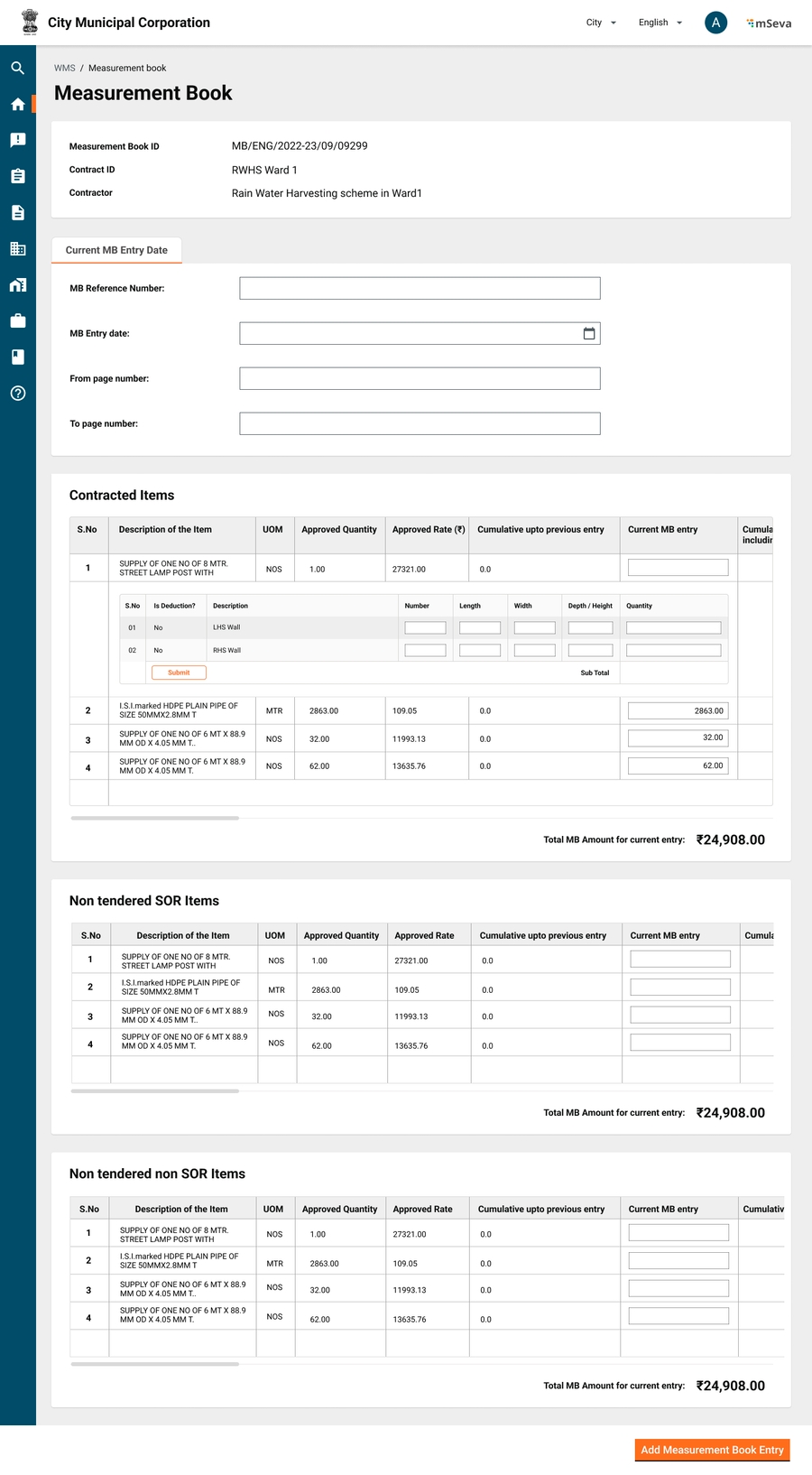
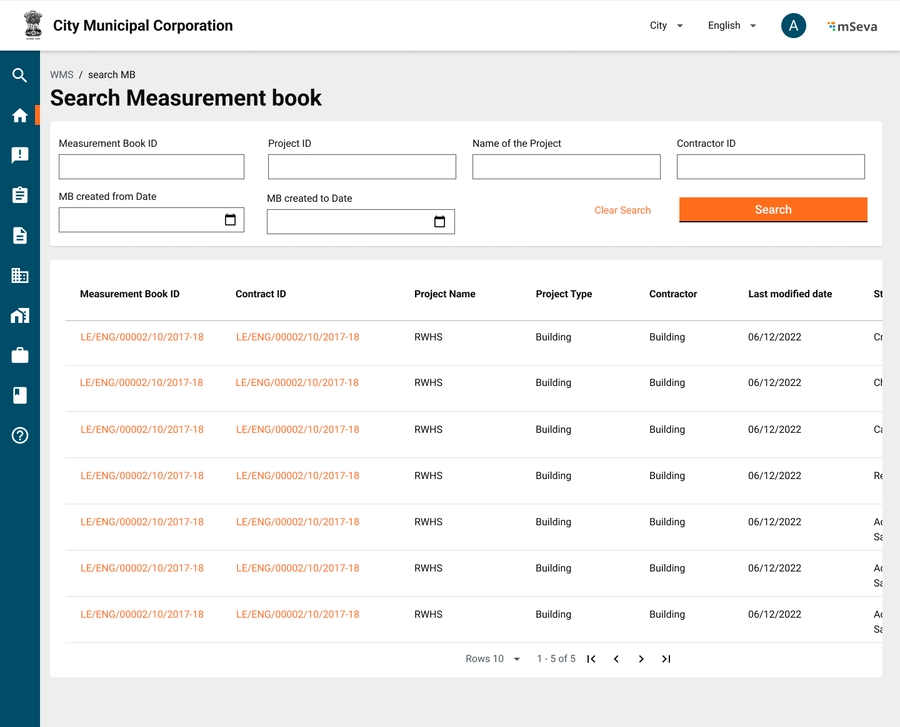

Contract Type
Status
Contract Amount
The detailed product roadmap is given below:
1. USER AUTHORISATION AND AUTHENTICATION
1.1. UAA-01: User Authorisation
v1.0
June'23
1.2. UAA-02: User Login
v1.0
ULB: Estimate Creator (Same as existing)
A detailed estimate creation screen to be provided.
The attributes defining detailed estimate are given in below table.
#
Field Name
Data Type
Is Mandatory?
Description
1
Estimate Type
Display
Yes
Estimate type, Original.
2
Project ID
Display
Yes
Note: Attachment section to be changed to remove detailed estimate as attachment.
Save as Draft - It is to save the details captured for detailed estimate and keeping it with creator.
Generate Analysis - Generate the analysis statement out of saved detailed estimate details.
Submit - It is the same as per existing estimate, allow the user to forward the estimate for verification.
View Analysis Statements - It will take the user to view analysis statement HTML page.
Estimate is created with the details provided.
If it is first time, estimate no. is generated as per the format provided.
Success toast message is displayed and page is loaded again in editable mode with the details saved.
Estimate gets assigned to the creator and made available in his/her inbox with the WF state Drafted.
On open from inbox, its get opened in editable mode same as edit estimate.
This action is enabled for saved estimate only.
The estimate details are saved.
Analysis statements are revised.
Estimate is forwarded to verifier.
Success page is displayed with success message.
First time, this action is enabled for saved estimate only.
The analysis is generated and Success toast message is displayed.
View Analysis Statements link is enabled.
Analysis statements are generated successfully.
Analysis statements generation failed.
Only active SORs and active and effective rates are displayed on search SOR.
All the intermediate figures are rounded up-to 2 decimal places.
Prerequisite
SOR Rate Master
Not applicable
The given additional features are incorporated.
The workflow is changed to have the option to save the details as draft.
The drafted estimate is assigned to the creator of estimate and can be searched using search estimate.
Estimate is made available to the inbox of estimate creator as well.
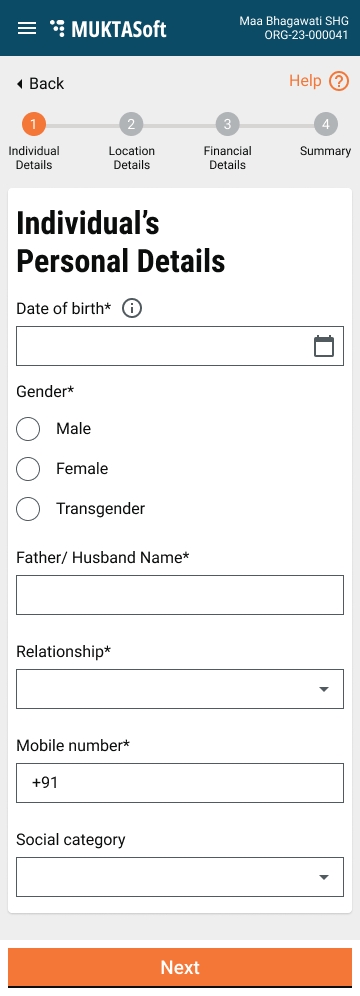
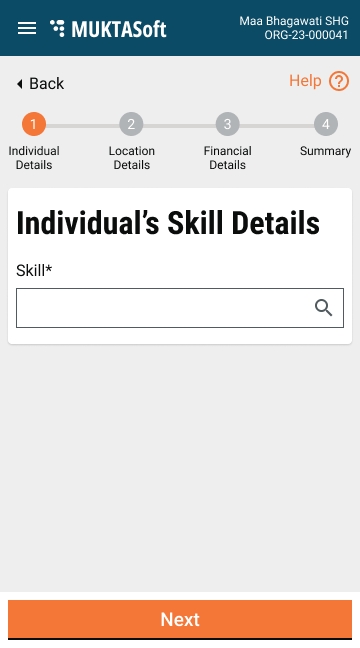
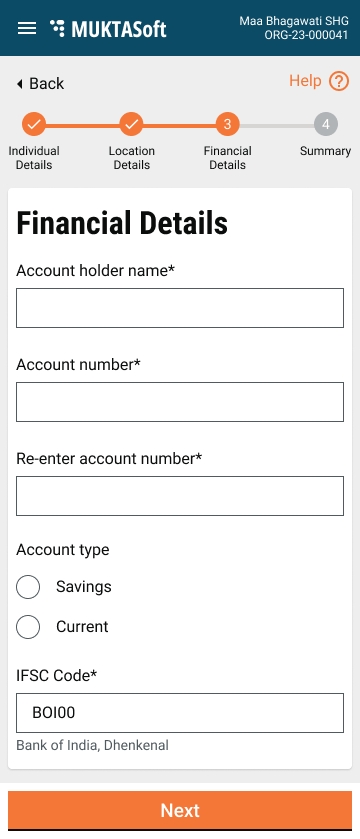
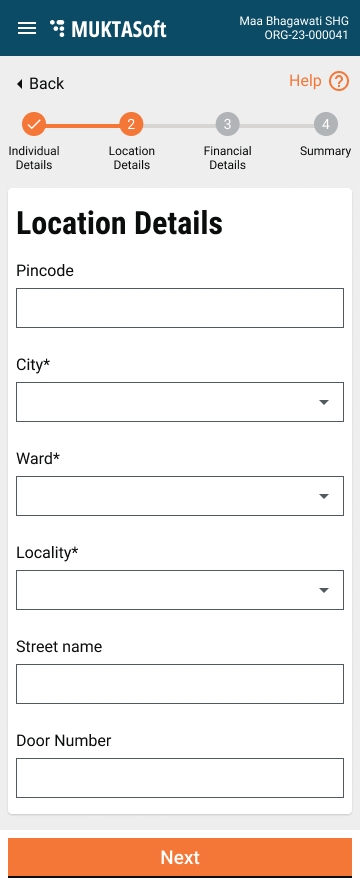
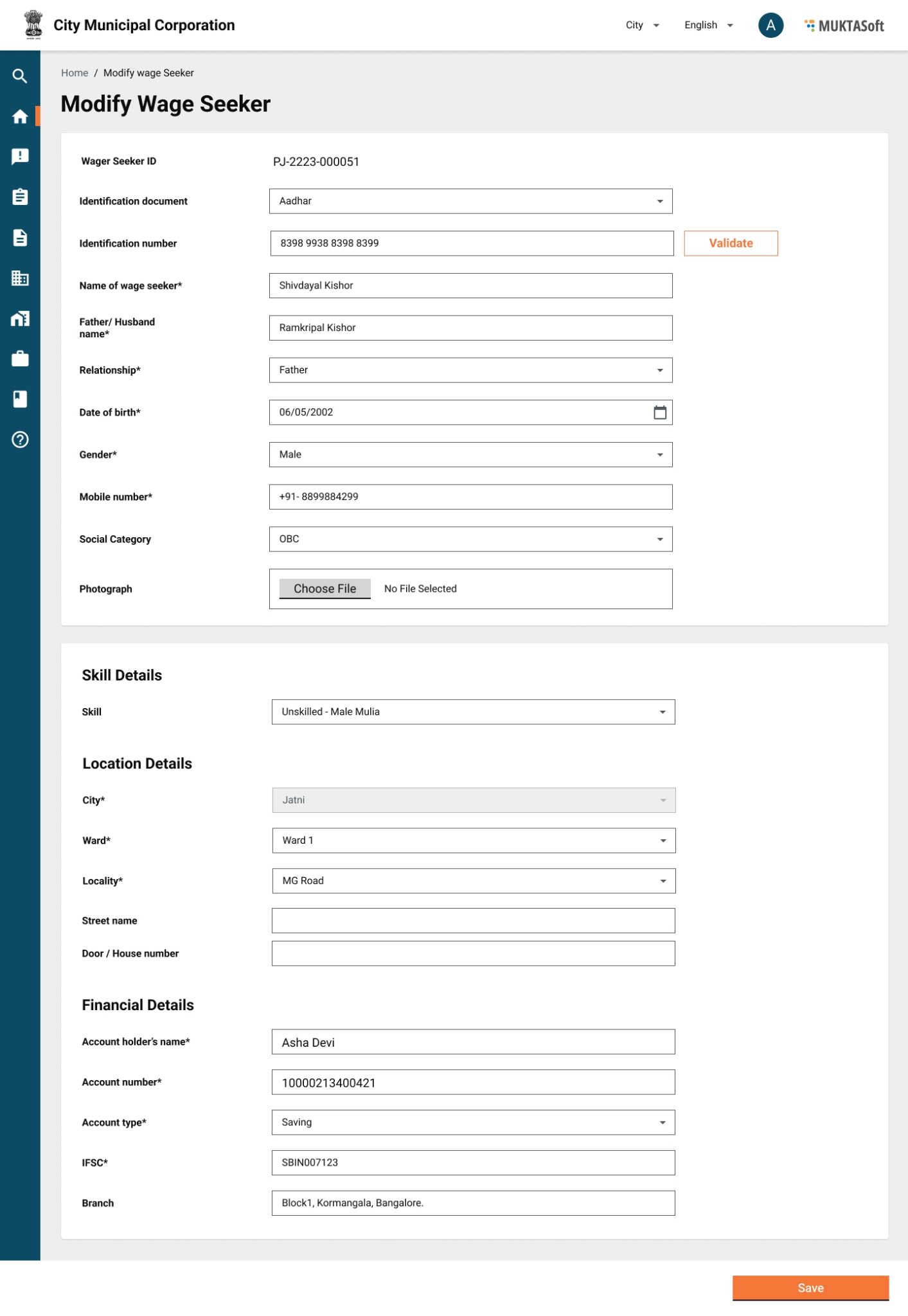
Project ID
3
Project Sanction Date
Display
Yes
Project sanction date
4
Project Name
Display
Yes
Project name
5
Project Description
Display
Yes
Project description
Search SOR
It provides the option to search a SOR and add to estimate.
SORs
1
Code
Display
Yes
SOR code, unique identifier for each SOR.
2
SOR Description
Display
Yes
SOR description from the SOR master for the selected SOR.
3
Unit
Display
Yes
Unit of measurement
4
Rate
Display
Yes
The rate defined and effective currently.
5
Quantity
Display
Yes
Calculated value out of measurements.
6
Amount
Display
Yes
Calculated value and equal to Qty*Amount.
Measurements
A table to capture the measurement details and calculate the quantity using it.
1.1
Sr. No.
Display
Auto
Measurement serial number.
1.2
Type
Drop-down
Yes
Plus/ Minus measurements.
1.3
Name
Alphanumeric
(32 Chars)
Yes
The name of the measurement.
1.4
Number (Nos)
Numeric
(6,4)
Yes
No. of items.
1.5
Length (L)
Numeric
(6,4)
Yes
Length measured. Allowed up-to 4 places of decimal.
1.6
Breadth (B)
Numeric
(6,4)
Yes
Width measured. Allowed up-to 4 places of decimal.
1.7
Height/ Depth
Numeric
(6,4)
Yes
Depth measured. Allowed up-to 4 places of decimal.
1.8
Quantity
Display
Yes
Qty = N* L*B*D; rounded up-to 4 places of decimal.
1.9
Total
Display
Yes
Grid total for the quantities of measurements. rounded up-to 4 places of decimal.
Non SORs
2
SOR Description
Alphanumeric
(2048 Chars)
Yes
SOR description from the SOR master for the selected SOR.
3
Unit
Drop-down
Yes
Unit of measurement
4
Rate
Numeric
(6,2)
Yes
The rate defined and effective currently.
5
Quantity
Display
Yes
Calculated value out of measurements.
6
Amount
Display
Yes
Calculated value and equal to Qty*Amount.
Measurements
The table is same as described under SOR.
Other Charges
It is going to be same as provided in the existing estimate screen as overhead.
7
View Analysis Statements
Link
Yes
It will take the user to analysis page. It gets enabled once the analysis is generated.
Actions
1
Save as Draft
Button
Yes
Save the estimate as a draft.
2
Generate Analysis
Button
Yes
Generates the analysis and populates the figures.
3
Submit
Button
Yes
Submit the estimate for verification.
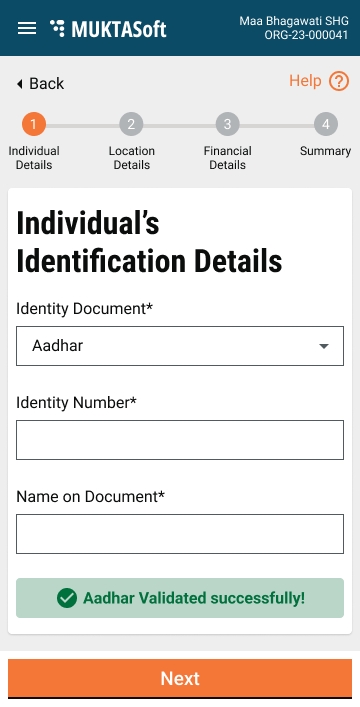
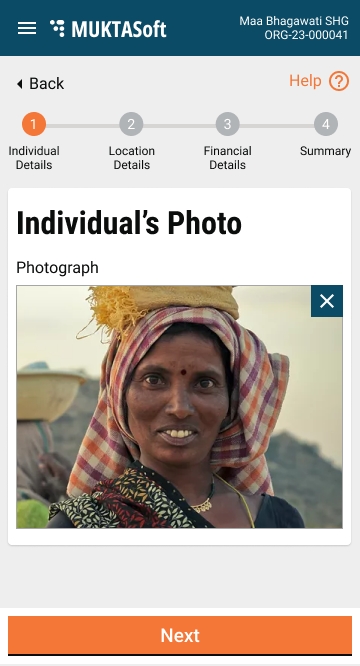
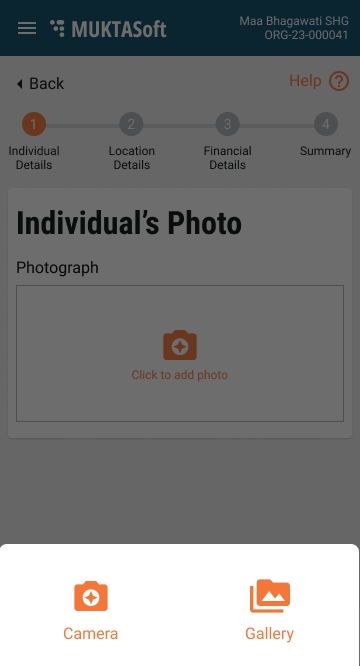
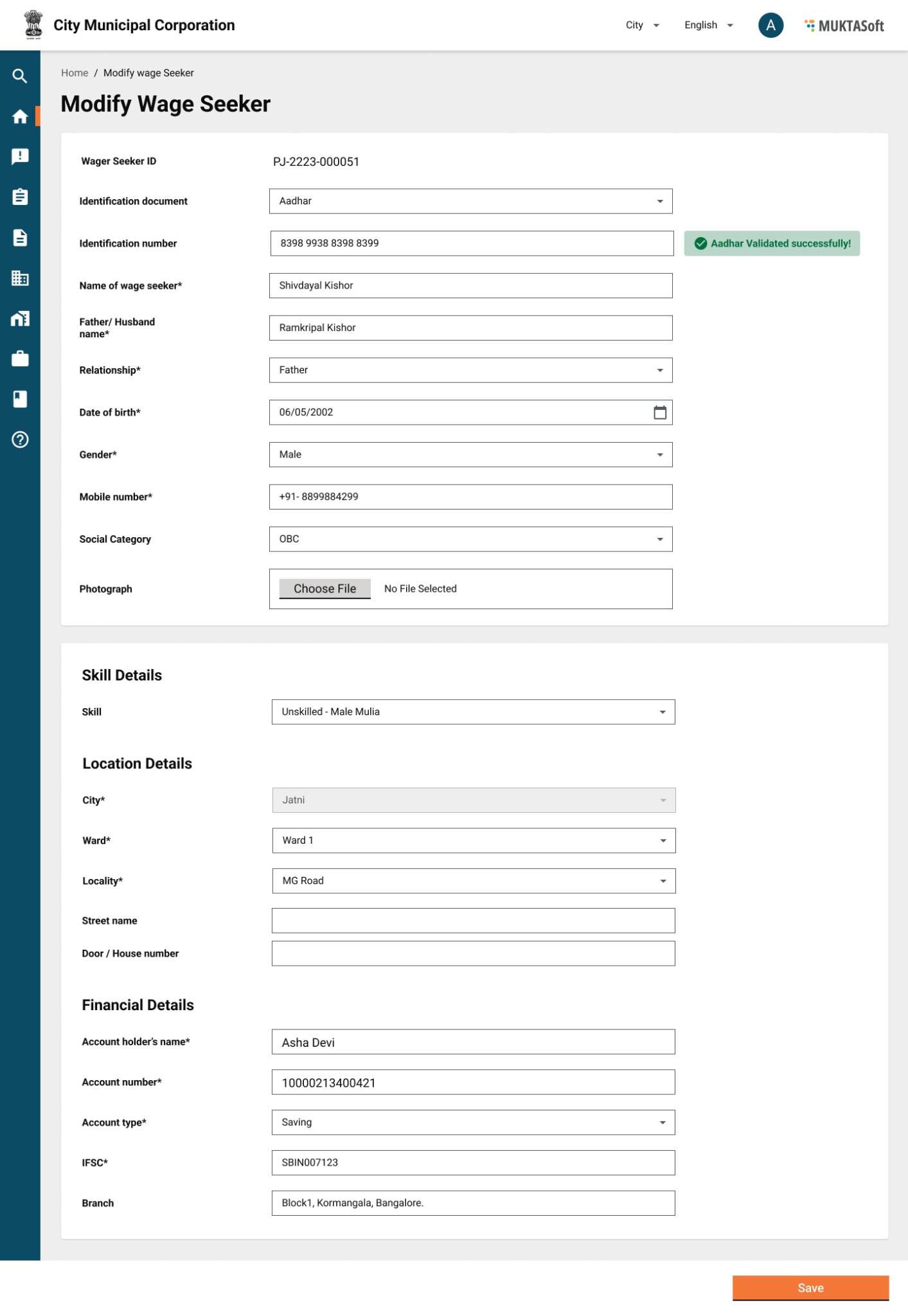
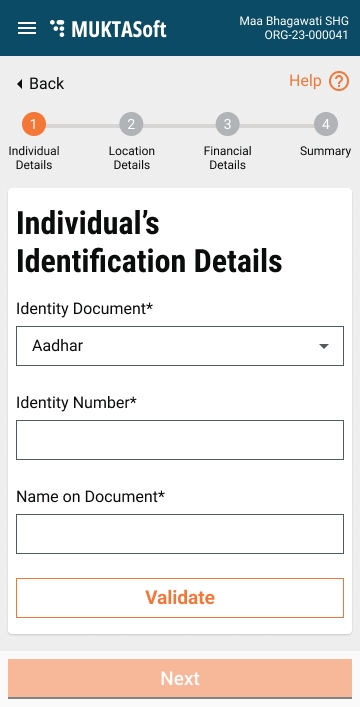
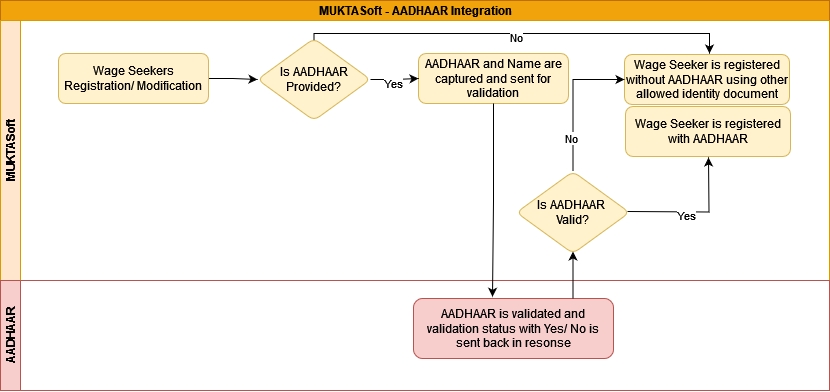
Payment Instruction
Auto Generation
Employee
Role: System
Payment instruction (PI) is the API to push the PI details into JIT.
For failed transactions, revised PI is generated and then pushed into JIT.
For each bill one PI is prepared and pushed into JIT.
PI is prepared and pushed with approval of Bill (Wage Bill, Purchase Bill, Supervision Bill).
To generate a PI, selection of HOA logic is given under configuration section.
For Request/ Response parameters, please refer the .
The response data is stored and maintained at MUKTASoft for each PI and revised PI.
Once a PI is generated can be searched and viewed using search and view PI feature.
System performs a check to decide on the HOA, It picks a HOA first out of three HOAs and check for the fund available for all the sanction orders one by one and when found sufficient fund is available, create PI.
HOAs are scanned in the sequence given below. Sequence of HOA to be selected should be configurable.
SC Head
ST Head
General Head
#
Parameter
Is Mandatory?
Description
2
jitBillNo
Yes
Payment Instruction ID of the payment instruction created in MUKTASoft and then pushed to JIT.
3
jitBillDate
Yes
Payment Instruction date of the payment instruction created in MUKTASoft and then pushed to JIT.
4
#
Parameter
Description
1
jitBillNo
Payment Instruction ID of the payment instruction created in MUKTASoft and then pushed to JIT.
2
jitBillDate
Payment Instruction date of the payment instruction created in MUKTASoft and then pushed to JIT.
3
ssuIaId
Special spending unit ID. A master value maintained in JIT-FS.
4
PI is created and saved at MUKTASoft.
Error message displayed on View Payment Instruction Page. [Message: On call of PI API: No response is received.]
PI status at MUKTASoft changes to Pending.
Beneficiary payment status update to “Payment Pending”.
Option to re-push the PI is provided, and the same time system will try to push all such PI once in a day at 9PM every day.
Error message is stored at MUKTASoft.
Error message displayed on View Payment Instruction Page. [Message: On call of PI API: <JIT error message>]
PI status at MUKTASoft updated/changes to Declined.
Beneficiary payment status updated to “Payment Pending”.
Option to re-push the PI is provided, necessary correction is made to encounter the error and PI is re-pushed.
Success response is received and same is stored at MUKTASoft.
Info message displayed on View Payment Instruction Page. [Message: On call of PI API: Response is received and updated successfully]
PI status at the MUKTASoft changes to Initiated.
Beneficiary payment status changes to “Payment Initiated”.
An expense transaction is recorded under Fund Allocation Register.
#
Response
PI Status (From)
PI Status (To)
Payment Status
User Action
API Call
1
No Response
Pending
Payment Pending
Resubmit
PI
Make sure DDO Code and SSUID are passed into requests as per the configuration. In case configuration is missing. [Message: DDO and SSUID configuration is missing.]
Make sure Net or Gross amount of Payment Instruction is not more than the total allotted amount for SSU a HOA and Sanctioned ID. [Message: Insufficient fund.]
Make sure the payment instruction ID is unique and no PI has already been pushed with same PI ID. [Message: Duplicate payment instruction ID.]
Make sure number of beneficiaries mentioned in the header should not mismatch with the actual details. [Message: Number of beneficiaries provided in header doesn’t match with the details.]
Make sure amount mentioned in the net amount should not mismatch with the total of all the beneficiaries amount. [Message: The total net amount provided in hear doesn’t match with total of all the beneficiaries.]
Make sure Gorss amount is either equal to or more than Net Amount and none of them can be zero. [Message: Gross amount can not be less than the net amount.]
Make sure at least one beneficiary is included in PI. [Message: Beneficiary detail is missing.]
Make sure total net amount is equal to sum of all the beneficiaries’ payment amount. [Message: The total net amount provided in header doesn’t match with total of all the beneficiaries.]
Make sure PI doesn’t have duplicate beneficiary. i.e. same a/c and ifsc cannot be repeated. [Message: There are 2 or more than 2 beneficiaries account number and IFSC are same.]
Beneficiaries original account no /IFSC/Bifid is not matching with correction file – Make sure parameter values passed are correct. [Message: The beneficiary <paymentid> was not present in the original payment instruction.]
Status are configured as master data.
PI Status
Pending
Declined
Initiated
Rejected
Approved
In Process
Completed
Payment Status - Beneficiary’s payment status.
Payment Pending
Payment Initiated
Payment In Process
Payment Successful
Payment Failed
Not applicable.
Not applicable.
Resubmit (*On View Payment Instruction)*
PI is re-constructed, availability of fund is checked and push and the response is updated back.
Scheduler: Same time a scheduler running every day at 10PM will try to push such PIs which are created with status Pending.
Not applicable
PI ID is generated following the format given below.
PI-<ULBCODE>/FY/<6 digit running sequence number>. E.g. PI-DK/2022-23/000023.
The Six digit running sequence no. should be running for ULB wise.
It has to be reset to 1 with start of every financial year. i.e. on 01/04 00:00AM
Payment transaction ID is generated for each beneficiary, which is unique for the every transaction. There is not specific format.
View Payment Instruction.
Make sure the the availability of fund is checked before pushing the payment instruction into JIT.
PI is generated for each and every bill and pushed to JIT with the approval of bill.
All the validations are taken care.
PI ID is generated as per the format defined.
If the PI is declined, the same PI can be modified and re-pushed.
The response is captured in MUKTASoft for debugging and error reporting.
Technical glitched in the integration are defined as error and captured.
System keep trying until a response is received. The latest response is recorded in the log.
An estimate template allows users to group necessary Schedule of Rates (SORs) for a well-defined piece of work, storing them in the system with a designated name and description. This facilitates their use in preparing estimates for similar projects.
Attributes
1
Project Type
Drop-down
Yes
Project types
2
Name
Text
Mockups
It enables the user to search a template using various parameters and see the result from where the complete detail of template can be seen clicking on the template code.
Search Criteria
1
Project Type
Drop-down
Project types
2
Template Name
Text
It is name of template
3
Search Result
1
Code
It is system generated unique code to identify the template
2
Name
Template description.
3
Description
Template description.
Mockups
It allows the user to view the details of the template and make corrections if need be using the action Modify Template.
Attribute
1
Code
A unique code generated for template.
2
Project Type
Project type for which template is defined.
3
Name
Name given to template.
Mockups
It is to enable the users to correct the already created template.
Attributes
1
Code
Display
Yes
A unique code generated for template.
2
Project Type
Drop-down
Mockups
June'23
1.3. UAA-03: User Credentials Recovery
v1.0
June'23
1.4. UAA-04: User Transfer
v1.0
June'23
2. SCHEME MONITORING (MON)
2.1. MON-01: MUKTA Fund Allocation Register
v2.2
Sep 24
2.2. MON-02: Scheme Dashboard (MUKTA Dashboard)
v1.1/ v2.1
July 24
3. REGISTERS AND DATABASES (RAD)
3.1. RAD-01: Database of Admin Units
v1.0
June'23
3.2. RAD-02: Database of Community Organizations
v1.0
June'23
3.3. RAD-03: Change Request from Community Organisation
V3
TBD
3.4. RAD-04: Database of Wage-seekers
v1.0
June'23
3.5. RAD-05: Change Request from Wage-seeker
V3
TBD
3.6. RAD-06: SMS Request from Wage-Seeker
V3
TBD
3.7. RAD-07: Database of Community Assets
V3
TBD
4. VENDORS’ EMPANELMENT AND RATE CONTRACT (VEN)
4.1. VEN-01: Items Master
V3
TBD
4.2. VEN-02: Schedule of Rates for Districts
Dropped (ULB)
4.3. VEN-03: Rate of Lead Charges for Items Groups
v2.0
Completed
4.4. VEN-04: Lead Distance Master for Items Groups for ULB
Dropped (ULB)
4.5. VEN-05: Schedule of Rate for ULBs
v2.0
Completed
4.6. VEN-06: Vendor Registration
V3
TBD
4.7. VEN-07: Annual Vendor Empanelment
V3
TBD
5. MOD 5: Finalization of Identified Public Works (WOR)
5.1. WOR-01: Wishlist of Works
V3
TBD
5.2. WOR-02: Feasibility Study and Observation Recording
V3
TBD
5.3. WOR-03: Final Worklist
V3
TBD
6. WORKS ESTIMATE, TS, AA (WES)
6.1. WES-01: Template Designer & Library
v2.1
July'24
6.2. WES-02: Works Estimate & Plan
v1.0/ v2.0
Feb'24
6.3. WES-03: Technical Sanction
v1.0
June'23
6.4. WES-04: Administrative Approval
v1.0
June'23
7. Work Order & Wage Seeker Engagement (ORD)
7.1. ORD-01: EoI Format Definition
Dropped (ULB)
7.2. ORD-02: EoI Invitation
Dropped (ULB)
7.3. ORD-03: EoI Submission
Dropped (ULB)
7.4. ORD-04: Rank List of Community Organization
V3
7.5. ORD-05: Issue of Work Order
v1.0
June'23
7.6. ORD-06: Cancellation of Work Order
v2.4
March'25
8. Attendance of Wage Seeker
8.1. EMR-01: Wage Seeker Engagement/ Disengagement
v1.0
June'23
8.2. EMR-02: Attendance Record (e-Muster-Roll)
v1.0
June'23
8.3. EMR-03: Record Attendance (m-Muster)
Dropped (ULB)
9. Work Execution
9.1. EMB-01: Commencement of Work
V3
TBD
9.2. EMB-02: Record Progress (e-MB)
v2.0
Feb'24
9.3. EMB-03: Record Progress (m-MB)
Dropped (ULB)
9.4. EMB-04: Works Review and Closure
v2.3
Sep'24
10. Purchase of Materials and Hiring of Equipment
10.1. PUR-01: Issue of Purchase Order
V3
TBD
10.2. PUR-02: Acknowledgement of Material/ Equipment Receipt from Vendor
V3
TBD
10.3. PUR-03: Vendor Invoicing
V3
TBD
10.4. PUR-04: Penalty for Vendor
V3
TBD
10.5. PUR-05: Cancellation of PO
V3
TBD
11. Billing & Payment Disbursement
11.1. PAY-01: Bill Preparation & Payment
v1.1
August' 23
IFMS - JiT Integration
v1.1
August' 23
Sujog - Accounting
V3
TBD
12. TRAINING AND KNOWLEDGE SHARING
12.1. TRA-01: Training Content Cataloguing and Repository
V3
TBD
12.2. TRA-02: Training Scheduler
V3
TBD
12.3. TRA-03: Assessment & Feedback
V3
TBD
13. GRIEVANCE REDRESS & CHATBOT
13.1. GRV-01: Grievance Registration
V3
TBD
13.2. GRV-02: Grievance Assignment and Resolution
V3
TBD
13.3. GRV-03: Grievance Feedback and Closure
V3
TBD
13.4. GRV-04: Chat-bot
V3
TBD
14. Social Audit and Compliance
14.1. SOC-01: Social Audit Planner
V3
TBD
14.2. SOC-02: Social Audit Agency Engagement
V3
TBD
14.3. SOC-03: Audit Register
V3
TBD
14.4. SOC-04: Audit Compliance and Report
V3
TBD
Additional
New Feature
Rate Analysis
v2.1
July'24
New Feature
Revise Estimate
v2.0
Completed
New Feature
Time Extension
v1.1
Completed
New Feature
AADHAAR Integration
v2.1
July'24
New Feature
NPCI Integration:
v2.3
Sep'24
New Feature
Mobile MB
v2.1
July'24
New Feature
Data Privacy Enhancements
v2.4
March'25
New Feature
Assetization
V3
TBD

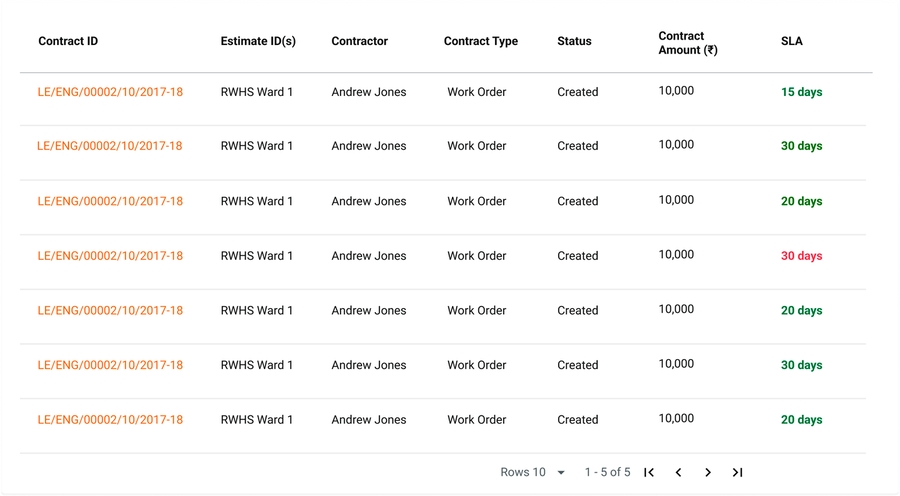
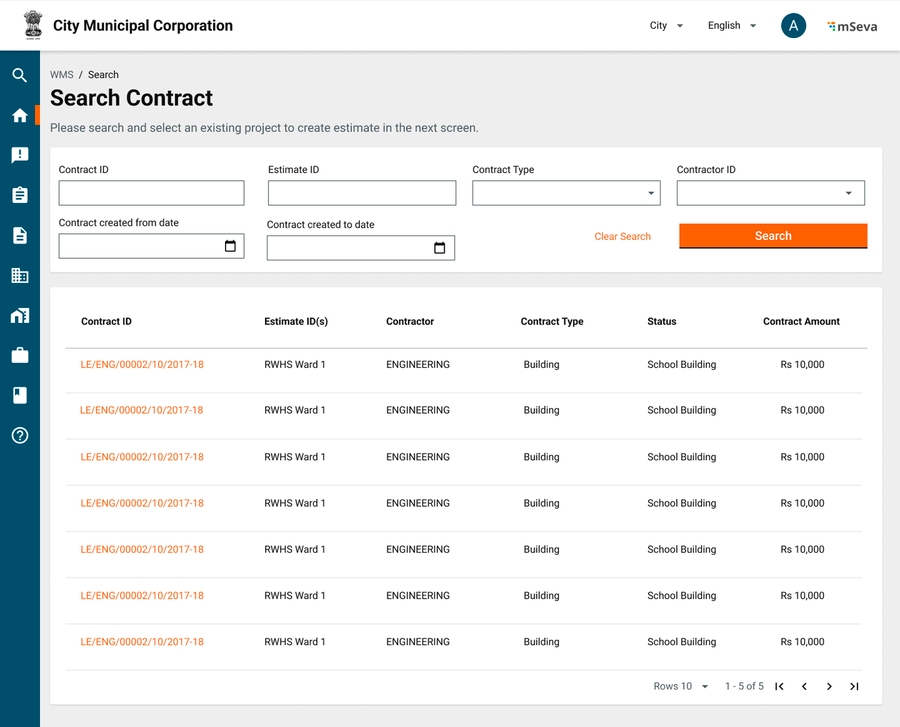
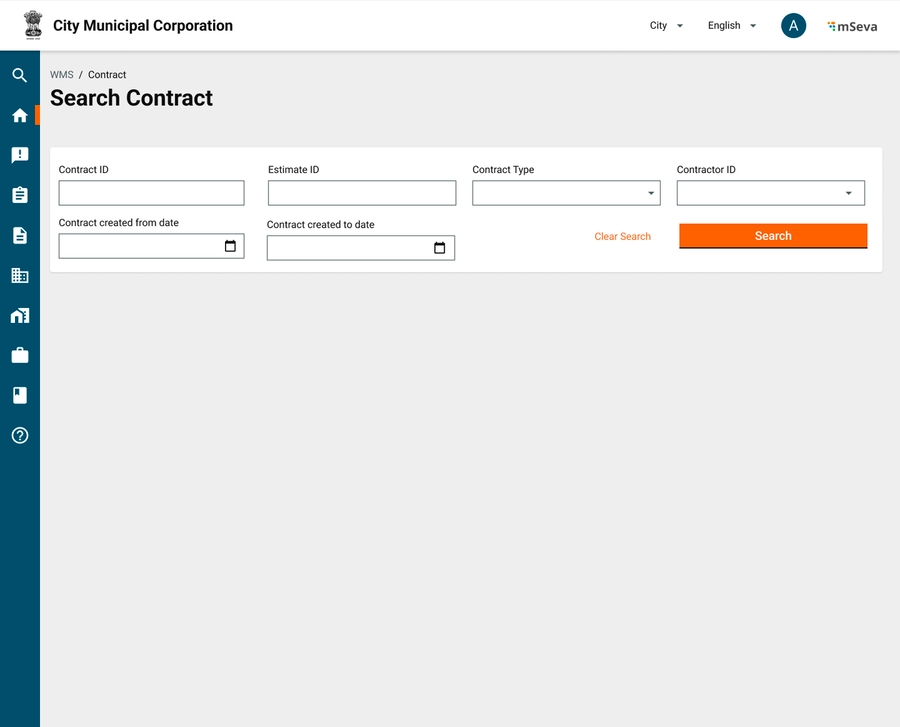
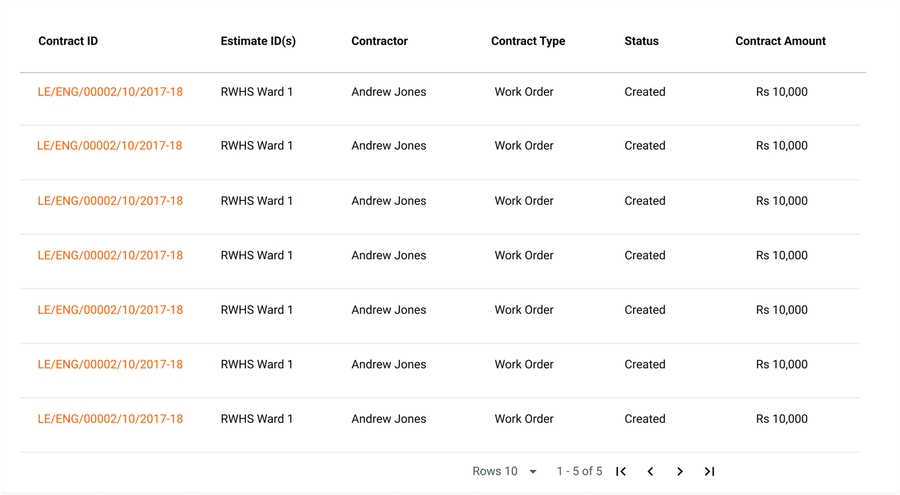
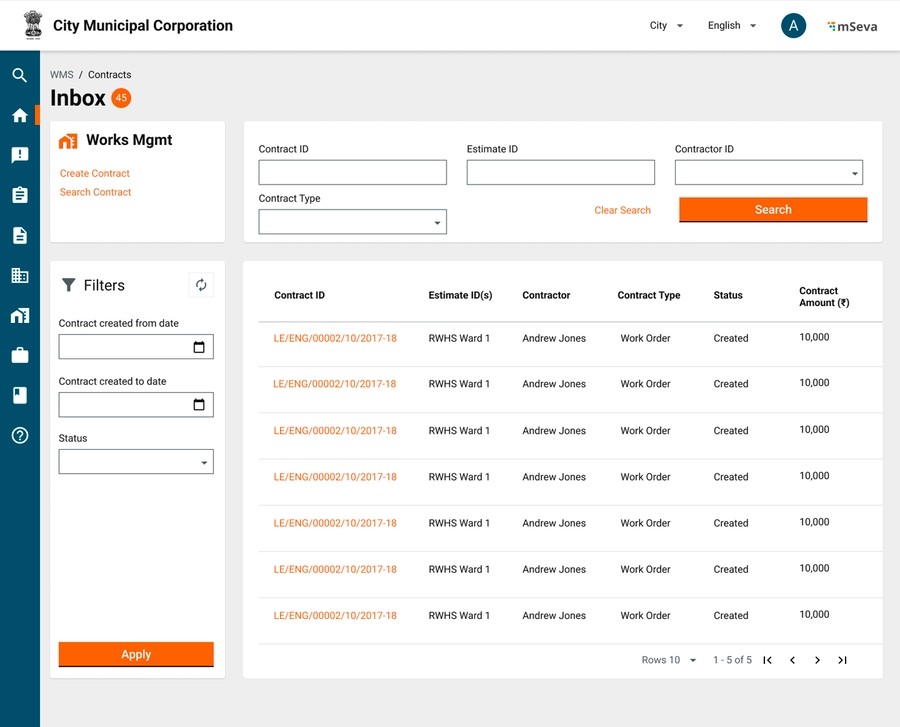
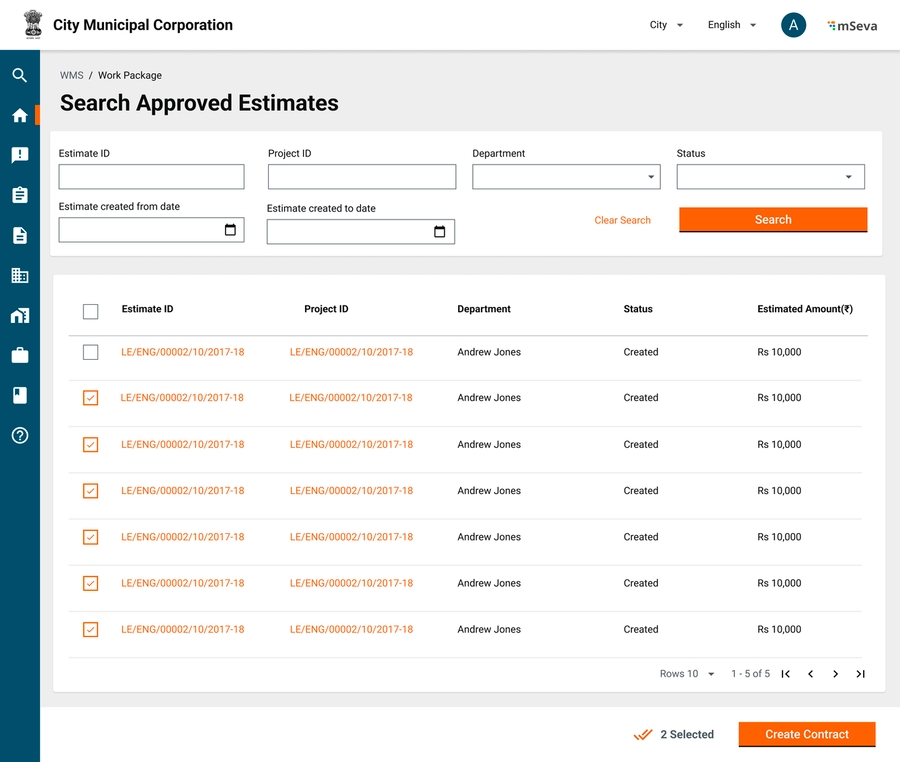
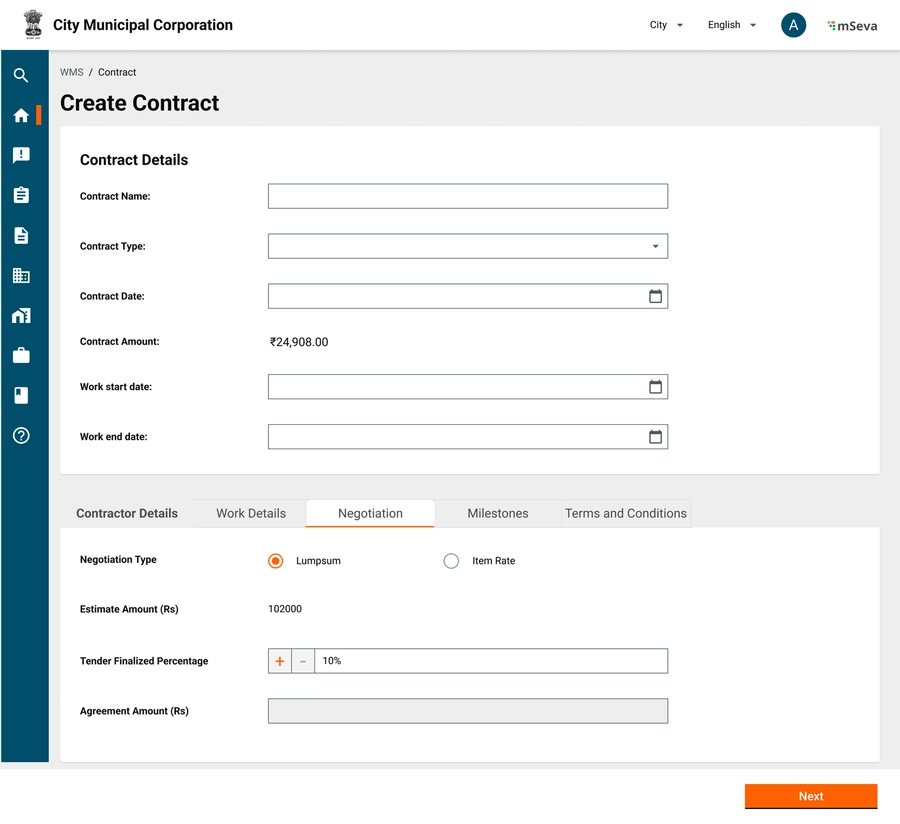

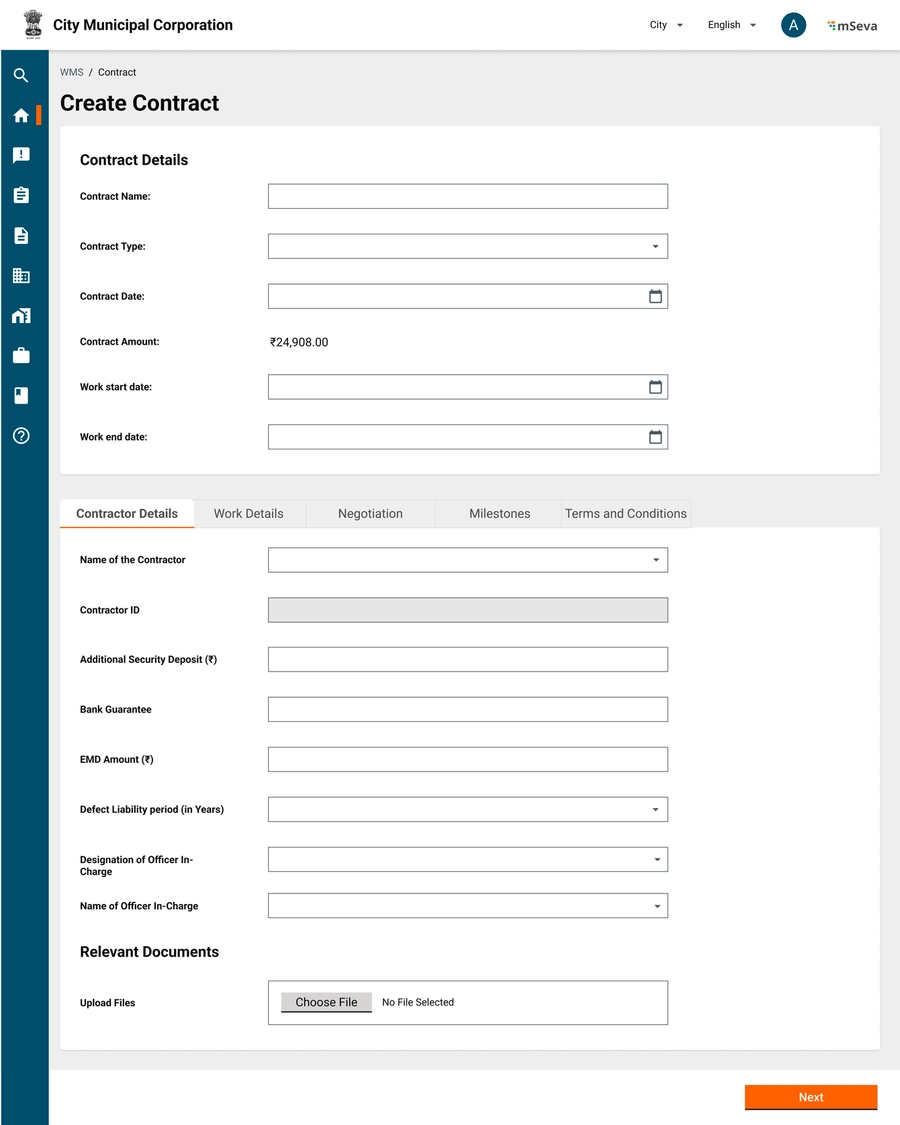
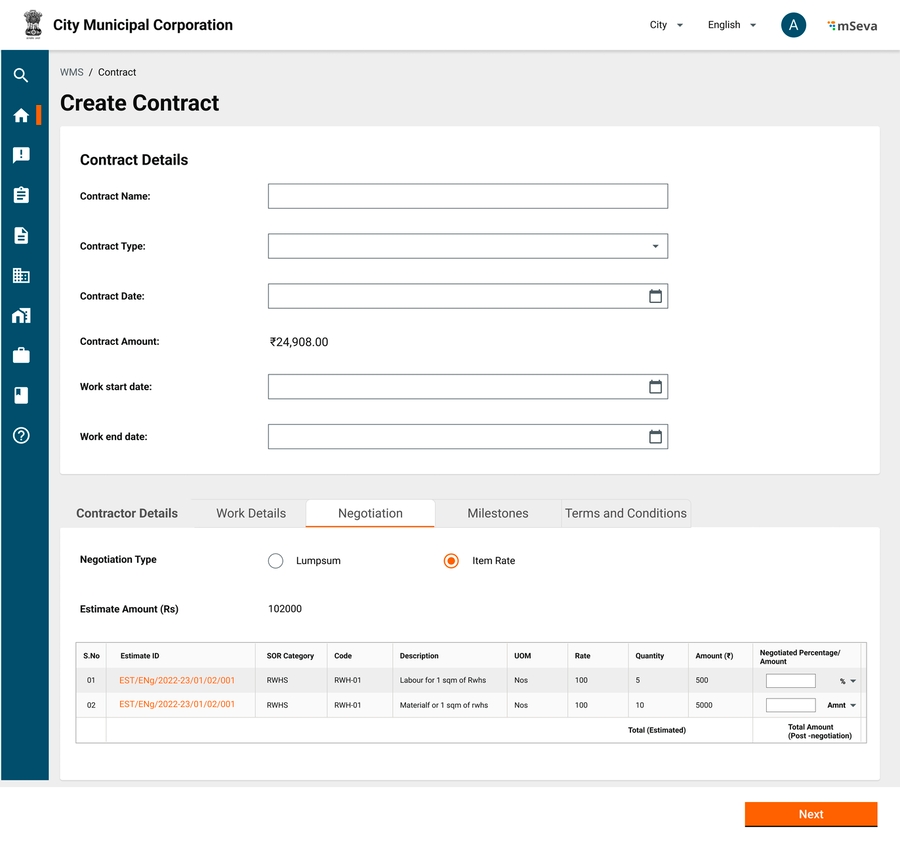
jitBillDdoCode
Yes
The code of DDO from the configuration.
5
granteeAgCode
Yes
Grantee code from the configuration.
6
schemeCode
Yes
MUKTA scheme code
7
hoa
Yes
Head of account from which payment to be made.
8
ssuIaId
Yes
Special spending unit id from the configuration.
9
mstAllotmentDistId
Yes
Virtual allotment parent ID/sanction ID from which payment to be made.
10
billNetAmount
Yes
PI net amount of the payment instruction created in MUKTASoft and then pushed to JIT.
11
billGrossAmount
Yes
PI gross amount of the payment instruction created in MUKTASoft and then pushed to JIT.
12
billNumberOfBenf
Yes
The count of beneficiaries in the payment instruction.
13
purpose
Yes
Purpose is the reference text. E.g. Muster Roll ID etc. for which the payment instruction is created.
Beneficiary Details
Array
In a single request multiple beneficiaries can be added.
14
benefId
Yes
The beneficiary's Payment ID, unique for each beneficiary for its payment. Payment of the beneficiary is tracked by this throughout the payment processing. It is generated with the PI generation.
15
benefName
Yes
Beneficiary name maintained in MUKTASoft.
16
benfAcctNo
Yes
Beneficiary’s bank account number maintained in MUKTASoft.
17
ifscCode
Yes
IFSC of bank branch from beneficiary’s accounts details.
18
benfMobileNo
Yes
Beneficiary's mobile number maintained in MUKTASoft.
19
benfAddress
Yes
Beneficiary’s address maintained in MUKTASoft.
20
accountType
Yes
Account type of beneficiary’s account maintained in MUKTASoft
21
paymentAmount
Yes
Amount payable to beneficiary.
22
panNo
No
PAN of beneficiary
23
adhaarNumber
No
Aadhaar of beneficiary
24
purpose
Yes
Purpose is the reference text. E.g. Muster Roll ID etc. for which the bill is created.
successCode
0 - for successfully accepting the PI.
7
sucessDescrp
Jit Bill is received successfully ,Payment Instruction will be generated after Bill is submitted by SSU in JIT-FS
2
Response with Error
Pending
Declined
Payment Pending
Resubmit
PI
3
Response Without Error
Pending/ Decline
Initiated
Payment Initiated
No Action
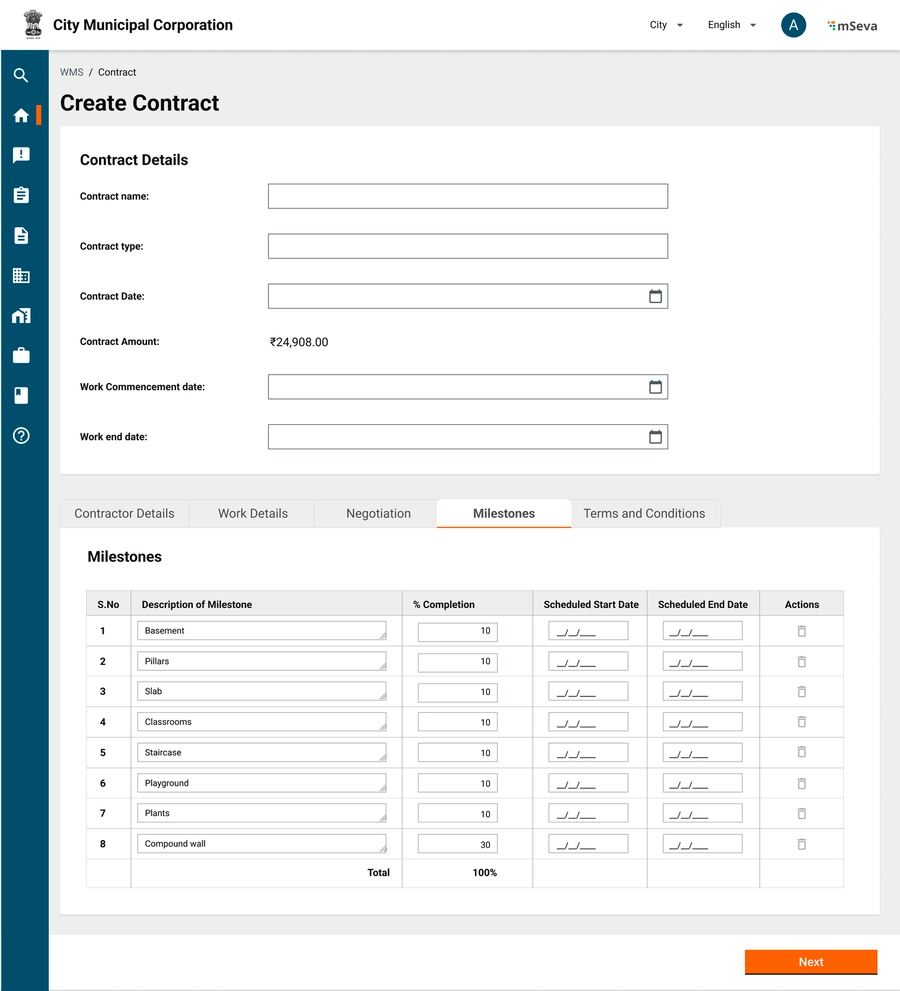
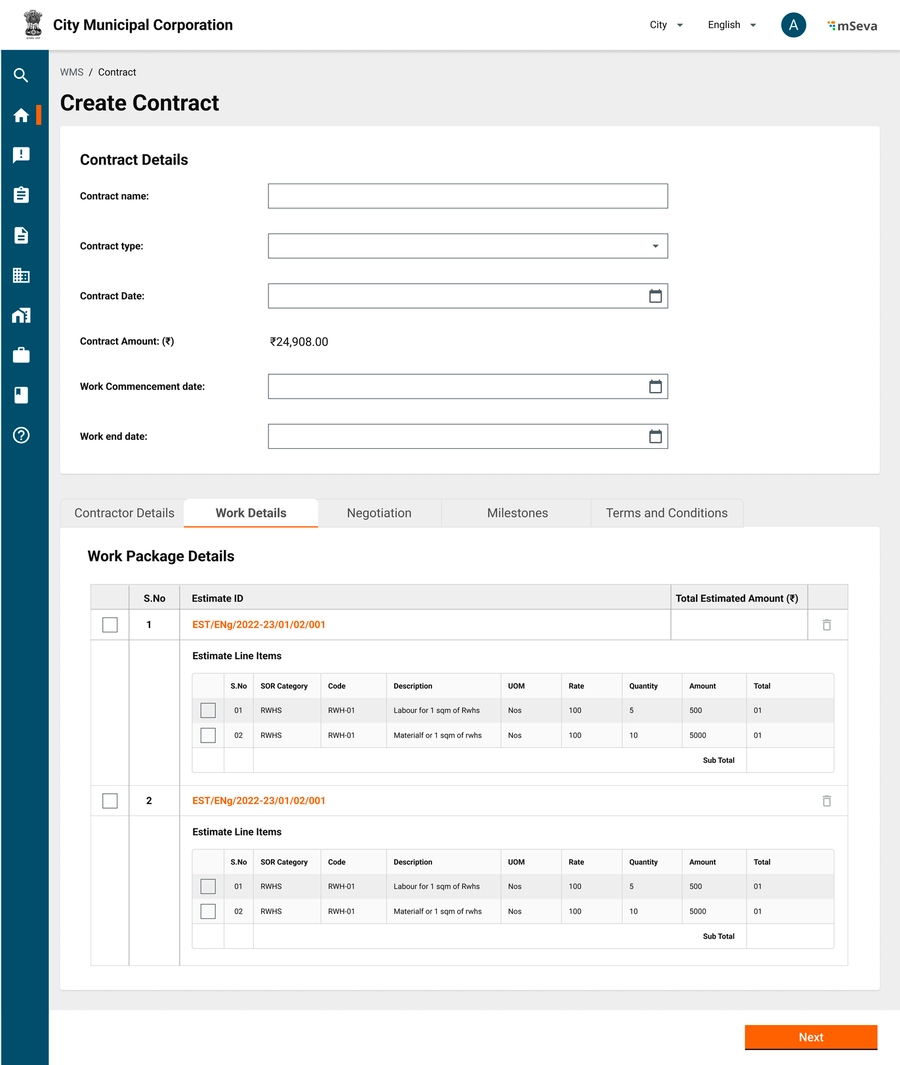
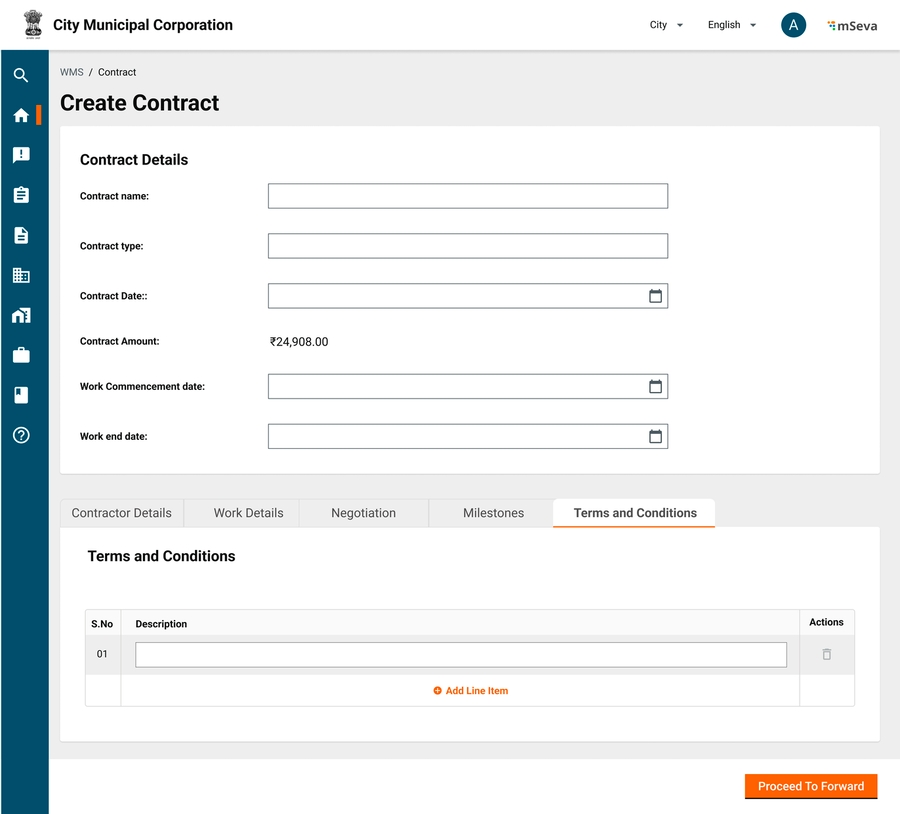
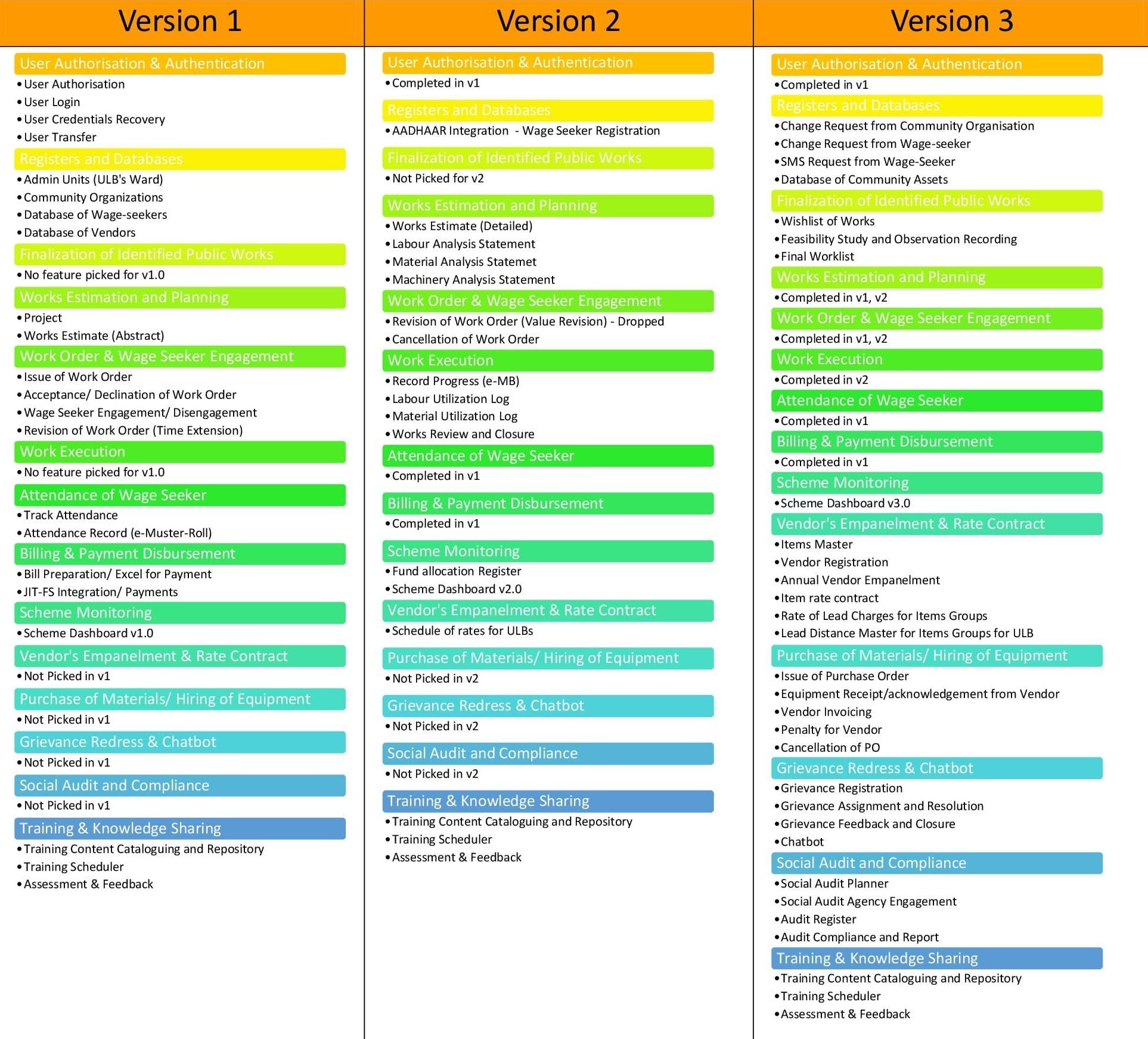
Yes
Name given to template.
3
Description
Text
Yes
The description, describing the template in detail.
4
Search SOR
Search
Yes
To search an SOR and add to the template.
5
SORs
5.1
Sr. No.
Display
Yes
Serial number.
5.2
Description
Display
Yes
SOR description
5.3
Unit
Display
Yes
Unit of measurement
6
Non SORs
6.1
Sr. No.
Display
Yes
Serial number.
6.2
Description
Text
Yes
Non SOR description
6.3
Unit
Drop-down
Yes
Unit of measurement
Template Code
Drop-down
It is system generated unique code to identify the template
4
Status
Drop-down
Active/ Inactive.
4
Status
Active/ Inactive.
4
Description
The description, describing the template in detail.
5
Is Active
Status of template, Active/ Inactive.
5
SORs
5.1
Sr. No.
Serial number.
5.2
Description
SOR description
5.3
Unit
Unit of measurement
5.4
Rate
Rate of SOR
6
Non SORs
6.1
Sr. No.
Serial number.
6.2
Description
Non SOR description
6.3
Unit
Unit of measurement
6.4
Rate
Rate of Non SOR
Yes
Project types
3
Name
Text
Yes
Name given to template.
4
Description
Text
Yes
The description, describing the template in detail.
5
Is Active
Drop-down
Yes
Active/ Inactive
Search SOR
Search
Yes
To search an SOR and add to the template.
6
SORs
6.1
Sr. No.
Display
Yes
Serial number.
6.2
Description
Display
Yes
SOR description
6.3
Unit
Display
Yes
Unit of measurement
7
Non SORs
7.1
Sr. No.
Display
Yes
Serial number.
7.2
Description
Text
Yes
Non SOR description
7.3
Unit
Drop-down
Yes
Unit of measurement


This section gives information related to Organisation Services. An organisation can be any contractor/vendor/business unit that works with the government and helps in citizen service delivery.
A contractor/vendor is someone who does projects with the government. Every Project, after estimation approval and tendering, will have to be assigned to a contractor/vendor for it to be executed.
Works contractors bid for or are assigned works' contracts depending on the mode of entrustment for specific projects
Process of registering a contractor.
Each contractor organisation is given a contractor class/grade depending on the screening/validation process.
Following are the fields required to grade contractors. This constitutes the MDMS data.
A contractor organisation has a class associated with at least one department; type and subtype based on what the organisation supplies to the government, staff details to know who is managing the organisation and financial details to make payments.
Create Detailed Measurement Book
Home > Measurement Book> MB Inbox > Create MB
ULB: MB Creator
A detailed measurement book creation screen to be provided.
From view work order page, action Create MB is provided.
The attributes defining detailed measurement are given in below table.
Save as Draft - It is to save the details captured for detailed MB and keeping it with creator.
Generate Utilization- Generate the utilization statement out of saved detailed MB details.
Submit - It is to allow the user to forward the MB for verification.
View Utilization Statements - It will take the user to view utilization statement HTML page.
MB is created with the details provided.
If it is first time, MB number and MB reference number are generated as per the format provided.
Success toast message is displayed and page is loaded again in editable mode with the details saved.
MB gets assigned to the creator and made available in his/her inbox with the state Drafted.
This action is enabled for saved (Drafted) MB only.
The MB details are saved.
Utilization statements are revised.
MB is forwarded to verifier.
First time, this action is enabled for saved (Drafted) MB only.
The utilization is generated and success toast message is displayed.
View Analysis Statements link is enabled.
Utilization statements are generated successfully.
Utilization statements generation failed.
MB period shall follow the muster roll period for each project.
Only active SORs and active and effective rates are displayed on search SOR.
All the intermediate calculated figures are rounded up-to 2 decimal places.
All the measurements can be entered into up-to 4 decimal places.
MB Number
MB/FY: yyyy-yy/SEQUENCE (6 Digits)
MB/2023-24/000091.
MB Reference Number
MB/FY: yyyy-yy/SEQUENCE (6 Digits)/ XX
Here XX 2 digit running sequence no.
MB/2023-24/000091/01
Not applicable
First MB
Second Onward
MB form is designed as per the wire-frame provided.
Each MB entry goes for approval.
Measurements entered are allowed to be captured up to 4 decimal places.
The amount calculated is rounded up to 2 decimal places.
3
Project sanction date
Display
NA
Project sanction date
4
Project Location
Display
NA
Project location
5
Project Name
Display
NA
Project name
6
Project Description
Display
NA
Project description
7
View MB History
Link
NA
In case second onward MB entries, to show the measurement history in the format given below.
MB History - It is displayed for second onward MB entries.
1
Sr. No
Display
NA
Serial number
2
MB Reference Number
Display
NA
Measurement reference number
3
MB Date
Display
NA
Measurement date
4
MB Period
Display
NA
Measurement period
5
MB Amount
Display
NA
Measurement amount
6
Status
Display
NA
Status of the measurement.
MB Period - It has to follow muster roll muster roll period.
1
From Date
Date
Yes
The date from which measurement is taken. In case not the first MB, auto filled with previous MB’s To Date +1.
2
To Date
Date
Yes
The date till which measurement is recorded.
SORs
1
Type
Display
Yes
SOR Sub type as provided in estimate
2
Code
Display
Yes
SOR Code as provided in estimate
3
SOR Description
Display
Yes
SOR description as provided in estimate
4
Unit
Display
Yes
Unit of measurement as provided in estimate
5
Rate
Display
Yes
Rate per unit as provided in estimate.
6
Quantity
Display
Yes
Quantity calculated from measurement captured.
7
Amount
Display
Yes
Calculated from Rate*Quantity. Rounded up to 2 decimal places.
Measurements
1.1
Sr. No.
Display
Auto
Serial number of measurement
1.2
Type
Display
Auto
Plus/ Minus from estimate.
1.3
Name
Display
Auto
The name of the measurement from the estimate.
1.4
Number (Nos)
Numeric
(6,4)
Yes
No. of items if the unit of measurement is number.
1.5
Length (L)
Numeric
(6,4)
Yes
Length measured for completed work.
1.6
Breadth (B)
Numeric
(6,4)
Yes
Width measured for completed work.
1.7
Height/ Depth (D)
Numeric
(6,4)
Yes
Depth measured for completed work.
1.8
Quantity
Display
Yes
Qty = N*L*B*D; rounded up-to 4 decimal places.
1.9
Total
Display
Yes
Grid total for the quantities of measurements, rounded up-to 4 decimal places.
Non SORs - The above is repeated for Non SORs also except Type and Code.
View Utilization Statements - A link to view the utilization statements in HTML view.
Worksite Photos
Tab
7
Worksite Photo
Upload File
Yes
5 photos JPG and PNG images are supported.
Actions
1
Save as Draft
Menu
Yes
Action to save the measurement record as draft.
2
Generate Utilization
Menu
Yes
Action to generate measurement statements out of measurements recorded.
3
Submit
Menu
Yes
Action to submit the measurement book for verification
View MB History - To display all the MBs created so far as per the detail provided in the table above.
On open from inbox, its get opened in editable mode same as edit estimate.
Success page is displayed with success message.
Attachment section to attach the site photos.
#
Field Name
Data Type
Is Mandatory?
Description
1
Work order number
Display
NA
Work order number
2
Project ID
Display
NA
Project ID
A contractor can have multiple staff that manage contractor organisation with permissions
List of things done by contractors for a project -
(Offline) Bid for contracts
(Offline)Negotiate contracts
(Offline)Accept Letter of Intent
(Offline) Issue Letter of Acceptance
(System) Accept/Reject Contract
(System) Track Work Measurements
(System) Track Attendance Measurements
(System) Create Running/Final Bills
(System) Download and upload relevant documents
Y
Minimum value of work that can be assigned to the contractor of the grade
Maximum Amount
Numeric
Y
Maximum value of work that can be assigned to the contractor of the grade
Y
Name of the Organisation
Organisation ID
Alphanumeric
N
Offline reference of Organisation ID given by govt
Formation Date
Date
N
Date of Formation of Organisation
Contractor Class
Drop down
N
Options will be list of contractor grades from the contractor grades master
Organisation Type
Multi Select Dropdown
Y
Contracts should be awarded to organisations who are of certain type. A Contractor registered as Vendor(material suppier) can only be awarded material contract
Ex - Contractor, Materials Supplier, Mixed
Organisation Sub Type
Multi Select Dropdown
N
Subset of type of organisation
Ex - Vendor - Sand, cement, concrete, paint etc Contractor - NA Mixed - NA
Status
Drop down
Y
Options will be the list of Contractor status maintained by the ULB
Active
Inactive
Black listed
Registered by department
Drop down
N
Options will be list of the departments of the ULB defined in the department master
Public Works Department, Water Department, Education Department
Registered date
Date
N
Date of registration with the department
Valid From Date
Date
N
The date from which the specified status is applicable to the contractor
Valid To Date
Date
N
The date until which the specified status is applicable to the contractor
Documents
Attachment
N
Upto 3 files max of 2 MB each
Location Details
Address
Alphanumeric
N
Contractor address using boundary hierarchy - Locality, Ward, ULB, District etc
Billing Address
Alphanumeric
N
Contractor address using boundary hierarchy - Locality, Ward, ULB, District etc
Contact Details
Owner Name
Alphanumeric
Y
Name of the owner
Owner Mobile number
Numeric
Y
Mobile Number of the owner
Owner e-mail address
Alphanumeric with special chars
N
Email of the owner
Contact person Name
Alphanumeric
Y
Name of the contact person
Contact person mobile number
Numeric
Y
Mobile Number of the contact person
Contact person email address
Alphanumeric with special chars
N
Email of the contact person
Total Members
Numeric
N
Number of members in the organisation
Financial Details
Account Name
Alphabet
Y
Name of the Bank Account
Account Type
Drop down
N
Savings, Current, Loan, Credit
Account Number
Alphanumeric
Y
Account number of the contractor against which payments will be made
Transfer Code
Drop down
Y
MDMS Data for selection of type of unique transfer code per bank account
Ex. IFSC Code
Bank Name
Drop down
N
Options will be a list of banks specified in the banks master. Used to select the bank where contractor’s account is maintained for direct bank payment
Bank Branch
Drop down
N
Tax Identifiers
Table Select Dropdown
N
Table with multiple identifier types List
GSTIN
PAN
TIN
User to enter identfier values for each identifier type
[Array] Staff Details
Staff ID
NA
NA
System generated ID of the staff that is prepopulated because of search by phone number
Staff Name
Name of staff
Staff Role
Dropdown
Y
Role Assigned to StaffAdmin - Role that allows all actions within the organisation including adding new members to organisationManager - Role allows only functional activities like accepting contracts, creating bills etc
Staff Designation
Dropdown
N
Designaton of the staff
Owner, President, Secretary, member etc
Employement start date
Date
N
Start date of the employement
Employement end date
Date
N
End date of the employement
Employment status
Dropdown
Y
Active, Inactive status of the employee
Once the Staff Details are added, a success message is displayed stating that the staff has been added successfully to that organisation.
Grade
Alphanumeric
Y
Unique field
Description
Alphanumeric
Y
Description of the grade
Minimum Amount
Organisation Details
Vendor ID
NA
NA
System Generated unique code assigned to the contractor
Format: VO-<FY>-<6 digit running sequence number> - VO-2022-23-000001
Organisation Name
Users with permission to Create Master records have to click on Masters on the home page to navigate to the Masters landing page.
On this page, the user has to select Vendor Organisation in the drop-down (one of the few registries that are available to edit/add from UI) and click on Search.
Users are shown records of existing vendors and the option to add new Vendor Organisation.
Clicking on Add New Organisation redirects users to Create New Organisation page.
Create Organisation page has 4 Tabs along with header details.
Attributes and explanations for each are mentioned in the attribute table above.
Vendor ID is the unique ID generated by the system with a specific format.
Organisation ID is the ID given to each vendor during offline registration.
The system checks the organisation ID to ensure that no existing record is present and avoid de-duplicating. This check can be performed by clicking on the Next button on the first screen.
Location Details have HQ address and Billing Address.
The selection of location details in the hierarchy limits the results to that selected boundary in the next hierarchy.
The check box copies the details of the HQ address to the Billing address and makes the fields non-editable.
The staff details tab is not accessible until the vendor organisation is created. The Show Info icon alongside staff states “Organisation needs to be created to add staff and staff details”
Contact Details have owner info and contact person info.
Name and Phone number of both are made mandatory.
System should check if user with this phone number is present already in user registry and if not create a new user.
Designation for Owner is auto-assigned in the staff details as the owner
The role of the owner defaults to admin and manager.
The designation and role of the contact person are kept open.
The checkbox shows the default details of the contact person same as the details of the owner and creates a single user.
Financial details of the organisation captures bank account details where payments are to be made.
Transfer code has single identifier type per bank account. List will have only IFSC code for now. User has to input IFSC code against it.
Tax identifiers are array of attributes which are financial/accounting related objects of the vendor like PAN, GSTIN, TIN etc. This list will be defined in MDMS and user can select/add any number of identifiers that are listed in the master.
As per Indian context, default the first row to GSTIN and allow user to add from second row.
Any identifier that is mandatory can be shown already with a row instead of user adding that row.
After adding financial details, user can create a vendor organisation by clicking on create vendor organisation
Vendor organisation is created successfully and ID is displayed.
Clicking on Masters on the home page redirects users to an empty screen where he/she will have to select the master/registry they want to create/view.
Selecting that registry from the dropdown displays the relevant records with pagination on the first screen.
Users can click on any data record to view that record or click on add new organisation that appears on selecting that master.
Filters for the master
Organisation ID
Name of the Organisation
Type of the organisation
Status
Create between start and end dates
Using this filters user should be able to shortlist/pinpoint to that organisation.
Show default no results found illustration screen along with text “No results found” when filter returns empty.
View Vendor screen has the same details as Create Vendors with 1 additional attribute which is the Vendor ID
Numeric
Alphanumeric
The user is prompted to add staff to the created vendor organisation.
By default the first/first two rows are auto-filled with the owner and contact person details inputted while creating the organisation.
Users can add the remaining attributes of these two users like employment start and end dates.
If a user exists -
The default phone number will be displayed on the new row along with the name. Allow the user to add other details like designation, start and end dates, and status.
Staff ID is not editable and is auto-generated once the Add Staff Details button is clicked.
If the user does not exist -
Display a message stating that “No staff exists with this phone number”
Capture phone numbers on UI using auto-fill. Allow the user to enter all other details including name designation, start and end dates and employment status.
Both these flows will ensure duplicate staff entries are not created in the user registry.
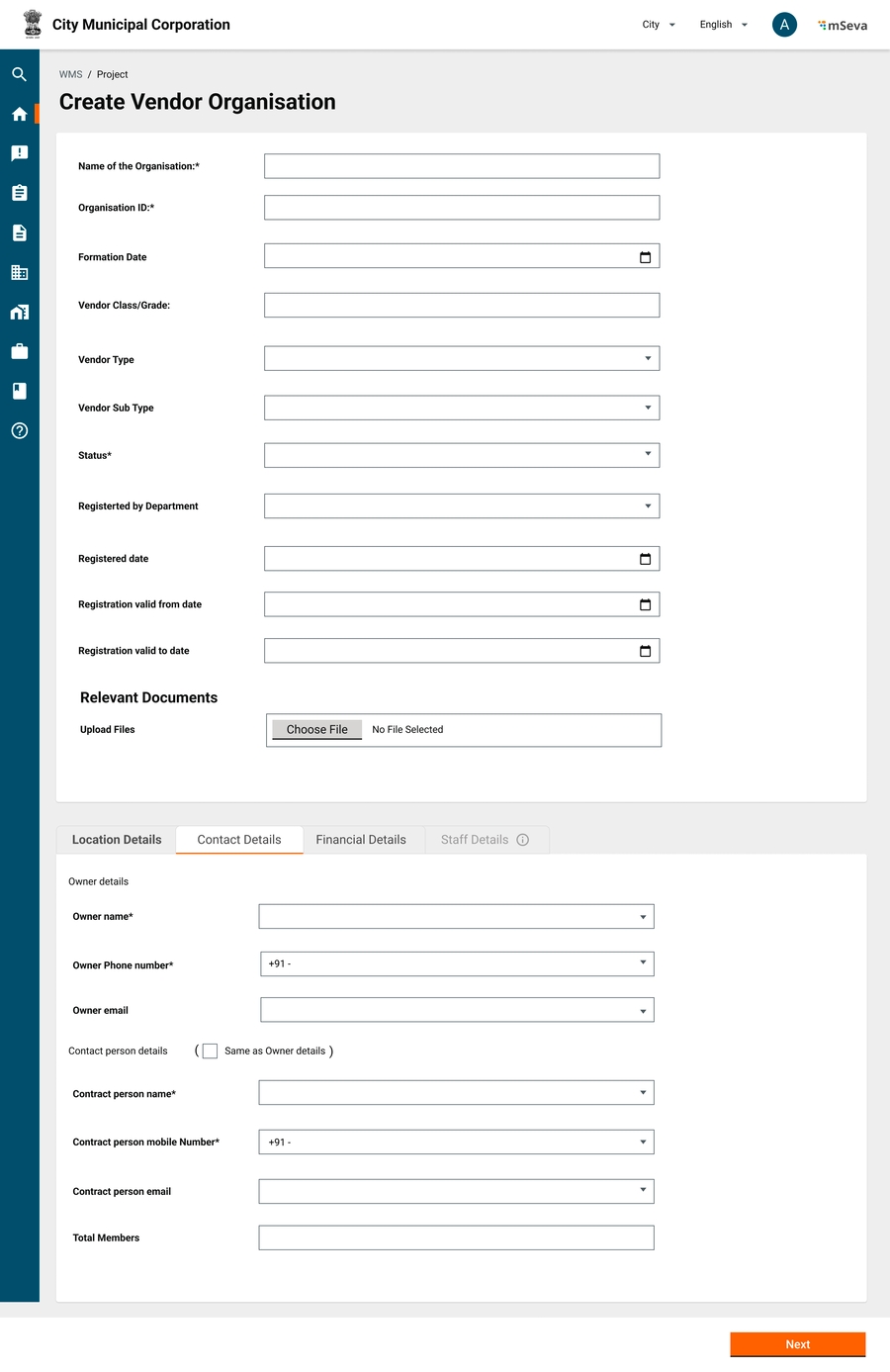
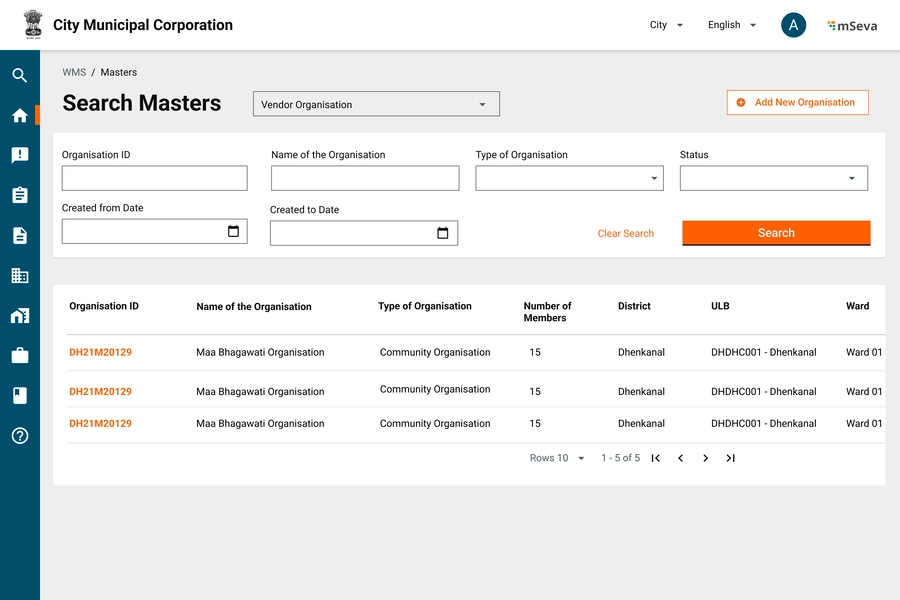
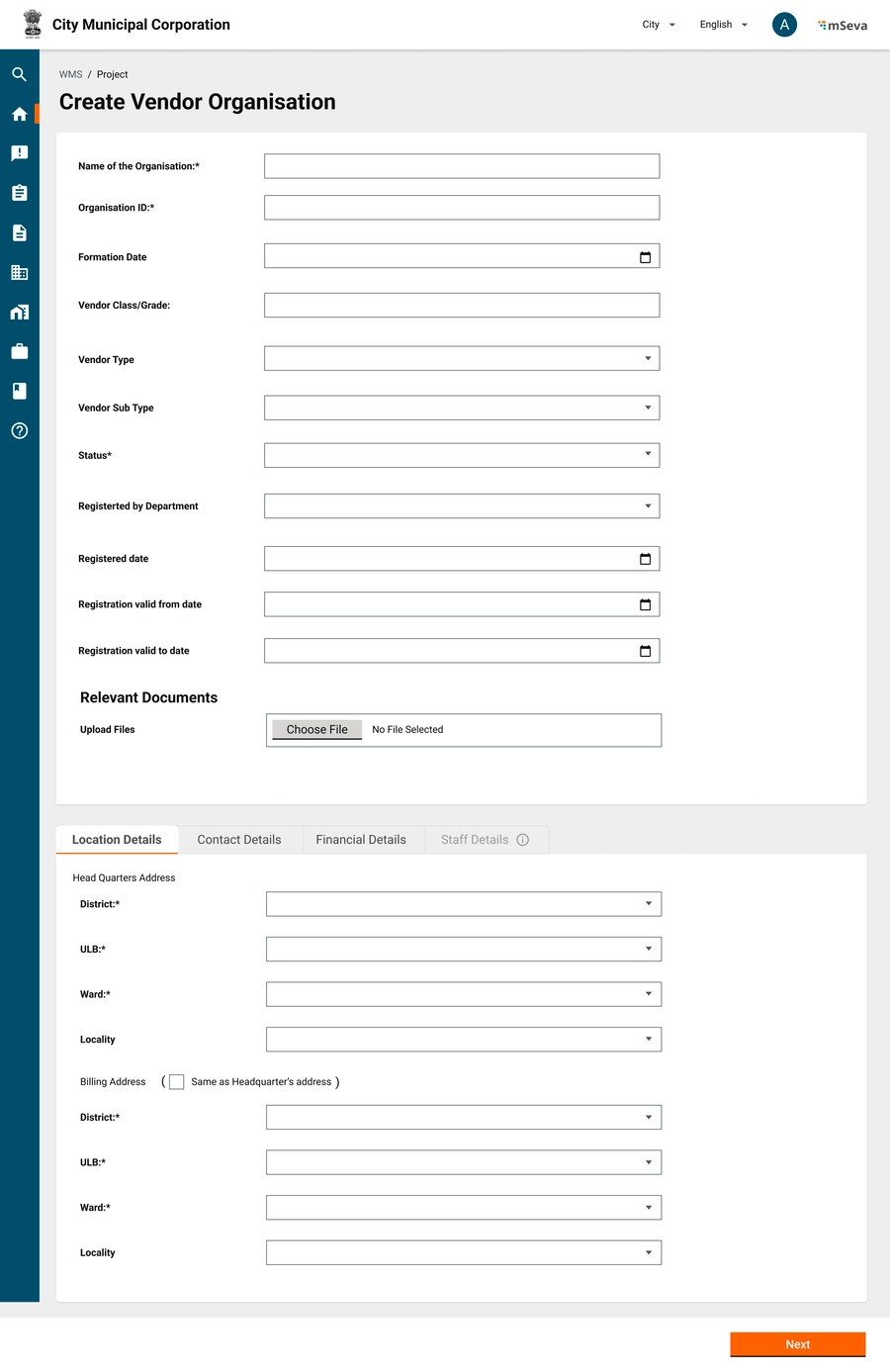
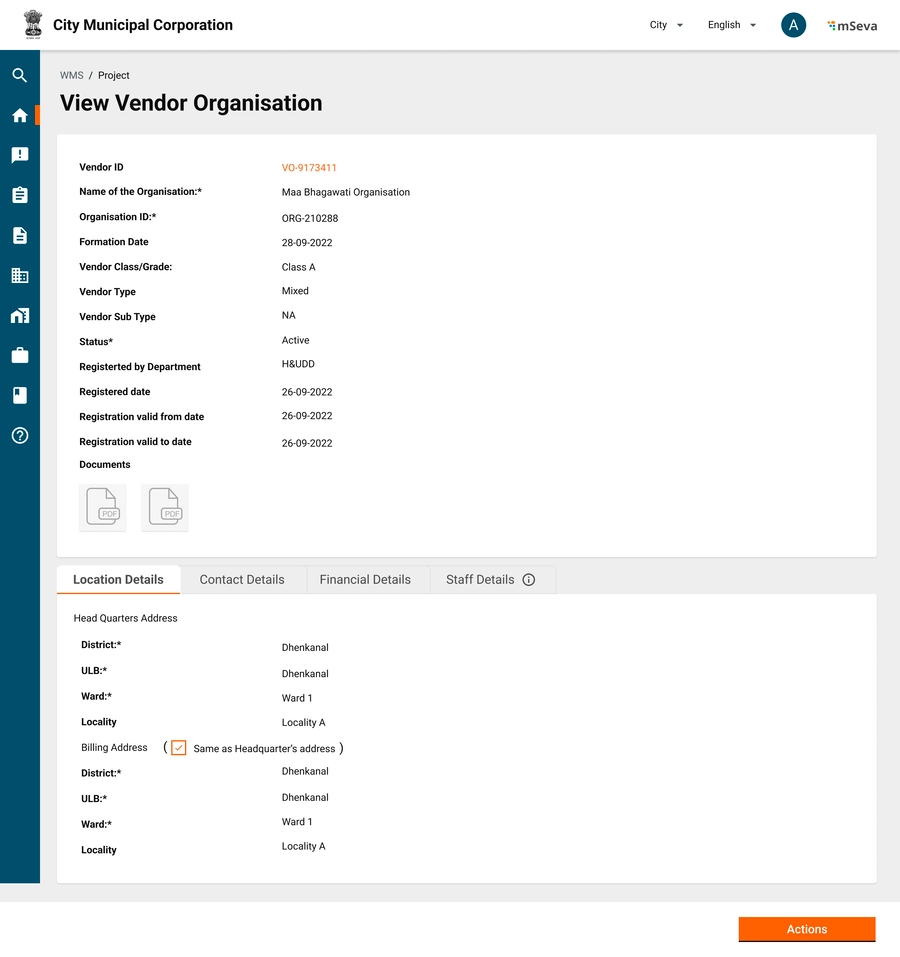
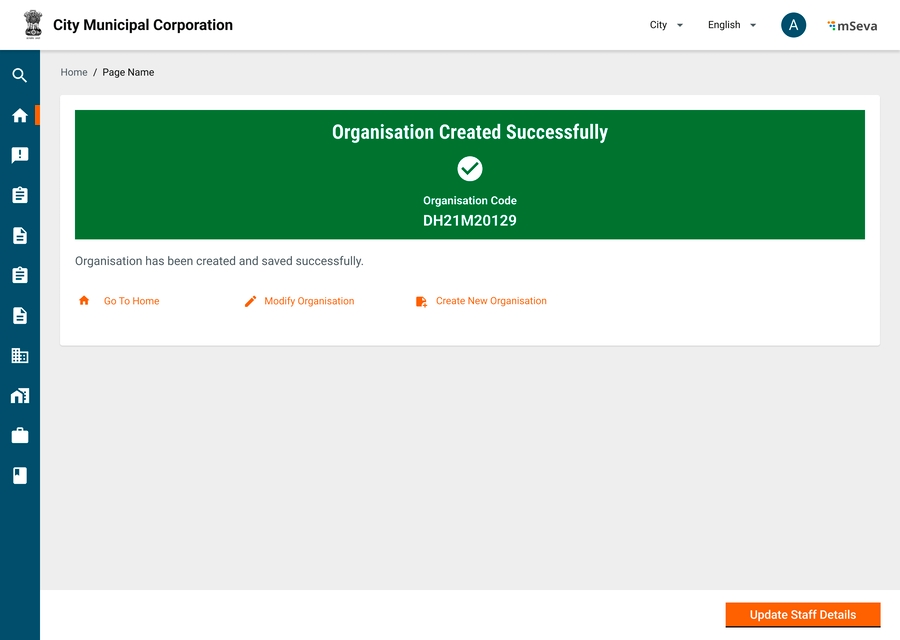
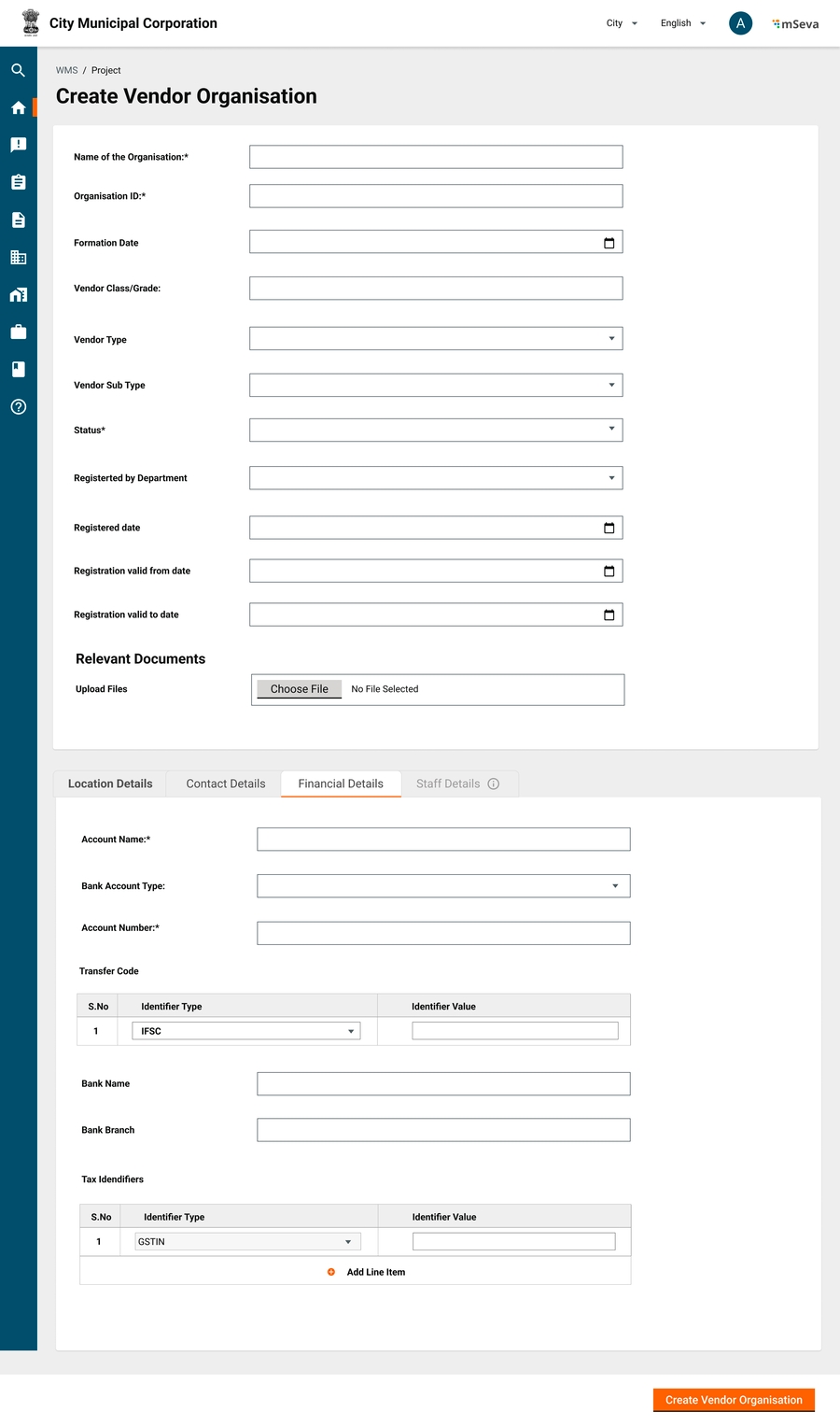
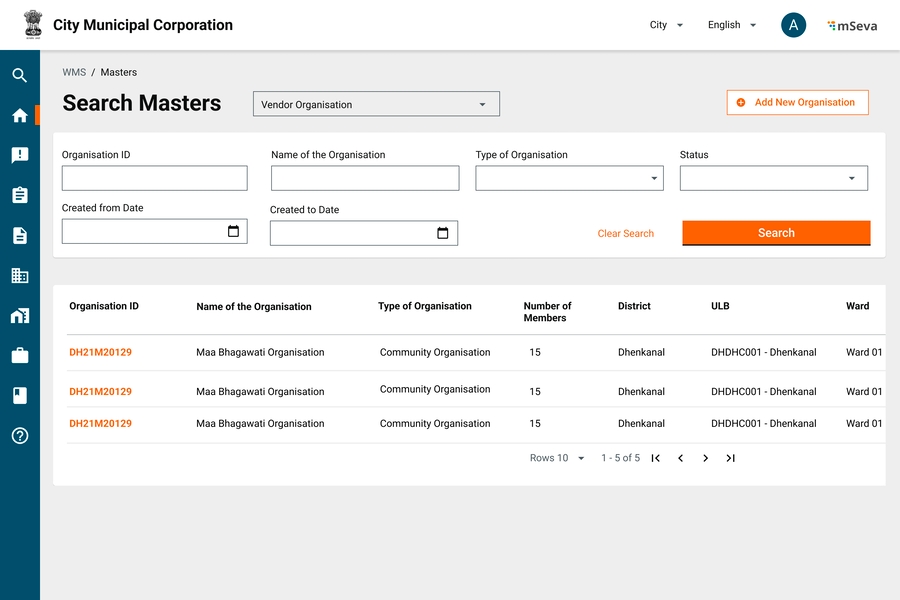
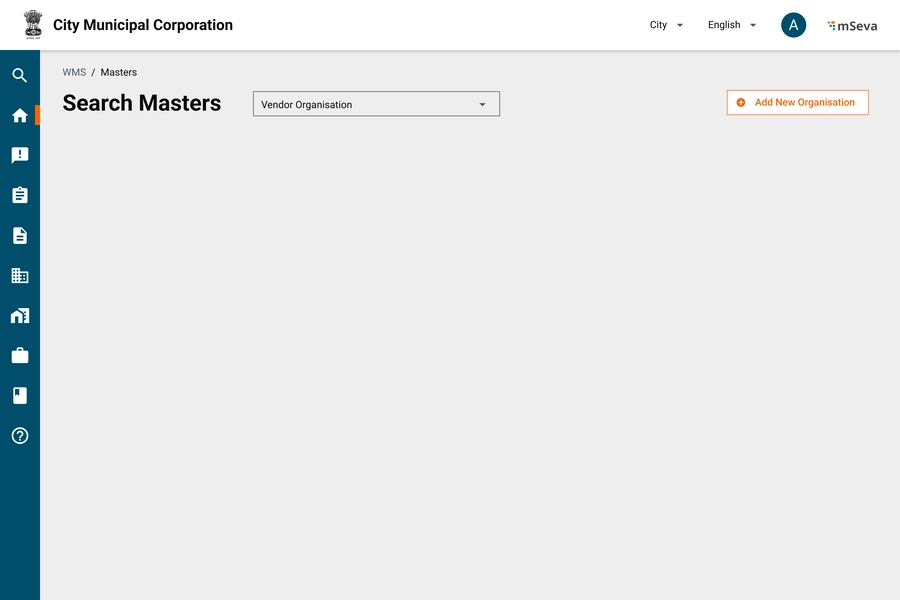
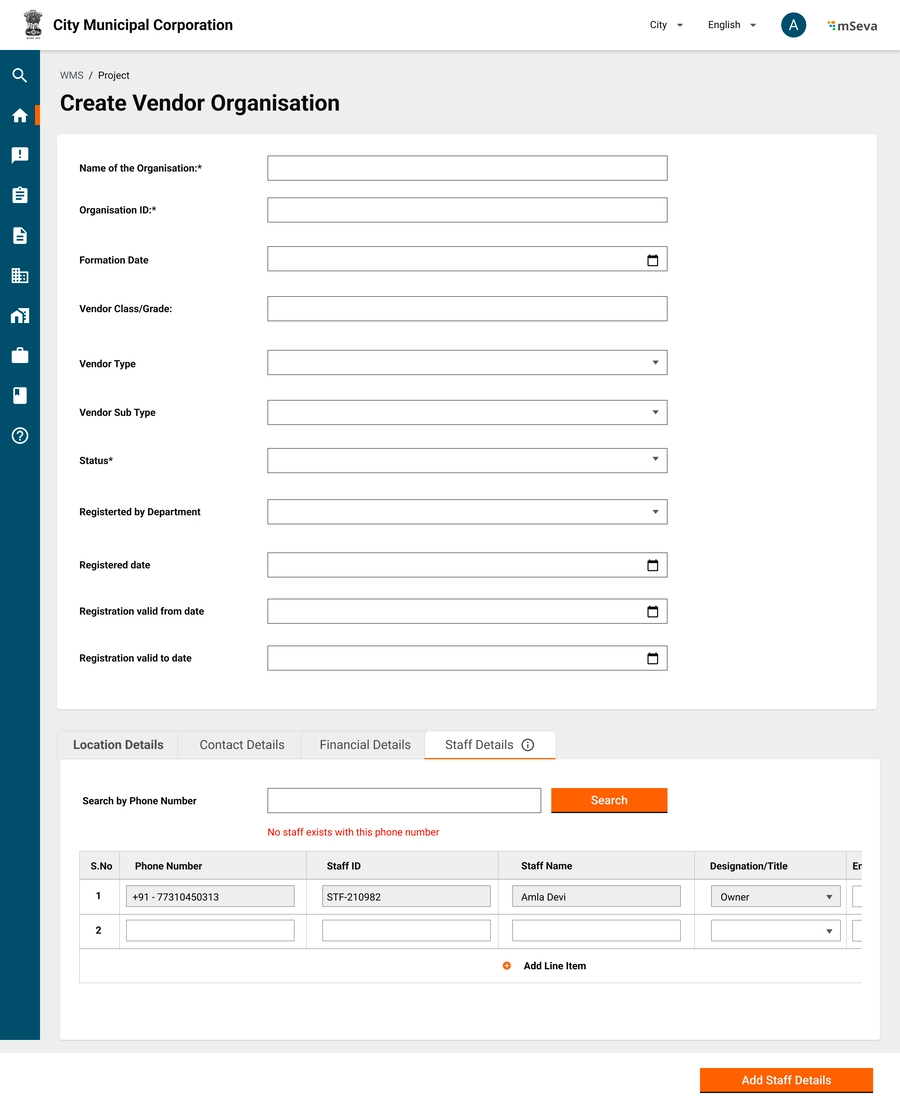
Estimates are created for each project/sub-project entity.
Need and Background
An estimate is prepared for each Works project to get technically sanctioned and proceed with tendering/contract.
Estimates are created for each project/sub-project entity.
There are multiple estimate types for each project prepared with different levels of abstraction (refer to the table below).
After creating the project (and getting it approved if it is in the workflow) the Junior Engineer estimates it.
The following details are required to create an estimate -
Line items from SOR
SOR is a line item that represents the rate for a single unit of work. SOR is defined by the Central PWD or state PWD and is revised based on the market needs from time to time. In general, there are about 3000+ SOR line items
Each executing authority ULB/Department may modify the rates of these SORs by applying lead charges.
Lead Masters will vary for each project as the project site will be different for each.
Analysis of Rates
Each line item of a SOR master/SOR variant will further be divided into sub-line items that come from a set of category Masters like Labour Master, Material Master, Royalty Master, Carriage Master etc.
A group of sub-line items together will form an estimate line item.
Each sub-line item will have Item detail 1, item detail 2, quantity, UOM, rate, and estimated amount.
Note: There are roughly about 200 materials, some of whose rates change quarterly.
There are about 80 types of labour.
The Lead Master will have the carriage and royalty details of each item that goes into the individual SOR items.
When a lead master is set on a particular material in a particular ULB, all SOR line items that contain this item will take the amount from the lead master and not from the basic rate master
CPWD does not define non-SOR items and based on project requirements will get added to the estimate.
They will have the same attributes as the SOR item but not a defined SOR ID or SOR category.
Example - Purchasing fancy benches & themed dustbins at the Park. The rate, in this case, is fixed by JE upon discussion with potential vendors.
Overheads can be of two types.
In-Line Overheads - Defined within the SOR line items
Estimate Level Overheads -
These are defined on top of estimates. Each overhead is defined within a time range with either a percentage or lump sum value of the estimated cost.
We should be able to abstract out similar overheads from multiple SOR line items and groups to form a single overall overhead for the estimate.
Revised Estimates
Estimate revision can happen before the final bill is submitted and the project is closed. For a revised estimate, the user can come onto the existing estimate and click actions → Revise estimate. This goes for a similar approval cycle as the main estimate.
For a revised estimate -
New line items can be added.
A schedule category is a grouping of SORs for easy identification and filtering. There are a total of about 3000 SOR items divided into 15-20 SOR groups
Examples - Earthwork, masonry, brickwork, painting, etc
Templates are created for specific types and sub-types of work so they can be reused for future use.
Templates are groupings of SOR items that combine to complete similar kinds of work.
On the UI, the Estimates inbox will have an Estimate Template section and users can see a list of templates, create a new template from there, or modify the existing template.
Example - Template to build 100 mt of 20 ft road, Template to build 8*10 sq ft standard room.
A user should be able to -
Create an estimate using templates
Add SOR items from the SOR Master
Change values as required for current work
Add/auto-populate overheads

Spill Over
For a multi-year project, an estimate is financially broken down into pieces and budget allocation is done for each year instead of allocating the entire budget in the first year.
Overheads
There are 3 ways how estimates can be added.
Manually adding from the SOR master list
Using estimate template
Copying the format of existing similar projects and changing the values
To select line items for SOR, select the SOR category, search for the SOR line item by SOR code or SOR description and select the SOR.
To the SOR line item, add the quantity required for the project.
SOR standard amount multiplied by this quantity gives the line item-wise cost.
Measurements are captured at the SOR line item level directly by the specified UOM or length, breadth, height, and quantity are captured and stored in an empty measurement book. The measurement book recordings can be used later.
Multiplication of L, B, H, and Q will give the required quantity of the line item for the estimate.
A non-SOR line item will not be defined in MDMS and hence will not be searchable using the SOR category or Code.
Rate, Quantity and Description have to be entered manually.
Just like SOR, capture L,B,H,Q details.
All SOR and Non-SOR items in the way captured in the estimates will be created as empty records in the Measurement Book to capture readings later.
Overheads are predefined masters.
The project cost becomes the cost of SOR and non-SOR items plus overheads.
Overheads are either added on top of SOR and Non-SoR separately or can be derived from SOR Sub Line items.
Overhead amounts will not be going to the contractor but will be going to specific heads defined in the Master for respective overheads. (GST 12% to GST department, Cess 1% to labour dept etc). This means Contracts will selectively capture only a few overheads for contractors.
Each estimate will have a unique ID that is generated
ID: EST/<ULB/Department Code>/<Year>/<month>/<Date>/<running sequence number>
Status of an estimate
Created
In progress
Approved
Rejected
Cancelled
For simplicity, SORs are usually kept constant under a ULB.
Each SOR Item may have multiple variants with slight changes in description and amounts.
Example: The estimate of tiling for the ground floor and the estimate of tiling for the first floor will change by 15 Rs to capture the carriage charges. These should be captured with .serial_number. (Parent.Child)
Y
Item description of the selected Item
Unit of Measurement
Y
Options will be the list from Unit of measurement master
[Array] for specific date ranges
Item Rate
Numeric
Y
Multiple entries can be specified for each Item, but there cannot be an overlap in the rates for a range of dates
Item rate Applicable From
Date
Y
To be entered in the format dd/mm/yyyy
Item rate Applicable To
Date
N
To be entered in the format dd/mm/yyyy
Item detail 1 will capture whether it is material/labour/carriage/overhead/royalty etc
Item detail 2 will capture the exact details of the item from the respective item master. rates need to be auto-populated.
With this when extracted, we should be able to produce labour analysis, material analysis and other standard reports, coming from the estimates.
Y
brick and tile, stone and road, metal and iron etc
Description of Material
Alphanumeric
Y
Second Class Table Moulded Chamber Burnt Bricks 9" x 41 /2" x 3"
Quantity
Numeric
Y
Quantity for which base rate is defined. Default to 1
Unit
Dropdown
Y
Number, Tons..etc
[Array] for specific date ranges
Item Rate
Numeric
Y
Multiple entries can be specified for each Item, but there cannot be an overlap in the rates for a range of dates
Item rate Applicable From
Date
Y
To be entered in the format dd/mm/yyyy
Item rate Applicable To
Date
N
To be entered in the format dd/mm/yyyy
Y
Highly Skilled, Semi Skilled Unskilled etc
Description of Labour
Alphanumeric
Y
Technical Assistant, Stone Polisher, Smith etc
Quantity
Numeric
Y
Quantity for which base rate is defined. Default to 1
Unit
Dropdown
Y
Day/Week/Month
[Array] for specific date ranges
Rate
Numeric
Y
Rate of Labour for specified (Quantity' units)
From Date
Date
Y
Date from which these rates are applicable
To Date
Date
Y
Date to which these rates are applicable
Y
Item for which Lead SOR is present
Name of Quarry
Dropdown
N
For Materials. Doesnt appy for labour
Unit
Dropdown
Y
Unit of Measurement
Lead (Km.)
Numeric
N
Distance from quarry
Basic Cost
Autofill
Y
Basic cost pulled from material rate master or labour rate master
Conveyance Cost
Numeric
N
Royalty
Numeric
N
Royalty on applicable material, abstracted, will go into specific head defined during estimation
Total
Calculation
Y
Total new cost of line item
N
Description
Account head
Dropdown
Y
Account head to which overheads should be credited
[Array] for specific date ranges
From Date
Date
Y
Date from which these rates are applicable
To Date
Date
Y
Percentage/ Lumpsum
Numeric
Y
Percentage or Lumpsum amount of estimate including value
Quantities in existing estimates can be modified.
A contract created from this estimate needs to be revised and sent to the contractor for approval.
Measurement books accordingly will be changed as per the new estimate.
If some part of the estimate is already measured and the bill has been created/approved, a revised estimate for that line item cannot go under that approved bill quantity for that line item.
Y
Description of the template
Status
Dropdown
Y
Status of the template
Active
Inactive
Work Type
Dropdown
Y
Select the Type of work. All the work types defined in the system should be shown
Work Sub Type
Dropdown
Y
Select the Sub type of work. All the work sub types defined in the system should be shown here
[Array] for each line item
Schedule Category
Dropdown
Y
Options are the list of SOR categories from the SOR category master.
SOR
Alphanumeric
Y
Enter the template code and search for it
Non_SOR Code
Alphanumeric
N
Non_SOR Description
Alphanumeric
N
Non_SOR UOM
Dropdown
N
lenght--KM; Area--SQM
Non_SOR Unit Rate
Numeric
N
UOM
Contains the unit of measurement for all categories.
Able to generate material analysis and labour analysis
Download PDFs of labour analysis, material analysis, and overall estimate
Proposal
A single line item has the overall project cost against the project title. This requires in-principal Admin sanction. Once approved detailed estimate for the same is created.
Detailed
A detailed estimate contains engineering drawings done on AutoCAD & other drawing tools. Modern tools also abstract out many measurements and materials from drawings created by these tools.
Abstract
An abstract estimate is prepared using standard SOR & Non-SOR Items defined by PWD (mostly ULBs customise SOR and have their own copies). SOR items are created internally using item rates.
Revised
When a project's finances are increasing then to what is initially estimated, revision estimates are created and approved. revision estimates may or may not have the same SORs as initial estimates. Revised estimate line items added to initial line items will give overall project cost.
Deviation
A deviation statement is a type of estimation when the scope of the project changes but the project cost is meant to remain the same. The deviation statement and revised estimate are the same as far as the estimation process is concerned. The approving authority changes only.
SOR Category ID
Drop down
Y
Options will be the list of Category Code from the SOR category type master
The combination of category Code and Item code is unique
Item ID
Alphanumeric
Y
System generated
Item Description
ID
NA
Na
System generated ID
Department
Dropdown
Y
Labour rates may vary by each department
Material Category
ID
NA
Na
System generated ID
Department
Dropdown
Y
Labour rates may vary by each department
Skill Category
ID
NA
NA
System Generated
Item ID
Dropdown
Item for which Lead SOR is present
Item Name
ID
NA
NA
ID generated for each overhead type
Name
Alphanumeric
Y
Name of the overhead
Ex. Labour Cess, GST, Royalty etc
Description
Category Code
Alphanumeric
Y
Unique Code Assigned to the Schedule Category
Category Name
Alphanumeric
Y
Name Assigned to the Schedule Category
Template Code
Alphanumeric
Y
Define the template code
Name
Alphanumeric
Y
Name for template
Description
Overheads
Contains the overhead charges applicable on an estimate.
SOR
- Sample data for SOR
Contains a comprehensive list of items and rates defined by the department. To be used in preparation of an estimate.
SOR Rates
- Sample data for Rates
Contains a comprehensive list of items and rates defined by the department. To be used in preparation of an estimate.
Category
Create Estimate
Estimate Successfully Created
Estimates Inbox
Inbox Table
SOR Data entry screen
Dropdown
Dropdown
Autofill/Dropdown
Alphanumeric
Alphanumeric
Contains the category of all items. - SOR - NON-SOR - OVERHEAD
Rate Analysis: Understanding and Application
Rate analysis in Public Works Departments (PWD) involves the examination and calculation of rates for various construction activities or works. It is a systematic process carried out to determine the cost of executing a particular work item per unit quantity. Rate analysis typically involves breaking down the cost components associated with a construction activity, including materials, labor, machinery, contractor's profit, overhead costs, and miscellaneous expenses.
The purpose of rate analysis in PWD is to establish fair and accurate rates for different items of work, which helps in estimating the overall cost of a construction project. These rates are often based on prevailing market prices, standard specifications, and historical data. Rate analysis is crucial for budgeting, tendering, and ensuring transparency and accountability in construction projects undertaken by the Public Works Departments.
{
"id": "1",
"code": "SC",
"description": "Supervision Charge",
"active": true,
"isAutoCalculated":true,
"isWorkOrderValue":true,
"type": "percentage",
"value": "7.5",
"effectiveFrom": 1682164954037,
"effectiveTo": null
}{
"id": "SOR_000188",
"uom": "Nos",
"sorType": "W",
"quantity": 1000,
"sorSubType": "NA",
"sorVariant": "NA",
"description": "1000 Bricks for constructing any wall of length 10*10*10"
}{
"rate": 989,
"sorId": "SOR_000152",
"validTo": "1697846400000",
"validFrom": "1697587200000",
"amountDetails": [
{
"type": "fixed",
"heads": "MH.2",
"amount": 979
}
]
}"Category": [
{
"name": "Overhead",
"code": "OVERHEAD",
"active": true
},
{
"name": "SOR",
"code": "SOR",
"active": true
},
{
"name": "non-SOR",
"code": "NON-SOR",
"active": true
}
]Schedule of rates
Definition
Rates
Rate analysis
Usage of rate analysis
Generation of analysis statements out of estimate
Generation of utilization statements out of measurement book
Revising the rates of works SORs
Download of documents
Labour, Material, and Machinery analysis statements from estimate
Labour, Material, and Machinery analysis statements from work order in CBO application
Labour, Material, and Machinery utilization statements from measurement book
State Users
ULB Users
Add Rate Analysis
Yes
No
Edit Rate Analysis
Yes
No
View Rate Analysis
Yes
Yes
Revise Rate
No
It enables the user to add rate analysis for a Works SOR.
To add the rate analysis -
Search for the relevant SOR and open it to view the details.
Select the Add Rate Analysis option from Take Action - this will open the add rate analysis form with the following attributes:
1
SOR Code
Display
It is system generated unique code to identify the SOR uniquely.
2
SOR Type
Display
SOR Type, Works only.
3
SOR Sub Type
Display
Search SOR is used to search a SOR and view the rate analysis associated with it.
A SOR is searched to view the SOR details and rate analysis details. The revision of rates can also be scheduled. The search parameters are given below.
SOR Type
SOR Sub Type
SOR Variant
SOR Code
View rate analysis enables the user to view the details of rate analysis for a SOR.
Attributes
1
SOR Code
Unique code generated for a SOR.
2
SOR Type
SOR type name.
3
SOR Sub Type
SOR sub type name as defined in the SOR master.
4
SOR Variant
Variant name as defined in variant master.
Screen Mock-ups
Edit rate analysis allows the user to modify the existing rate analysis, on modification the existing rate analysis is marked inactive while the new rate analysis is added and made effective from the same date and time for which the existing rate analysis was effective.
The rates of works SORs are revised when the rates of SORs of type Material, Labour, and Machinery are revised. The rates for works SORs are to be revised by scheduling a job in the system. The user at the ULB takes a call to revise the rate and accordingly schedule it in the system.
It allows the users to search, view and track the status of the JOBs scheduled for revising rate.
The analysis of estimates is done to know the breakup of the labour, material and machinery at the item and cost level. Once an estimate detail is saved, analysis statements can be generated. Action to generate analysis is provided from the Edit/ View Estimate page, once generated the same can be downloaded from the edit/view screen using the download option in PDF format.
The analysis of material out of the estimate prepared is the process of identifying the quantity of material which is required to accomplish the work. It generates a statement for material to be procured and then handed over to CBO along with the work order.
1
SOR Description
SOR item from the estimate.
1.1
Code
The item code from the lead charges
1.2
Name
The item name from the lead charges
1.3
Unit
The unit of measurement
Screen Mock-ups
Utilization statements are generated out of the measurement book and are used to validate the Muster Roll and Purchase Bill.
Using the rate analysis the material utilization statement is created for the consumed quantity of SOR items in the measurement book and a statement in the same format as the material analysis statement is created. The cost of material utilized here is used to validate the purchase bill created for payment now.
Using the rate analysis the labour utilization statement is created for the consumed quantity of SOR items in the measurement book and a statement in the same format as the labour analysis statement is created. The cost of labour utilized here is used to validate the muster roll created for the period.
Using the rate analysis the machinery utilization statement is created for the consumed quantity of SOR items in the measurement book and a statement in the same format as the machinery analysis statement is created. The cost of machinery utilized here is used to validate the purchase bill created for the period.
The option to download the estimate analysis statements is to be enabled in the view work order screen for both CBO and Employee.
Same way labour and machinery analysis statement PDFs are also generated and allowed to be downloaded.
{
"code":"KG",
"description":"Kilogram",
"active":true,
"effectiveFrom":1677044852,
"effectiveTo":null
},Yes
SOR sub types, the values from SOR Sub Type Master.
4
SOR Variant
Display
SOR variant, the values from the SOR Variant Master.
5
Unit of Measurement
Display
Unit of measurement.
6
Quantity for which rate is defined
Display
The quantity for which SOR rate is defined.
7
SOR Description
Display
SOR description.
8
Status
Display
Active/ Inactive.
Rate Analysis
9
Effective From
Date
The effective date from which the added rate analysis will become effective.
10
Quantity for which analysis is defined
Numeric
The quantity for which rate analysis is defined.
11
Material
Section
11.1
Code
Display
Unique code defined for the material item.
11.2
Name
Search
Name of the material item.
11.3
Unit
Display
Unit of measurement on which item is measured.
11.4
Basic Rate
Display
Rate of item defined for a unit
11.5
Quantity
Numeric
Quantity of the item defined for the given SOR.
11.6
Amount
Display
The total amount for item arrive from Quantity * Rate.
11.7
Total
Display
Total of all the items added under material.
12
Labour
Section
12.1
Code
Display
Unique code defined for the labor item.
12.2
Name
Search
Name of the labor item.
12.3
Unit
Display
Unit of measurement on which item is measured. Mostly Nos.
12.4
Basic Rate
Display
Rate of item defined for a unit.
12.5
Quantity
Numeric
Quantity of the item defined for the given SOR.
12.6
Amount
Display
The total amount for item arrive from Quantity * Rate.
12.7
Total
Display
Total of all the items added under labor.
13
Machinery
Section
13.1
Code
Display
Unique code defined for the machinery item.
13.2
Name
Search
Name of the machinery item.
13.3
Unit
Display
Unit of measurement on which item is measured.
13.4
Basic Rate
Display
Rate of item defined for a unit
13.5
Quantity
Numeric
Quantity of the item defined for the given SOR.
13.6
Amount
Display
The total amount for item arrive from Quantity * Rate.
13.7
Total
Display
Total of all the items added under machinery.
14
Extra Charges
14.1
Description
Text
Extra charge description
14.2
Applicable On
Drop down
The name of the component on which additional amount to be added.
14.3
Calculation Type
Drop-down
Fixed/ Percentage.
14.4
Figure
Numeric
The figure for fixed or percentage calculation type.
14.5
Amount
Display
The calculated value, Basic Rate * Figure, or user entered fixed value.
15
Basic Rate/ RAQ UOM
Display
This is the rate for the base variant for the quantity defined.
16
Basic Rate/ SORQ UOM
Display
This is the rate for base variant in case variant per unit quantity.
5
Unit of Measurement
Unit of measurement.
6
Rate Defined for Quantity
The quantity for which rate analysis is defined.
7
SOR Description
SOR description.
8
Status
Active/ Inactive
Analysis
9
Effective From
Display the date when it was last modified.
10
Analysis Defined for Quantity
The quantity for which rate analysis is defined.
11
Labour
11.1
Code
Unique code defined for the labor item.
11.2
Name
Name of the labor item.
11.3
unit
Unit of measurement on which item is measured. Mostly Nos.
11.4
Basic Rate
Rate of item defined for a unit.
11.5
Quantity
Quantity of the item defined for the given SOR.
11.6
Amount
The total amount for item arrive from Quantity * Rate.
11.7
Total
Total of all the items added under labor.
12
Material
12.1
Code
Unique code defined for the material item.
12.2
Name
Name of the material item.
12.3
Unit
Unit of measurement on which item is measured.
12.4
Basic Rate
Rate of item defined for a unit
12.5
Quantity
Quantity of the item defined for the given SOR.
12.6
Amount
The total amount for item arrive from Quantity * Rate.
12.7
Total
Total of all the items added under material.
13
Machinery
13.1
Code
Unique code defined for the machinery item.
13.2
Name
Name of the machinery item.
13.3
Unit
Unit of measurement on which item is measured.
13.4
Basic Rate
Rate of item defined for a unit
13.5
Quantity
Quantity of the item defined for the given SOR.
13.6
Amount
The total amount for item arrive from Quantity * Rate.
13.7
Total
Total of all the items added under machinery.
14
Royalty
14.1
Code
Unique code defined for the material item.
14.2
Name
Name of the material item.
14.3
Unit
Unit of measurement on which item is measured.
14.4
Royalty Rate
Rate of item defined for a unit
14.5
Quantity
Quantity of the item defined for the given SOR.
14.6
Amount
The total amount for item arrive from Quantity * Rate.
14.7
Total
Total of all the items added under material.
15
Conveyance
15.1
Code
Unique code defined for the material item.
15.2
Name
Name of the material item.
15.3
Unit
Unit of measurement on which item is measured.
15.4
Conveyance Rate
Rate of item defined for a unit
15.5
Quantity
Quantity of the item defined for the given SOR.
15.6
Amount
The total amount for item arrive from Quantity * Rate.
15.7
Total
Total of all the items added under material.
16
DMF
District Mineral Fund
16.1
Code
Unique code defined for the material item.
16.2
Name
Name of the material item.
16.3
Unit
Unit of measurement on which item is measured.
16.4
DMF Rate
Rate of item defined for a unit
16.5
Quantity
Quantity of the item defined for the given SOR.
16.6
Amount
The total amount for item arrive from Quantity * Rate.
16.7
Total
Total of all the items added under material.
17
EMF
Environment Management Fund
17.1
Code
Unique code defined for the material item.
17.2
Name
Name of the material item.
17.3
Unit
Unit of measurement on which item is measured.
17.4
EMF Rate
Rate of item defined for a unit
17.5
Quantity
Quantity of the item defined for the given SOR.
17.6
Amount
The total amount for item arrive from Quantity * Rate.
17.7
Total
Total of all the items added under material.
18
Additional Charges
18.1
Code
Unique code defined for the material item.
18.2
Name
Name of the material item.
18.3
Unit
Unit of measurement on which item is measured.
18.4
EMF Rate
Rate of item defined for a unit
18.5
Quantity
Quantity of the item defined for the given SOR.
18.6
Amount
The total amount for item arrive from Quantity * Rate.
18.7
Total
Total of all the items added under material.
19
Extra Charges
It is applicable only for variants other than Basic Variant.
13.1
Description
Variant description
13.2
Applicable On
Heads/ Components, like Labour Basic Rate, Material Basic Rate etc.
13.3
Calculation Type
Fixed/ Percentage.
13.4
Figure
The figure for fixed or percentage calculation type.
13.5
Amount
Calculated extra amount on top of base variant.
13.6
Total
Total of all the items added under variants.
20
Labour Cess
It is calculated on the sum of all above components.
21
Rate/ Qty UOM
This is the rate calculated for the quantity rate analysis defined.
22
Rate/ UOM
This is the rate calculated as per latest rates per unit quantity.
23
Existing Rate/ UOM
Thus is SORs existing rate.
24
Take Actions
Edit Rate Analysis
Add Rate Analysis
Revise Rate
1.4
Rate
Rate per unit
1.5
Quantity
Total quantity required for the given SOR item.
1.6
Amount
Amount calculated rate*quantity.
1.7
Total
Total of all the material required for a given SOR item.
2
Grand Total
Total of all the material required.
Material Wise Consolidation
1
Code
The item code from the lead charges
2
Name
The item name from the lead charges
3
Unit
The unit of measurement
4
Rate
Rate per unit
5
Quantity
Total quantity required.
6
Amount
Amount calculated rate*quantity.
7
Total
Total of all the material required.
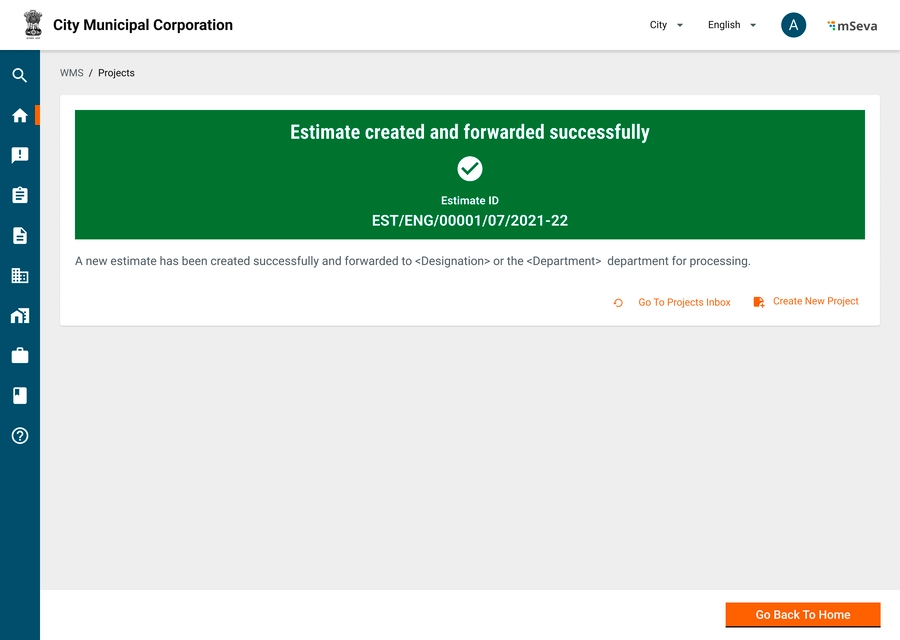
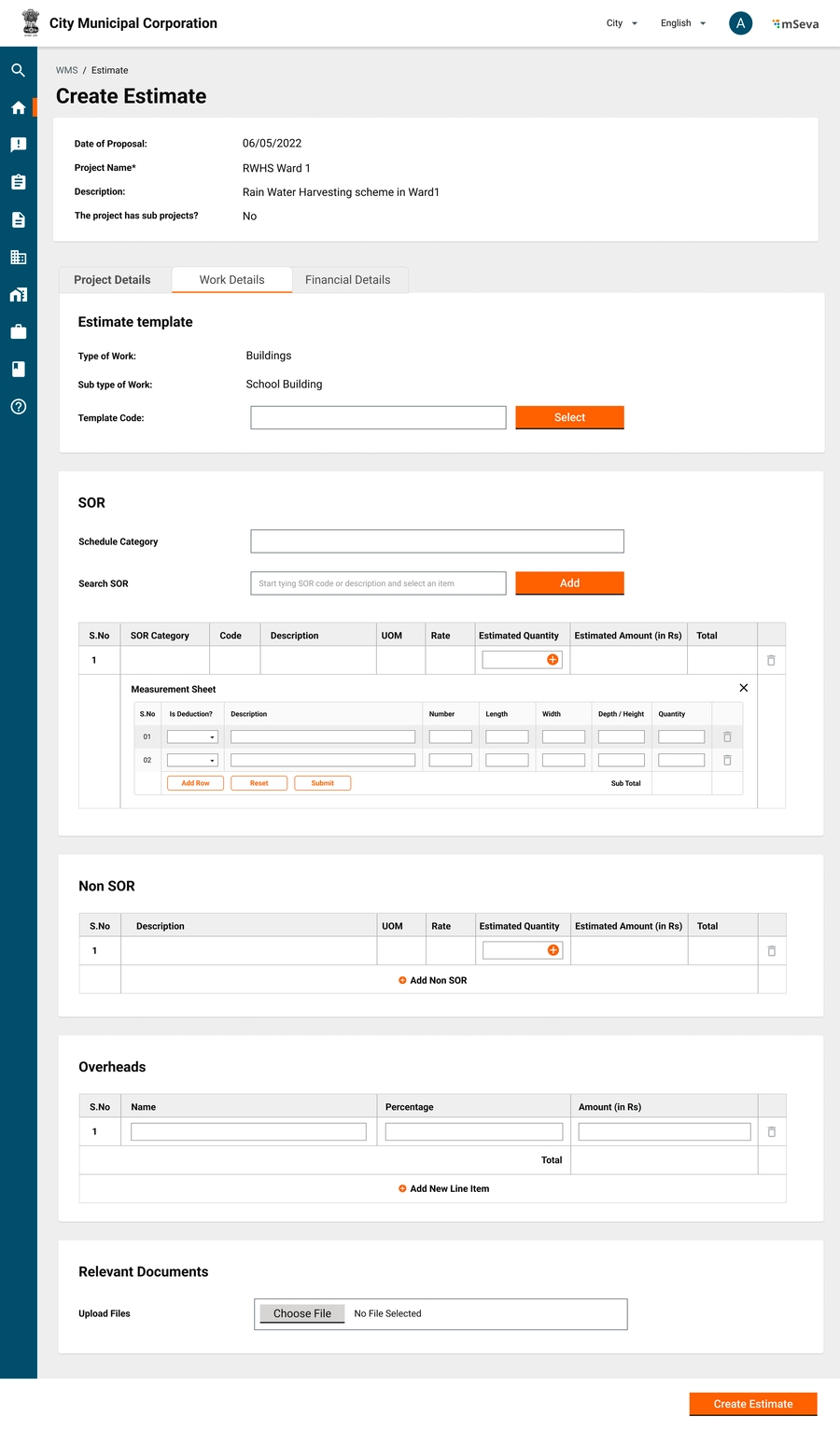
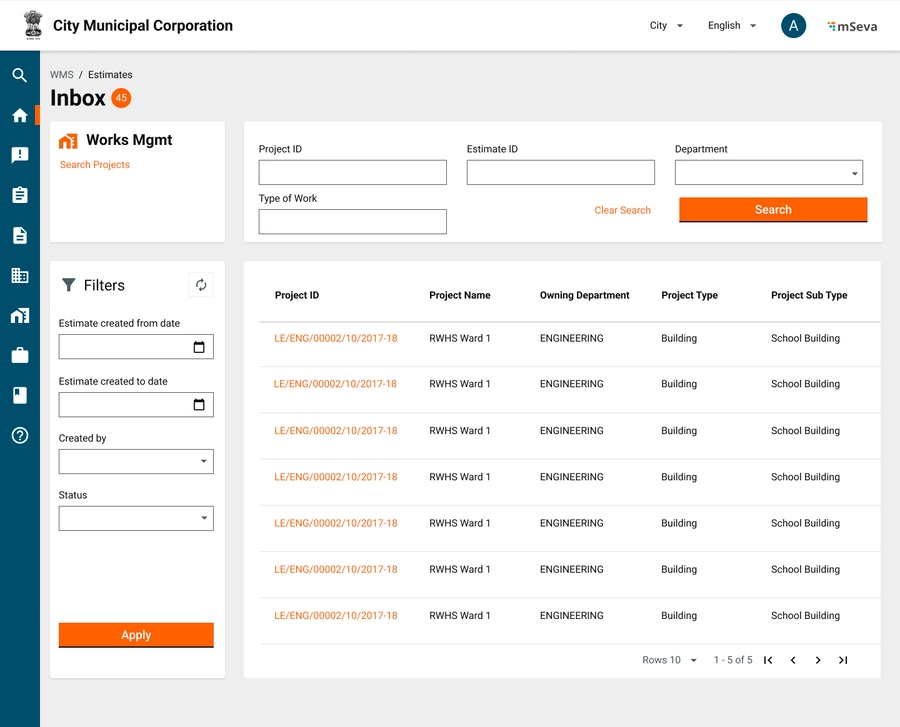
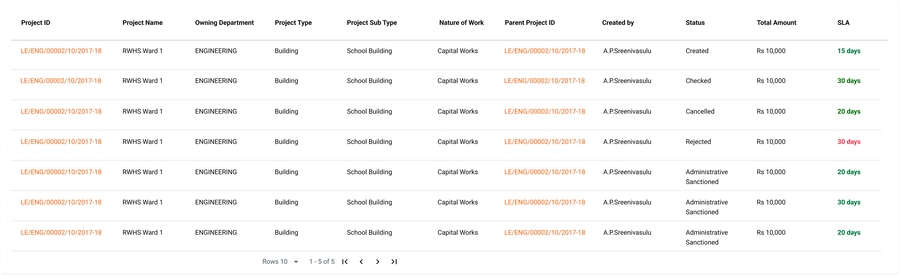


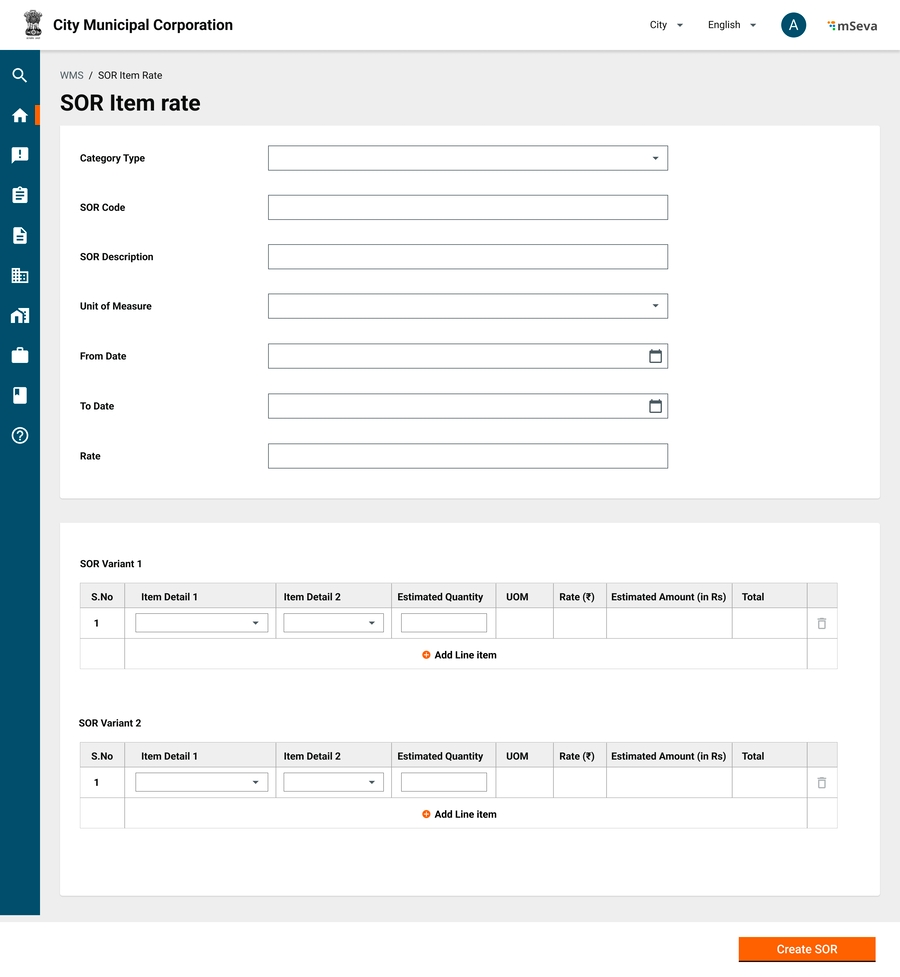


In a government setting, payments can be categorized into two main types: payments made to the government and made by the government.
Payments made to the government are payments received by the government, categorized as receipts or revenue. Payments to the government can be divided into two types: demand-based collection and non-demand-based collection.
Payments made by the government are expenses incurred by the government. Examples include - Salaries, Wages, Beneficiary payments, Contractor Payments, or Ad Hoc Payments.
Demand-Based Collection
Demand Generation: The government generates a demand for payments.
Examples: Property Tax, Trade License, Water Tax.
Invoice Issuance: An invoice is issued by the government detailing the demands. This invoice specifies what is owed to the government, including taxes, charges, or levies.
Payment by Citizen: The citizen acknowledges the demand and pays the specified amount.
Receipt Issuance: A receipt is issued to the citizen upon payment, acknowledging the receipt of the amount.
Non-Demand-Based Collection
Collections are made without a prior demand being generated by the government.
The DIGIT demand and billing service is used to manage payments made to governments.
For any transaction to happen, there is a payer, payee, amount and entity details
Payer and payee can be individuals or organizations.
Entity details contain other information which are important for a bill to be generated but not mandatory for payment advice
Examples - Invoice ID, Invoice date, Verification details etc
Every transaction ideally starts with an invoice equivalent that is generated by the supplier/contractor/muster/contract/payroll etc against which a payee generates a bill in the name of the payer.
A bill can have single or multiple beneficiaries depending on verifiable information sources.
Example - If a muster roll has 20 beneficiaries, Bill also can have 20 beneficiaries. It is not needed to create 20 individual bills.
A single invoice should not be split into multiple bills.
Example - Even though the material is supplied in tranches, a single PO can lead to multiple invoices and only after the consumption of the entire material as per individual invoice and associated measurement book a bill for that invoiced amount can be created and paid.
Payment advice is generated to enable beneficiary payments and the module is integrated with a payment gateway.
Hence payment advice contains minimal information required for the bank/gateway to make the payment. Limits on the number of beneficiaries and amounts etc are configurable as needed by the integration.
Expenses are created by the JE and approved by ME, EE/ EO depending on the amount and associated approval authority.
This module should have the following components
Header Details
Bill ID
Bill Date
Party Bill ID
Party Bill Date
Debit Details
Account Code, Account head, Debit Amount
Treasury Payments - {Major, Sub Major, Minor, Sub Minor, Detail, Object head, Debit Amount}
ULB Payments - {Fund, Functionary, Budget head, Scheme, Sub Scheme, Debit Amount}
Deductions
The amount that is deducted from the gross value of the bill as these are already included in the work line items
Deductions are classified into many types
Internal transfer
Actions to resolve:
Budget Checks
Input to expenditure service is when a project is created and an estimate is to be approved.
Expenditure will query the program service to get the status of fund availability.
Budget Blocking
In case funds are available, the expenditure service can also ask the program service to block respective funds (from estimation) for this project.
The budget hence is blocked and won’t be available for the next projects.
Release Blocked Budget
The expenditure module should also have a provision to release the pre-blocked budget. So this can be used for other projects. Or the existing project for which the budget has been blocked is deferred.
Expense Planning
The expenditure service will also have a planning module which will give timelines of expenses and respective amounts to funding agencies.
The blocking module also feeds into the planning module to block funds on time.
Billing management
Bills are created under contracts (projects)
A contract is issued by Payer to Payee.
The contract can be materials, labour, services, supervision etc
A payee in turn issues invoices against the contract on the supply of material/services.
Bill Type
Salary/Pension Bill - Based on Payroll, leaves, PF, GPF, other allowances
Advance Bill
Unlike other bills which are post-work/service completion and measurement, the advance bill is raised prior and adjusted later.
Advance bill is horizontal and be applicable on top of all other bill types
Works/Contractor Bill
A contractor bill is created and measured against the measurement books and contract(work order) objects for verification.
When a user selects to pay a contractor bill, the user can select against which measurement books of the contract this bill is being raised, and accordingly bill amount will be calculated.
Muster/Labour Bill -
A labour bill is created from a muster roll and usually has multiple beneficiaries within the same bill.
When a user selects to pay a wages bill, the user can select which muster rolls to process as part of this bill, and accordingly bill amount and array of beneficiaries will be processed.
Supplier/Vendor Bill
A vendor bill is similar to a contractor bill where as here instead of a measurement book and work order, an invoice and material receipt register or purchase order are used for verification.
A vendor bill should ideally be against each invoice as submitted by the supplier.
Contingency/Expense Bill
Ad Hoc expenses
Supervision Bill
This type of Bill is calculated as a percentage on top of other types of approved bills.
Others (need more use cases)
Debit details should ideally be captured at the time of project creation. This helps in budget checks being done.
Each Project will be associated with a set of account codes and percentage amounts of the entire project, from where debit will happen.
Similarly, respective amounts (lumpsum/percentage) should be chosen from these account codes for each bill created.
Service should not allow debit more than the initial quoted amount under respective heads against the sum of all the bills created for the project.
SOR line items also include royalty on the material. That needs to be deducted from here and transferred to Tahsildar.
Advance recoveries
Amounts paid earlier for mobilization advancement or material procurement etc are deducted while creating a new bill.
Retention Money
Money is withheld for payments and paid at a later date after the defect liability period.
Deductions are always done against a beneficiary.
If a bill contains multiple beneficiaries, it needs to be specified against which beneficiary the deductions are made.
Credit Details
A bill can have multiple beneficiaries. However, the nature of payments or beneficiary types should be the same for all beneficiaries in one bill.
Wage seekers bill should contain only beneficiaries for wages
Material bills should contain only vendors and be verified against their invoices
Once the bill of any type is created, this will go for approval and have wfstatus.
Every bill will also have a beneficiary payment status.
In the absence of intergrations with Banks/IFMS, this status can be updated manually to mark beneficiary payments.
In the presence of integration, systems should show the status of payment.
Once a bill is approved, payment advice needs to be created and sent to an integrated system. This system will send back the success/failure status along with the reasons.
In case of payment failure, Works should allow modifying the bill, marking the changes as mentioned in the error codes and resubmitting.
This will create a new payment advice, linking reference to an earlier bill.
Todays Date
2
Party Bill Date
Date
N
Date on which Invoice is given by third party
3
Party Bill Number
Alphanumeric
N
Reference number on Invoice given by third party
4
Bill Type
Dropdown
Y
Salary, Pension, Works, Advance, Others etc
Financial Details (For ULB Payments)
5
Fund
Dropdown
Y
Capital Fund, Municipal Fund, Grant Fund
6
Function
Dropdown
Y
202107 - Roads and Building Maintenance
202406 - Street Lighting Maintenance
202500 - Storm Water Drains
7
Department
Dropdown
Y
Road and highways
Streetlights
Storm water drains
8
Scheme
Dropdown
N
Scheme is tied to a fund
Muncipal Fund, funds schemes such as Housing, employment, Capital fund, funds scheme like buildings & highways
9
Sub Scheme
Dropdown
N
Sub Scheme is tied to scheme.
10
Fund Source
Dropdown
N
Loans, Own sources, Grants, etc
Financial Details (For State Department Payments)
11
Chart of Accounts
Dropdown
Y
Length varies from state to state. Punjab has 16 digits. Odisha has 27 Digit Codes.
Odisha has following format
Demand Number(2)-Major(4) –
SubMajor(2) – MinorHead(3)-
Sub(4)-Detail(5)-Object(3) –
PlanStatus(2) – ChargedVoted(1) – SectorCode(1)
Example - 11(Demand Number) –
2225 (Major Head) – 02 (Sub
Major Head) - 277 (Minor Head) –
2367 (Sub Head) – 40004 (Detail
Head) – 544 (Object Head) – 21
Beneficiary Details (Array)
12
Beneficiary ID
Searchable dropdown
Y
Registration ID of the beneficiary in the system
13
Beneficiary Name
Y
Name of the beneficiary
14
Beneficiary Type
Contractor, Employee, Tahsildar, Wage seeker, Asha Worker, Student etc
15
Phone Number
Phone Number
16
Aadhar Number
Aadhar Number
17
Account Number
Y
Account Number
Bank Account Name
Y
Name on bank account
18
Account Type
Savings, Current, Loan etcRequired in IFMS while processing payments
19
IFSC
Y
IFSC
20
Amount
Numeric
Y
Debit Details
21
Account Code
Y
2723000 ,2101001
22
Account Head
Roads and Bridges-Roads & Bridges
Salaries, Wages and Bonus-Basic Pay
23
Debit Amount
Y
Deduction Details
24
Account Code
N
3502017,
25
Account Head
Recoveries payable-LCCS, Creditors-Contractors
26
Deduction Amount
N
Net Payables
27
Account Code
Y
3501002
28
Payable Amount
Y
Debit Amount should be equal to sum of deduction detail plus credit amount.
DDO Details
29
DDO Code
N
30
DDO Login ID
N
DDO Login id is mandatory if multiple DDO exists for the same DDO code.
Summary Details
Y
31
Gross Amount
Y
32
Net Amount
33
Number of beneficiaries
Y
34
PreviousBillReferenceNumber
N
Needed if re-submitting previously objected to the bill.
35
Payment Date
Y
36
Payment Mode
Y
Users click on create Bill in the billing management inbox and search for existing contracts to create Bills
Search parameters to create Bills
Contract Name
Clicking on Contract ID in first tab should show contact view screen exactly as it would open from contracts flow on home screen.
Primary CTA here will be same as what Actions menu shows on the previous screen.
Create Bill (If Billed Amount < Contract Amount)
Choosing Bill Type
Clicking on create bill should ask the user to select a particular bill type, next screen will be displayed accordingly.
Expenditure service may have many bill types like Salary/Pension Bill, Contractor Bill, Wage Bill, Vendor Bill, Supervision Bill, Advance Bill etc
Works Product will only show
Contractor Bill
Header details will capture
Bill Date - Default to todays, but allow to change to previous date
Agency/ Firm Bill Number
In the second Tab, account details to be selected
Deductions
Deductions will be predefined master
Completion Checklist
Only for final bills
Along with bill certain checklist and attachments need to be added to it can trigger project closure.
Wage Bill
Header information is same for all types of Bills
Unlike a contractor Bill, Wage bill is verified against Muster rolls.
All Muster rolls that are created and approved under that contract are shown here for user to select which muster rolls can become part of this bill.
Vendor Bill
A vendor bill should be verified against Purchase order that is given to the supplier.
A purchase order can contain n*m (line items *quantity) and each invoice can be a subset of these items only.
Since in V1, we do not have complete Purchase Order detailed out.
Advance Bill
Advance Bill is just an amount that is given to the vendor/contractor/individual to commence the work.
Advance bill can be given at any time of the contract.
Advance bill will not have to be verified against any other document
Supervision Bill
A supervision bill is a special type of bill that will be processed as percentage on top of existing bills.
User can select bills under that contract and select percentage to be given as commission. This will be created as new bill in the system
Deductions, Retention money, Advance adjustment and net payables act same as contractor bill.
3
EX0007
Digital Certificate found to be Revoked
Technical
4
EX0008
Digital Certificate found to be Expired
Technical
5
EX0009
Certificate Serial Mismatch
Technical
6
EX0010
Signature Verification Failed
Technical
7
EX0030
Invalid Zip File
Technical
8
EX0033
Invalid File Naming Convention
Technical
9
EX0034
Public key not available for Signature verification
Technical
10
EX0903
XSD Validation Failure
Technical
11
FV0004
Duplicate File / Message
Technical
12
FV0005
Number of Transaction mentioned in the Header mismatch with the actual transaction
Technical
13
FV0006
Amount mentioned in the net amount mismatch with the actual transaction amount
How is this possible?
14
FV0007
ePayments Subscription not done for the Initiating Party
What is ePayments Subscription?
15
FV0008
Mismatch in Department Code or Service Code
Technical / Mapping
16
FV0058
Invalid File Name
Technical
17
FV0059
File Creation Date is greater than CBD
Technical
18
PV0007
Debtor Account Closed
Modify and Resubmit the Bill
19
PV0008
Debtor Account Freezed
Modify and Resubmit the Bill
20
PV0009
Debtor Account In-Operative
Modify and Resubmit the Bill
21
PV0010
Debtor Account Dormant
Modify and Resubmit the Bill
22
PV0014
Invalid Debtor IFSC
Modify and Resubmit the Bill
23
PV0070
Debtor IFSC and Creditor IFSC should not be same
Modify and Resubmit the Bill
24
PV0072
Invalid Payment Information ID Format
25
PV0073
Duplicate Payment Information Id
26
TV0002
Invalid Currency
27
TV0003
Invalid Creditor IFSC
Modify and Resubmit the Bill
28
TV0004
Duplicate End to End ID
29
TV0121
Creditor Account Closed
Modify and Resubmit the Bill
30
TV0122
Creditor Account Freezed
Modify and Resubmit the Bill
31
TV0123
Creditor Account In-operative
Modify and Resubmit the Bill
32
TV0124
Creditor Account Dormant
Modify and Resubmit the Bill
33
TV0130
Creditor Account Invalid
Modify and Resubmit the Bill
34
TV0133
Creditor Account Type Invalid
Modify and Resubmit the Bill
35
TV0161
Invalid IIN
What is IIN?
36
TV0162
Invalid Aadhaar format
Not required
37
TV0163
Invalid User Number
Not required
38
TR0001
Previous financial year bill not allowed
Modify and Resubmit the Bill
39
TR0002
Wrong bill head of account
Modify and Resubmit the Bill
40
TR0003
Duplicate bill number
Bill Number is generated Automatically by the system. It should ensure that this doesnt happen. if so, create another bill with new bill number
41
TR0004
Wrong object breakup head of account
Modify and Resubmit the Bill
42
TR0005
Wrong by transfer head of account
Modify and Resubmit the Bill
43
TR0006
Bill objected
Why?
44
TR0007
Payment failed
Why?
45
TR9999
Internal system error
Technical
46
0
Processed successfully
After successful verification of supplies and invoices, the payer adds bills into the finance system
A voucher is created in the accounting system for auditing purposes.
Payment advice is sent to the bank for making financial transactions.
The voucher and bill statutes are updated once the payments are made.
Validations
A contract can have multiple invoices raised by the payee before the contract is deemed closed.
An invoice can be a material invoice, labour invoice (Muster roll), or invoice for supervision charges.
PS: Not every time an invoice is required to generate a bill.
Ex. Salary Bill, Advance bill, contingency bill etc don't need any invoices.
An invoice can have multiple line items.
In case of a restaurant bill - Restaurant captures additional GST amount on net amount. All line items are paid immediately by the service seeker. They pay the taxes collected from all invoices to respective government bodies at set intervals.
In the case of a salary bill - All line items are not immediately paid to the service provider (Employee). Instead, the employer deducts TDS and only pays part amount to the employee. Employer remits this amount to a government body. Even the employee remits his part of the tax at regular intervals.
An invoice when entered into the system creates a Bill. A billing entity internally will have multiple line items each by payer, beneficiary, amount and head combination.
So a muster roll with 1 payer, 3 payees, each payee having 500 rs payable and 50 rs deduction on ESI can be on 1 bill with 6 line items.
This bill when processed will create a voucher in the accounting system
A payment voucher however can be a combination of multiple payers and payees by line items. From above example
There can be a minimum of 2 payment advises one for all payables of 450 rs to each individual
Other for all ESI deductions directed to the ESI department.
This will help payments go faster to respective departments.
Once the payments are made, respective bill line items will be updated with statuses. Once all bill line items are updated, the overall bill will be updated with status.
Bill Details
1
Bill Date
Date
Works Home Screen
Users having access to billing management can come to the billing inbox by clicking on billing management on the home screen.
Billing Management Inbox
Billing management inbox will have links to create new bill, search for existing bill and filter bills using
Bill ID
Contract ID
Bill Status
Bill created from date
Bill created to date
Initially inbox will be empty as no bills are created.
When bills are created and assigned to other users for approval, inbox table is filled as shown.
Table columns are
Bill ID
Bill date
Bill Type
Search Contracts to Create Bills
1
EX0005
Could not find the XML in the Zip File
Technical
2
EX0006
Digital Signature File Missing in the Zip File
Y
Technical
An invoice can also have multiple beneficiaries and head-wise breakdowns for each beneficiary.
Contract ID
Contractor Name
Status
Total Amount
SLA
Will be represented as
112225022772367400045442111.
Organization
Contract Type
Contract Created from Date
Contract Created to Date
Search results in the table to show
Contract ID
Estimate ID(s)
Contractor
Contract Type
Status
Contract Amount
Billed Amount
Actions
Validations
Show only contracts whose project closure is not done
Show contracts for which billed amount is equal to contract amount. But do not give option to create a new bill in Actions
Create a New Bill in actions will only be present for contracts whose bill amount is less than contract amount.
Advance Bill
Contractor Bill
Vendor Bill
In specific implementations such as Mukta, this can extend to
Contractor Bill
Vendor Bill
Wage Bill
Supervision Bill
Validations
Mapping of Contract Type to Bill Type
WO.Work_Items
Contractor Bill
WO.Labour_and_Material
Vendor Bill
Wage Bill
Supervision Bill
PO
Vendor Bill
Mixed (ex. Mukta// Custom implementation)
Wage Bill (But has validations of contractor Bill)
Vendor Bill (But choose to pay to contractor or vendor depending on internal validations)
Supervision Bill
To create any type of bill under a contract, current billed amount shouldn’t have crossed the contract amount.
Contractor Bill is completely based on measurement book
If a contract is formed by combining multiple estimates it will have 1 Mbook for each estimate.
All the readings from multiple Mbooks under this contract, that are recorded and approved, but not yet paid will show in measurement details
User can select upto what date of the mbook reading payments can be made.
It is not mandatory to pay for entire approved readings.
Upon selection of days of readings, final calculation of gross amount payables is calculated and displayed.
Amount is either percentage of Bill or Lumpsum
User can add comments
Deductions cannot be more than gross bill amount.
Retention Money
Retention money is the amount retained within the source as part of every bill.
Retention money account heads will be defined in master.
Amount should be entered from UI
Retention money cannot be more than current bill amount - deductions
Advance Adjustment
Total Advance Paid - Sum of all the advances paid to this contractor under this contract.
Total Advance pending - Advance given - Advance Paid
Current Bill Deductions - Deductions that will be written off against balance amount.
Net Payables
Net payables is the account code from which payment has to be made.
If we are capturing this at time of project creation, make this a default view only screen.
Bill will have the following statuses
Created
Checked
Approved
Deductions on each beneficiary
Similar to Contractor Deductions, each individual also can attract deductions.
User can choose to add deductions by each individual by clicking on edit icon.
A popup shows asking for deduction details.
User can also select to apply same deduction calculationf for all wage seekers from all musters that are selected.
Gross amount is calculated accordingly
Hence deductions in Account details(next tab) is view only field, a sum of all deductions by each deduction head.
Similar columns should be present for Retention money and Advance Adjustment where details against each individual will be captured in a popup and choosent to be applied to all individuals if needed.
Hence, retention money and advance adjustment are also view only fields in next screen.
Functionality of net payables is same as contractor bill.
It will have
Vendor ID (Ideally comes from contract details if it is PO. Incase of Mixed, or Material and Labour contract this should be captured from UI at the time of Bill creation)
Bill Amount
File Attachment
Deductions, Retention Money, Advance Adjustment and net payables are same as contractor Bill
< contract value - Billed Amount - Advance Adjustment
There should be provision to adjust Advance Amount in each bill
Current Bill deductions cannot be more than gross Bill Amount - Deductions - Retention money
Rejected
Re-submitted
Cancelled
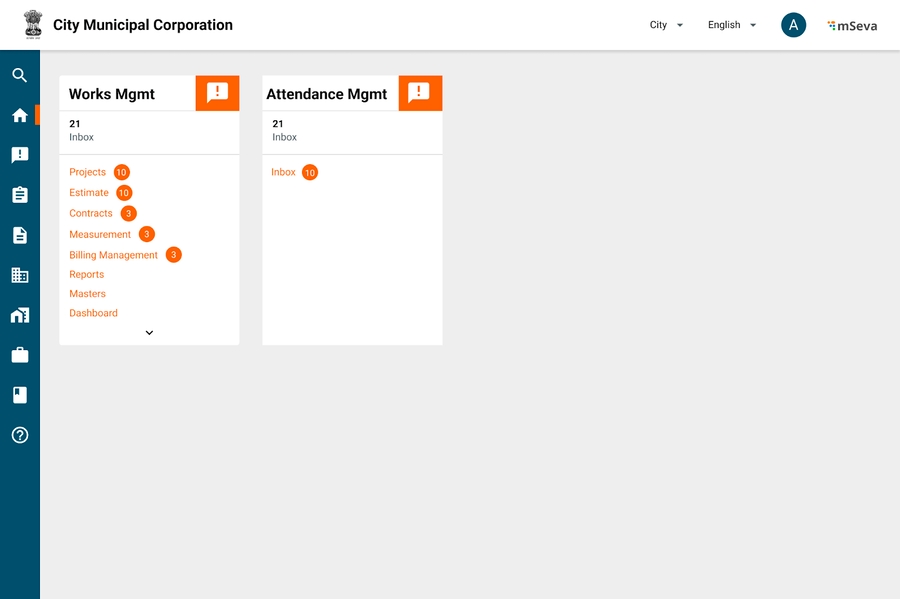
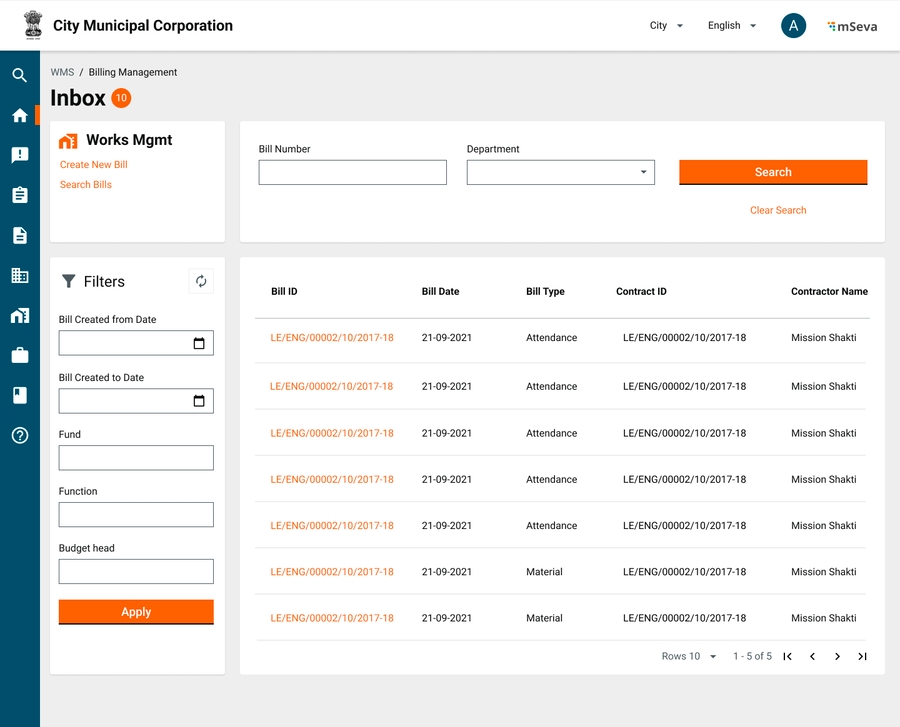
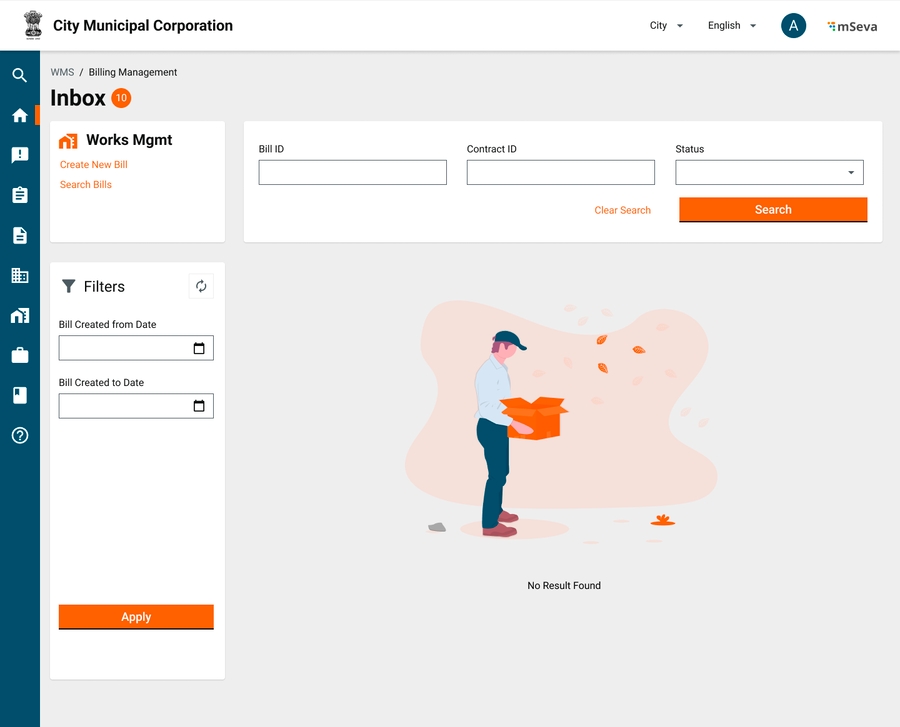
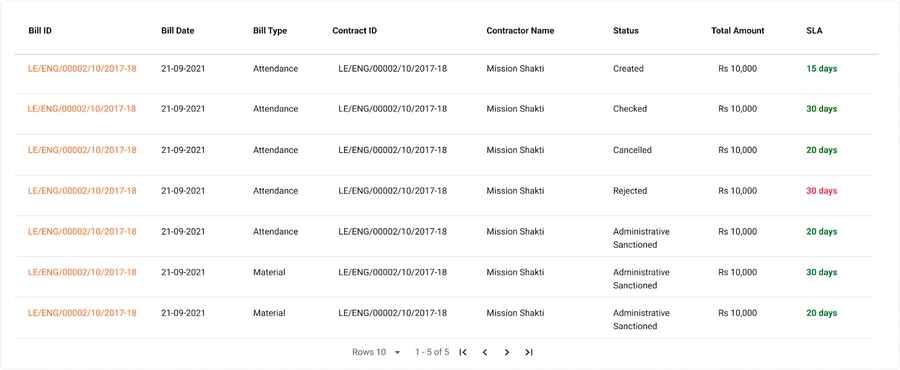
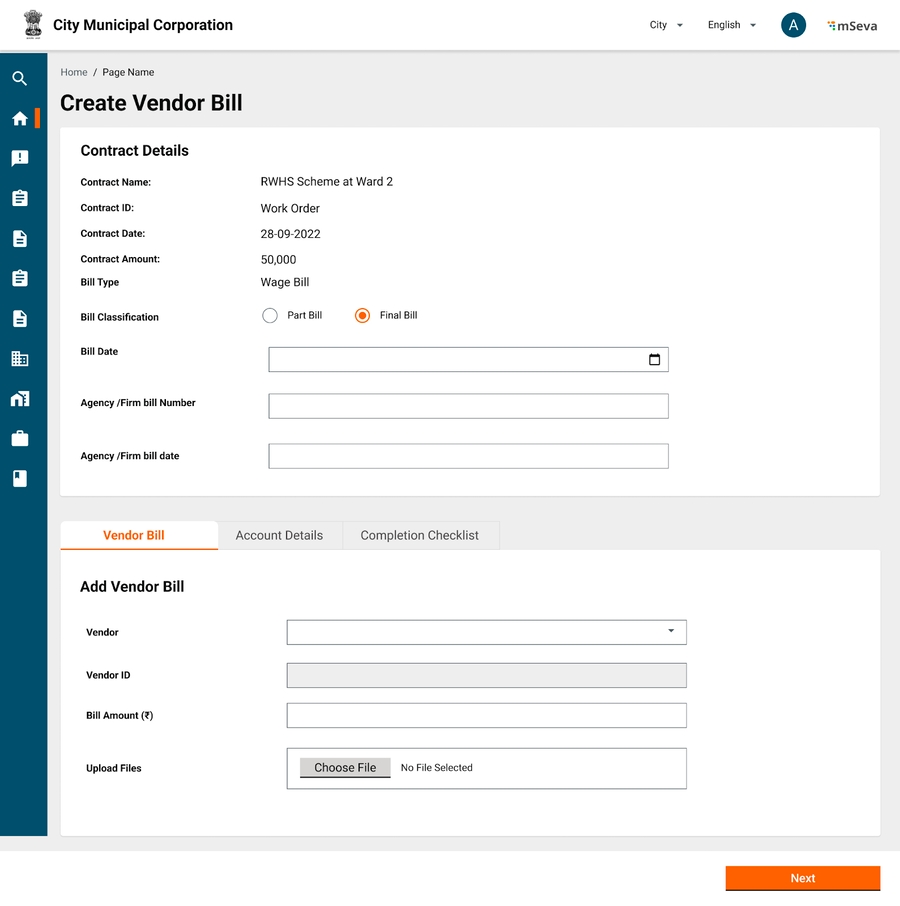
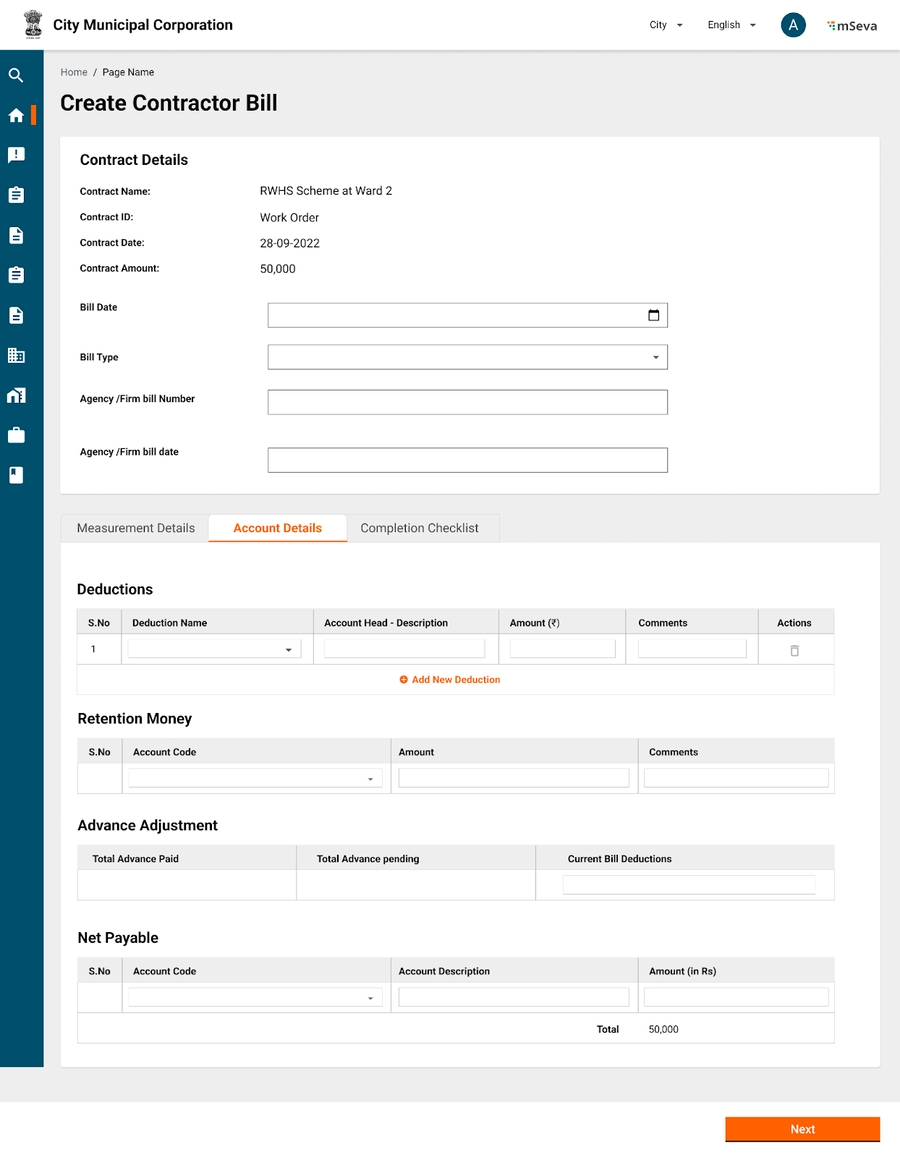
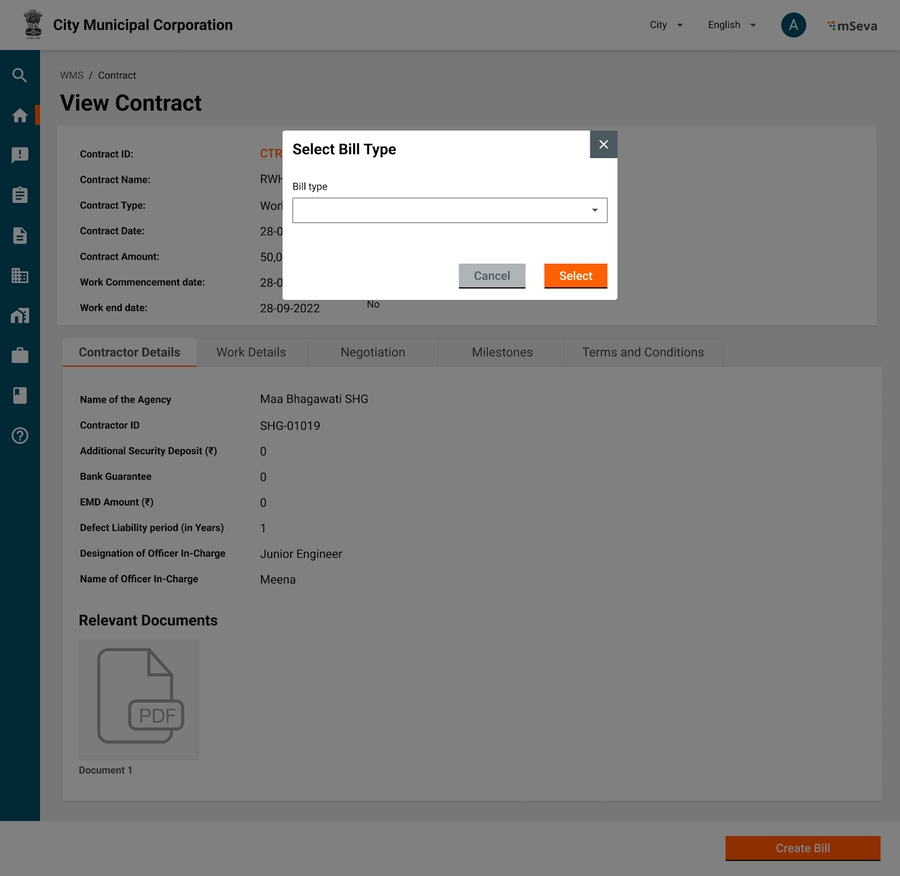
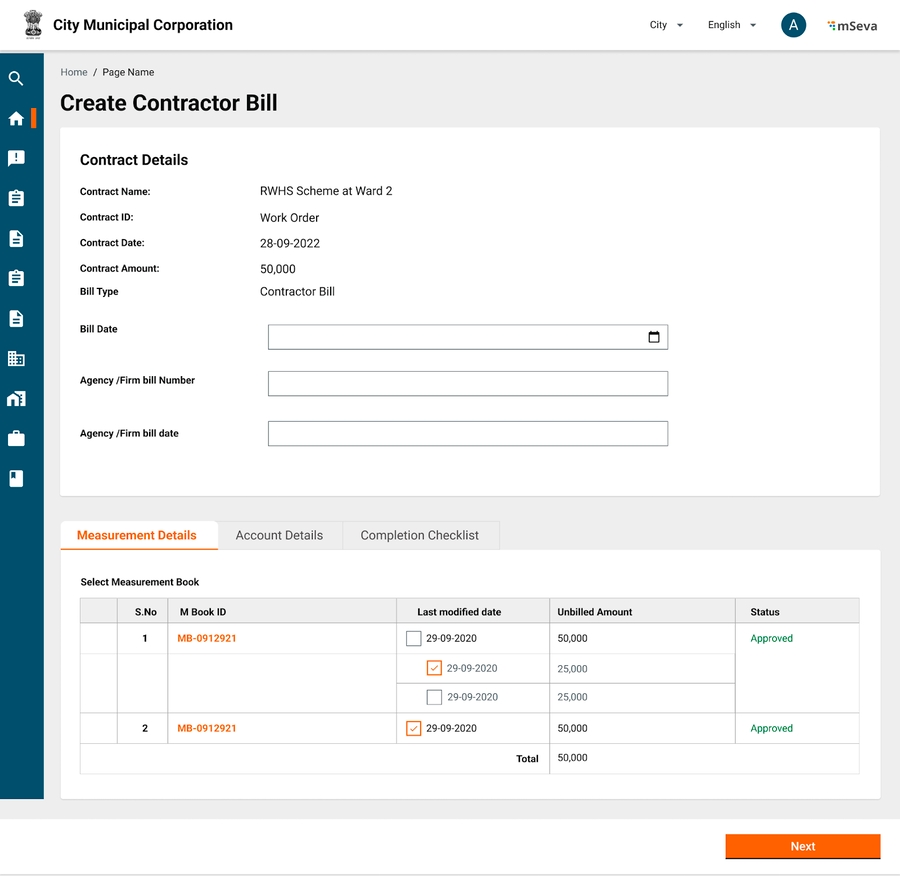
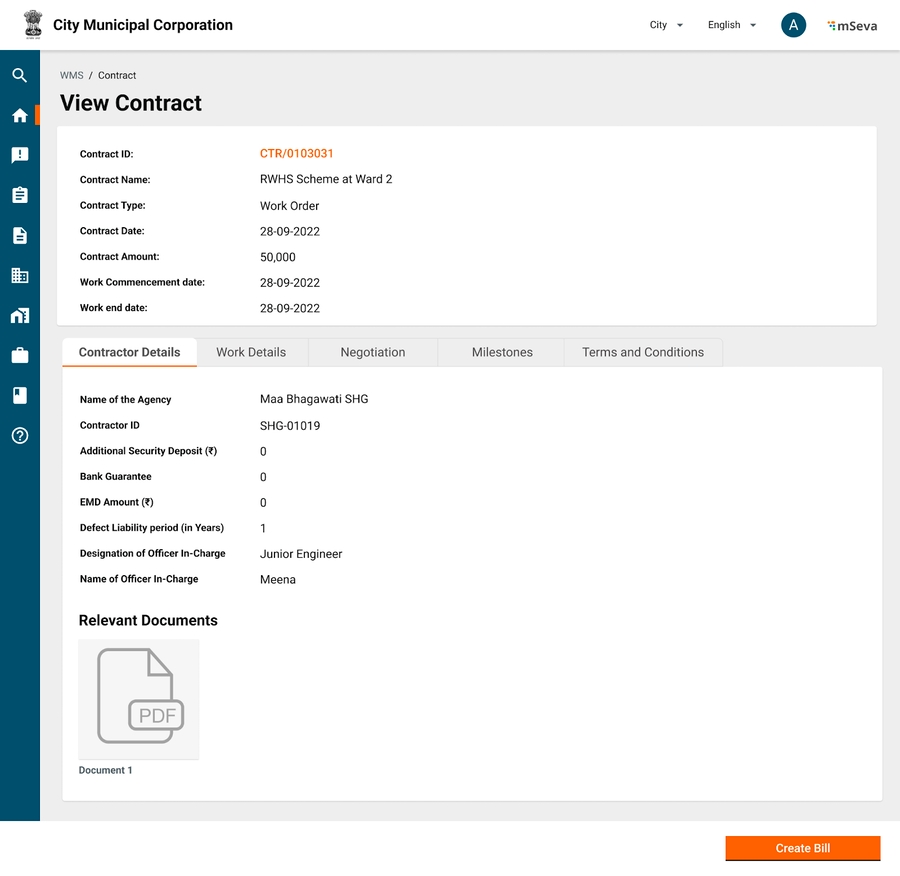
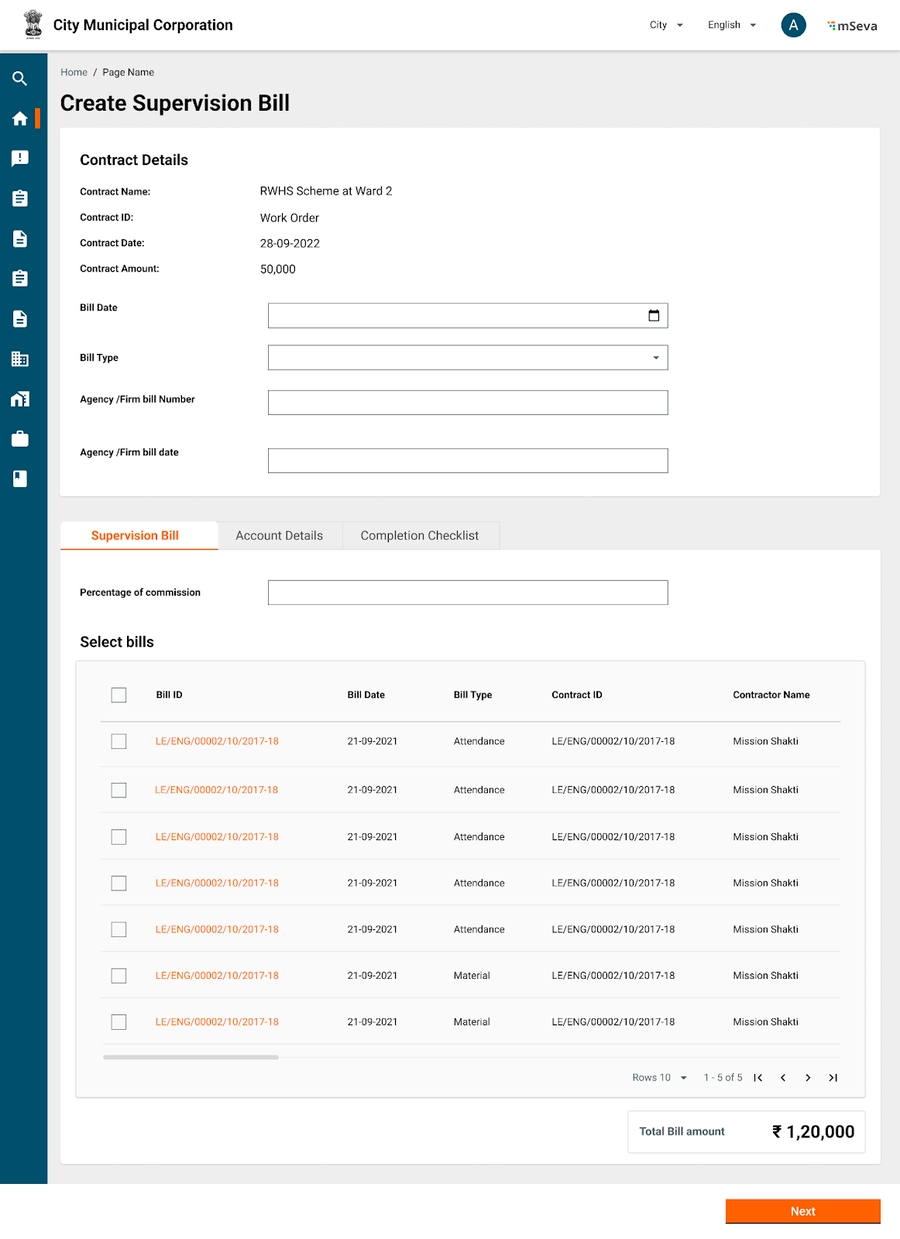
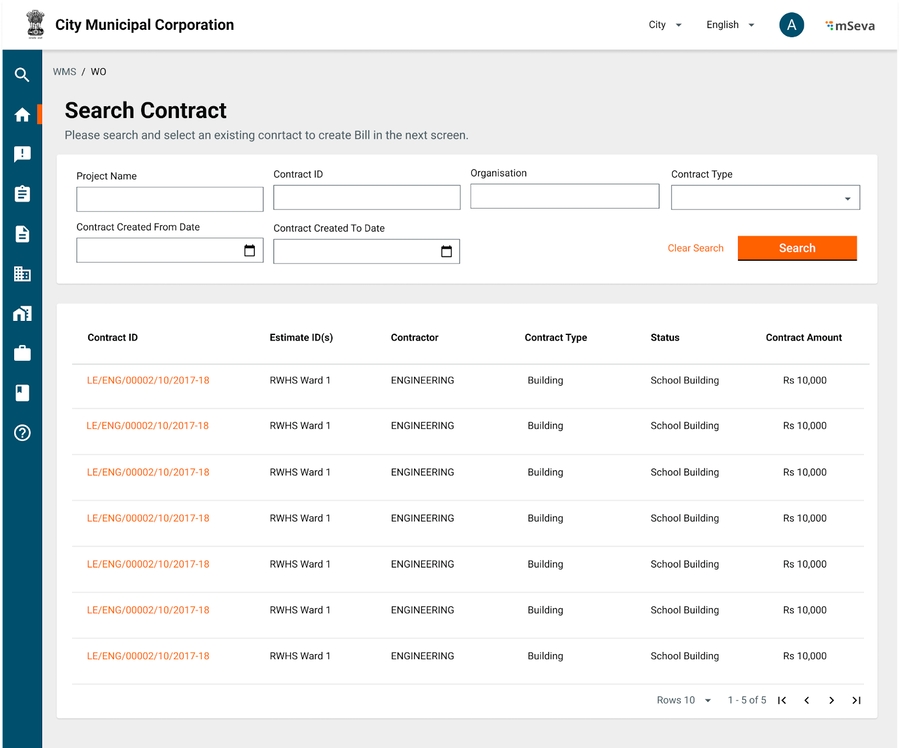
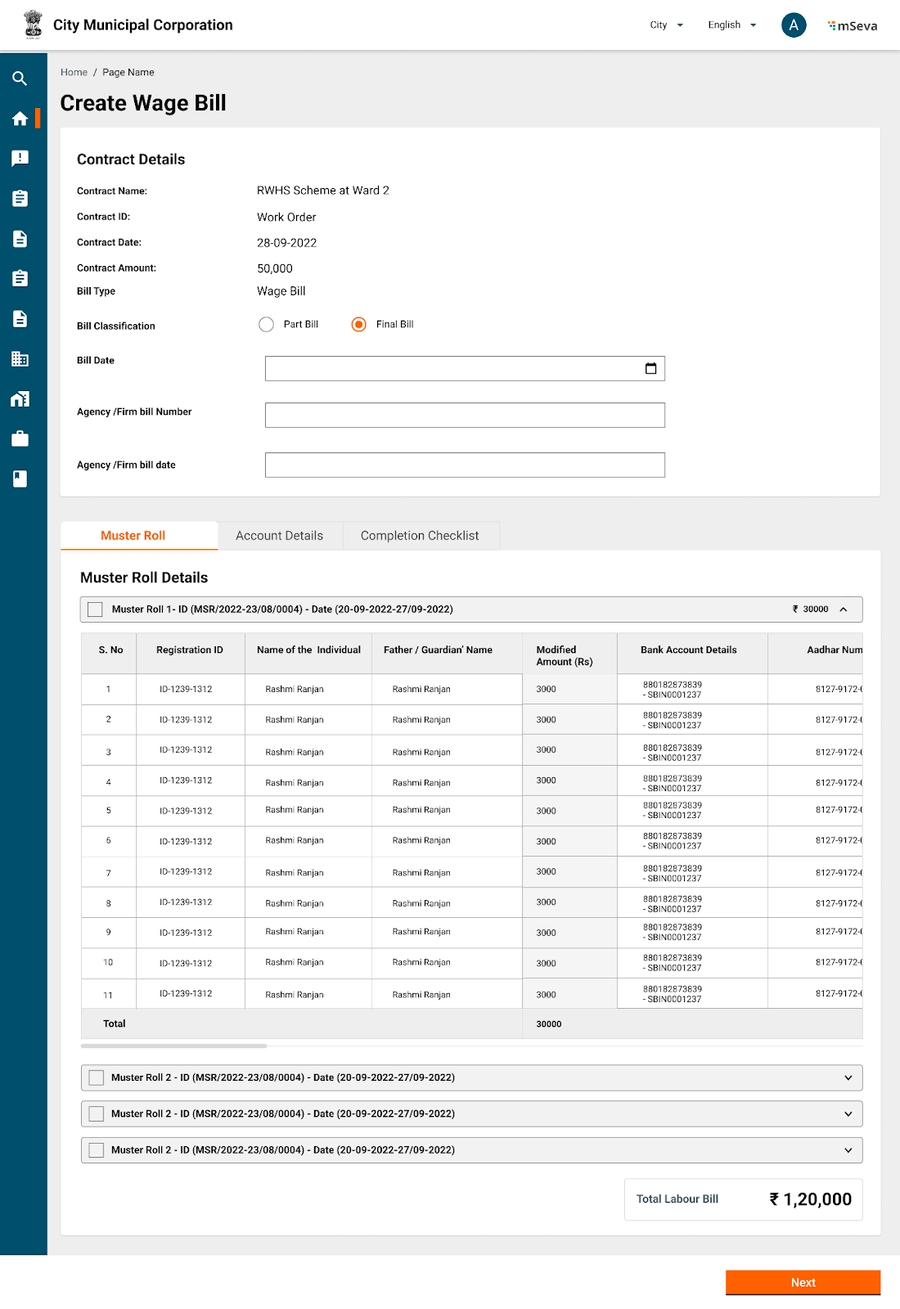
Mukhyamantri Karma Tatpara Abhiyan Yojana ( MUKTA Yojana) is a government scheme and This scheme is helpful for the poor urban people, which leads to the rising of the employment rate of the state. This document is prepared to detail out the specification MUKTASoft v2.0.
MUKTASoft aims to improve the overall scheme efficiency of MUKTA by identifying & providing equal job opportunities to the urban poor, construct environment-friendly projects, develop local communities and slums & plan better for upcoming years.
The purpose of this document is to give a detailed description of the requirements for the MUKTASoft v2.0. It will illustrate the purpose and complete declaration for the development of the system. It will also explain system constraints, interface and interactions with other external applications. This document is primarily intended to define the scope of the version v2.0 and propose to the stakeholders for its approval and as a reference for developing the next version of the system for the development team.
1. MUKTA
2. Field Visit to Dhenkanal and Jatni ULBs [21st & 22nd June 2023]
Schedule of Rates
Material
Machinery
Labour
Rate Analysis
Estimate Template
Analysis Statements
Labour Analysis
labourThe basic rate of material, labour, and machinery is decided by the state public works department which would be the same for a group of ULBs and then the final cost of SORs would vary from ULB to ULB based on the Conveyance and Royalty Charges applicable for the ULB.
CUM
QNTL
MT
NOs
Basic Rate (Material, Labour, Machinery)
Conveyance
Royalty
Labour Cess
There are a total of 4 types of SOR.
sub-typesThe SOR of type works are grouped into various sub-types as given below.
The scheduled items for which the works department publishes the rates are known as the schedule of rates. There are mainly 4 types of items for which schedules of rates are published.
Material - These are the material items which are required to accomplish a work.
Labour - The skilled and unskilled labourers who are required to accomplish the work.
Machinery - These are the equipment which are required to accomplish the work.
Works - The composition of material, labour, and machinery together form a building block for a work.
Create
In MUKTA only a limited set of SORs are being used to estimate a work and initially, only the relevant SOR items are created. The option to create an SOR is provided to help the user take any missing or new SOR into the system as and when needed.
Attributes
Mockups
Search SOR
Search SOR provides the option to the user to search an SOR to see the details and modify it to bring the new rates into effect from a well-defined effective date.
Search Criteria
Search Result
The search result always displays the currently effective rates unless the search is for a different effective period.
Mockups
View SOR
It enables users to display the details of a SOR and then take the required action from there. E.g. Create Rate Analysis, View Rate Analysis, Modify SOR.
Attributes
Mockups
Modify SOR
Modifying SOR enables the user to make the necessary corrections in the details and add the new rate effective from a future date.
Attributes
Mockups
The screen to modify SOR is almost the same as creating SOR with the limitation mentioned in the above table.
Add/ Modify Rate
Add Rate enables the user to add the new rate effective from a future date.
Attributes
Mockups
The screen to modify SOR is almost the same as creating SOR with the limitation mentioned in the above table.
After getting administrative approval on pre-estimation, a detailed estimate is prepared. In this, the estimate is divided into SOR, Non-SOR and Other Expenses and the quantities of various items are calculated individually by recording the detailed measurement of each activity. A detailed estimate is more accurate in terms of predicting the cost, material, labour, and machinery required to complete the work. It is also used for tendering and contracting the work.
Create Estimate
Create estimate enables users to create a detailed estimate using the measurements taken from ground. The options of searching a template, and adding SOR using SOR search is provided on the create estimate page.
Search SOR
SOR Type - Drop-down to select a value for SOR type.
SOR Sub Type - Drop-down to select a value for the SOR sub type.
SOR Variant - Drop-down to select a value.
SOR - Drop-down with incremental/ fuzzy search on code or description.
Plus Measurements
These are the measurements which are added to the measurement to calculate the quantity of a particular SOR.
Minus Measurements
These are the measurements which are subtracted from the measurement to calculate the quantity of a particular SOR.
Attributes
Mockups
One additional step of adding and saving the estimate as a draft with the creator of the estimate is incorporated.
The measurement book is the most important record. It is the basis of all accounts of quantities of work done, and purchase made and it must contain such a complete record of facts as to be conclusive evidence in the court of law.
It is the basis of all accounts of quantities whether of works done by Contractors or by labourers employed departmentally, or materials received. It is so written the transactions are readily traceable.
All the measurements for the work completed are measured and recorded in the measurement book against each and every BOQ provided in the estimate. Once the complete quantity of the item mentioned in the estimate is consumed in MB the item is considered completed.
It enables users to capture the measurement of the completed works item (SOR/ Non-SOR) and create a record which becomes the basis of payment for the wage seekers, suppliers and supervisors (CBOs).
Attributes
Mockups
The table below illustrates the steps of workflow followed to approve the revised work order.
It enables users to search and MB recordings which are captured for a period and then sent for verification/ approval.
Search Criteria
Search Result
Mockups
It enables the users to view the details and workflow status of the measurement book.
Attributes
View measurement book displays all the details related to it as given below.
MB Reference Number
MB Number
Work Order Number
Project ID
Mockups
The screen is similar to creating MB in the display mode of information including timelines.
Work Order
PO
Purchase Order
MB
Measurement Book
Works (Includes Material, Machinery, Labour)
Detailed Estimate
Detailed Measurement Book
Muster roll and purchase bill validations
Material Analysis
Machinery Analysis
Revise Estimate
Revise Work Order
Cancel Work Order
Utilization Statements
Labour Utilization Statement (Quantity of Work Completed)
Material Utilization Statement
Machinery Utilization Statement
Project Closure
Dashboard Enhancements
Yes
No
Add/Modify Rate
No
Yes
KG
LTR
SQM
HOUR
EACH
MTR
KL
W
Works
MB
MASONRY BRICK WORK
5
MS
MASONRY STONE WORK
6
PL
PLASTERING
7
WC
WHITE & COLOUR WASHING
8
FL
FLOORING
9
PA
PAINTING
10
RD
ROAD WORK
11
WD
WOOD WORK
12
RF
ROOFING
13
DI
DISMANTLING
14
PB
PAVER BLOCK
15
SC
SITE CLEARANCE
16
PF
PILE FOUNDATION
17
IW
IRON WORK
18
BI
OTHER BUILDING ITEMS
TF
Third Floor
5
PL
Foundation and Plinth
6
SG
Super Structure (GF)
7
SS
Super Structure (SF)
8
ST
Super Structure (TF)
9
BS
Basic
No
Applicable for SOR type Works only.
4
Unit of Measurement
Yes
Unit of measurement for the item.
5
Rate Defined for Quantity
Yes
Quantity of items for which basic rate is defined.
6
Description
Yes
Name of item as per the standard definition of OPWD
Rate Details
Optional
7
Effective From
Yes
The date given rate will become effective, it can be a past and future date.
Heads
Grid
To select a head whichever is applicable.
8
Basic Rate
Yes
The basic rate of the item defined by the OPWD
9
Conveyance
No
The conveyance charges applicable based on the distance item is carried.
10
Royalty
No
The royalty amount on the items as per the state mining department.
11
Labour Cess
No
It is applicable for works items only and calculated on Basic + Conveyance + Royalty.
12
Rate
Display
A calculated value.
Drop-down
SOR subtypes, the values from SOR Sub Type Master
4
SOR Variant
Drop-down
SOR variants, the values from Variant master
5
Status
Drop-down
Active/ Inactive
6
Effective From
Date
The rate effective from date
7
Effective To
Date
The rate effective from date
SOR Sub Type
SOR sub types, the values from SOR Sub Type Master.
5
Status
The status of SOR, Active/ Inactive.
6
Rate
The current effective rate of the SOR.
SOR Variant
SOR variant, the values from the SOR Variant Master.
5
Unit of Measurement
The unit of measurement.
6
Rate Defined for Quantity
The quantity of SOR for which rate is provided.
7
SOR Description
It is the description of SOR to describe the SOR.
8
Status
The status of SOR Active/ Inactive. Active means active for usage.
Rate
The rate section of SOR.
9
Effective From
The date from which the rate is effective.
Heads
10
Basic Rate
Basic rate of the SOR, provided by the state PWD.
11
Conveyance
Conveyance cost defined for the unit of quantity given in SOR.
12
Royalty
Royalty defined for the unit of quantity given in SOR.
13
Labour Cess
The amount of labour cess
14
Total Rate
The final rate of SOR.
Rate History
History of rates which were effective in the past.
15
Serial No.
Serial number of the record.
16
Effective From
The rate effective from date.
17
Rate
The net effective rate.
18
View Details
Button to view the break-up of rate.
19
Actions
Modify SOR/ Add Rate - Applicable to all types of SOR.
Create Rate Analysis - Applicable to Works type of SOR.
View Rate Analysis - Applicable to Works type of SOR.
Display
SOR sub types, the values from SOR Sub Type Master.
4
SOR Variant
Display
SOR variant, the values from the SOR Variant Master.
5
Unit of Measurement
Display
The unit of measurement.
6
Defined for Quantity
Display
The quantity of SOR for which rate is provided.
7
SOR Description
Text
It is the description of SOR to describe the SOR.
8
Status
Drop-down
The status of SOR Active/ Inactive.
Display
SOR sub types, the values from SOR Sub Type Master.
4
SOR Variant
Display
SOR variant, the values from the SOR Variant Master.
5
Unit of Measurement
Display
The unit of measurement.
6
Defined for Quantity
Display
The quantity of SOR for which rate is provided.
7
SOR Description
Display
It is the description of SOR to describe the SOR.
8
Status
Display
The status of SOR Active/ Inactive.
Rate Details
9
Effective From
Date
The date from which the rate is effective. A future date.
Heads
Grid
It will enable the user to select and add a head applicable.
10
Basic Rate
Text
Basic rate of the SOR, provided by the state PWD.
11
Conveyance
Text
Conveyance cost defined for the unit of quantity given in SOR.
12
Royalty
Text
Royalty defined for the unit of quantity given in SOR.
13
Labour Cess
Display
The amount of labour cess, non editable.
14
Total Rate
Display
The final rate of SOR.
Project ID
3
Project Sanction Date
Display
Yes
Project sanction date
4
Project Name
Display
Yes
Project name
5
Project Description
Display
Yes
Project description
Search SOR - It provides the option to search a SOR and add to the estimate.
SORs
1
Code
Display
Yes
SOR code, unique identifier for each SOR.
2
SOR Description
Display
Yes
SOR description from the SOR master for the selected SOR.
3
Unit
Display
Yes
Unit of measurement
4
Rate
Display
Yes
The rate defined and effective currently.
5
Quantity
Display
Yes
Calculated value out of measurements.
6
Amount
Display
Yes
Calculated value and equal to Qty*Amount.
Measurements
1.1
Sr. No.
Display
Auto
Measurement serial number.
1.2
Type
Drop-down
Yes
Plus/ Minus measurements.
1.3
Name
Text
Yes
The name of the measurement.
1.4
Number (Nos)
Numeric
(6,2)
Yes
No. of items.
1.5
Length (L)
Numeric
(6,2)
Yes
Length measured
1.6
Breadth (B)
Numeric
(6,2)
Yes
Width measured
1.7
Height/ Depth
Numeric
(6,2)
Yes
Depth measured
1.8
Quantity
Display
Yes
Qty = N* L*B*D;
1.9
Total
Display
Yes
Grid total for the quantities of measurements
Analysis
1
Material Cost
Display
Yes
Cost of material out of SORs.
2
Labour Cost
Display
Yes
Cost of labours out of SORs.
3
Machinery Cost
Display
Yes
Cost of machinery out of SORs.
Action
1
Save
Button
Yes
Save the estimate as a draft.
2
Generate Analysis
Button
Yes
Generates the analysis and populates the figures.
3
Submit
Button
Yes
Submit the estimate for verification.
Estimate Creator
Saved as draft
Pending for verification
Submitted
3
Verify and Forward
Estimate Verifier
Pending for verification
Pending for technical sanction
Verified
4
Technical Sanction
Technical Sanctioner
Pending for technical sanction
Pending for approval
Technically Sanctioned
5
Send Back
Estimate Verifier
Pending for verification
Pending for correction
Sent Back
6
Send Back
Technical Sanctioner
Pending for technical sanction
Pending for verification
Sent Back
7
Send Back
Estimate Approver
Pending for approval
Pending for technical sanction
Sent Back
8
Send Back To Originator
<roles having access>
<Current Status>
Pending for correction
Sent Back
9
Edit/ Re-submit
Estimate Creator
Pending for correction
Pending for verification
Re-submitted
10
Approve
Estimate Approver
Pending for approval
Approved
Approved
11
Reject
<any roles having access>
<Current Status>
Rejected
Rejected
Project ID
3
Project sanction date
Display
NA
Project sanction date
4
Project Location
Display
NA
Project location
5
Project Name
Display
NA
Project name
6
Project Description
Display
NA
Project description
7
View MB History
Link
NA
To show the measurement history in the format given below.
Measurement History
1
Sr. No
Display
NA
Serial number
2
MB Reference Number
Display
NA
Measurement reference number
3
MB Date
Display
NA
Measurement date
4
MB Period
Display
NA
Measurement period
5
MB Amount
Display
NA
Measurement amount
6
Status
Display
NA
Status of the measurement.
Measurement Period - It has to be the same as muster roll period.
1
From Date
Date
Yes
Muster roll start date.
2
To Date
Date
Yes
Muster roll end date.
SORs
1
Category
Display
Yes
SOR Sub type
2
Code
Display
Yes
SOR Code
3
SOR Description
Display
Yes
SOR description from the SOR master for the selected SOR.
4
Unit
Display
Yes
Unit of measurement
5
Rate
Display
Yes
Rate per unit
6
Quantity
Display
Yes
Quantity calculated from measurement captured.
7
Amount
Display
Yes
Calculated from Rate*Quantity.
Measurements
1.1
Sr. No.
Display
Auto
Serial number of measurement
1.2
Type
Display
Auto
Plus/ Minus from estimate.
1.3
Name
Display
Auto
The name of the measurement from the estimate.
1.4
Number (Nos)
Numeric
(6,2)
Yes
No. of items if the unit of measurement is number.
1.5
Length (L)
Numeric
(6,2)
Yes
Length measured for completed work.
1.6
Breadth (B)
Numeric
(6,2)
Yes
Width measured for completed work.
1.7
Height/ Depth (D)
Numeric
(6,2)
Yes
Depth measured for completed work, allowed up-to 2 decimal places.
1.8
Quantity
Display
Yes
Qty = N*L*B*D; rounded up-to 2 decimal places.
1.9
Total
Display
Yes
Grid total for the quantities of measurements, rounded up-to 2 decimal places.
Non SORs - The above is repeated for Non SORs also.
View Utilization Statements - A link to view the utilization statements in HTML view.
Worksite Photos
Tab
7
Worksite Photo
Upload File
Yes
5 photos JPG and PNG images are supported.
Actions
1
Save as Draft
Button
Yes
Action to save the measurement record as draft.
2
Generate Utilization
Button
Yes
Action to generate measurement statements out of measurements taken.
3
Submit
Button
Yes
Action to submit the measurement book for verification
MB Creator
Drafted
Pending for verification
Submitted
3
Verify and Forward
MB Verifier
Pending for verification
Pending for approval
Verified
4
Send Back
MB Verifier
Pending for verification
Pending for correction
Sent Back
5
Send Back
MB Approver
Pending for approval
Pending for verification
Sent Back
6
Send Back To Originator
<any roles having access of action>
<Current Status>
Pending for correction
Sent Back
7
Edit/ Re-submit
MB Creator
Pending for correction
Pending for verification
Re-submitted
8
Approve
MB Approver
Pending for approval
Approved
Approved
9
Reject
<any roles having access>
<Current Status>
Rejected
Rejected
Text
MB number
4
MB Reference Number
Text
MB reference number
5
Status
Drop-down
Active/ Inactive.
6
Created From
Date
MB created date
7
Created To
Date
MB created date
CBO Name
Name of CBO to whom work order is awarded.
5
Status
Status of MB.
6
MB Amount
MB amount.
Project Sanction Date
Project Location
Project Name
Project Description
Measurement History
Sr. No
MB Reference Number
MB Date
MB Period
MB Amount
Status
Measurement Period
From Date
To Date
SORs/ Non SORs
SOR Category
SOR Code
SOR Description
Unit
Rate
Quantity
Amount
Measurements
Sr. No.
Type
Name
Analysis
Material Consumed (₹)
Labour Utilized (₹)
Machinery Utilized (₹)
Workflow Timelines
JE
Junior Engineer
ME
Municipal Engineer
EO
Executive Officer
MC
Municipal Corporation
DDO
Drawing and Disbursing Officer
SOR
Schedule of Rates
Create SOR
Yes
No
Search SOR
Yes
Yes
View SOR
Yes
Yes
1
M
Material
2
L
Labour
3
E
Machinery
1
EW
EARTH WORK
2
CC
CEMENT CONCRETE
3
RC
RCC WORK
1
FN
Excavation in Foundation
2
GF
Ground Floor
3
SF
Second Floor
1
SOR Type
Yes
Material, Labour, Machinery, Works.
2
SOR Sub Type
Yes
Applicable for SOR type Works only.
3
1
SOR Code
Text
It is system system-generated unique code to identify the SOR uniquely
2
SOR Type
Drop-down
SOR types, the values from SOR Type Master.
3
1
SOR Code
It is system generated unique code to identify the SOR uniquely.
2
SOR Description
It is the description of SOR to describe the SOR.
3
SOR Type
SOR types, the values from SOR Type Master.
1
SOR Code
It is system generated unique code to identify the SOR uniquely.
2
SOR Type
SOR types, the values from SOR Type Master.
3
SOR Sub Type
SOR sub types, the values from SOR Sub Type Master.
1
SOR Code
Display
It is system generated unique code to identify the SOR uniquely.
2
SOR Type
Display
SOR types, the values from SOR Type Master.
3
1
SOR Code
Display
It is system generated unique code to identify the SOR uniquely.
2
SOR Type
Display
SOR types, the values from SOR Type Master.
3
1
Estimate Type
Display
Yes
Estimate type, Original/ Revised.
2
Project ID
Display
1
Save as Draft
Estimate Creator
Saved as draft
Drafted
2
1
Work order number
Display
NA
Work order number
2
Project ID
Display
1
Save
MB Creator
Drafted
Drafted
2
1
Ward
Drop-down
Ward name from the configured data.
2
Project Name
Text
Project name
3
1
MB Reference Number
MB reference number.
2
MB Number
MB number
3
Project Name
Project name
WO
Modify SOR
4
4
4
SOR Variant
SOR Sub Type
4
4
SOR Sub Type
SOR Sub Type
Yes
Submit
NA
Submit
MB Number
4
Number (No)
Length (L)
Breadth (B)
Height/ Depth (D)
Quantity
Total