> For the complete documentation index, see [llms.txt](https://docs.digit.org/llms.txt). Markdown versions of documentation pages are available by appending `.md` to page URLs; this page is available as [Markdown](https://docs.digit.org/platform/guides/developer-guide/ui-developer-guide/run-application.md).
# Run Application
{% tabs %}
{% tab title="Old Folder Structure" %}
## Overview
Once the local setup is completed, the next step is to run the application locally. This document provides the steps on how to run the digit-ui on a local machine.
## Steps
### Configure Environment File
The new folder structure looks something like this: \

You can refer this [console branch](https://github.com/egovernments/DIGIT-Frontend/tree/console) to understand the architecture more deeply.
**Step 1:** To run the application in the local environment, add the `.env` file in the web folder -
```
micro-ui/web
```
**Step 2:** Copy the following content and add it to the .env file. If the user is a citizen, configure the .env file as shown below:
```js-templates
SKIP_PREFLIGHT_CHECK=true
REACT_APP_USER_TYPE=EMPLOYEE
REACT_APP_EMPLOYEE_TOKEN=c835932f-2ad4-4d05-83d6-49e0b8c59f8a
REACT_APP_CITIZEN_TOKEN=7cd58aae-30b3-41ed-a1b3-3417107a993c
REACT_APP_PROXY_API=https://unified-dev.digit.org
REACT_APP_PROXY_ASSETS=https://unified-dev.digit.org
REACT_APP_GLOBAL=https://egov-dev-assets.s3.ap-south-1.amazonaws.com/globalConfigsWorkbenchDev.js
```
**Step 3:** To run the application as an employee, update the value of the param to - `REACT_APP_USER_TYPE=EMPLOYEE.`
**Step 4:** To direct the front end to different environments, update the `REACT_APP_GLOBAL` variable and add the GlobalConfig environment file corresponding to that environment.
To learn more about global config visit [How to configure globalconfig](https://core.digit.org/guides/developer-guide/ui-developer-guide/ui-configuration#globalconfig).
Update both `REACT_APP_PROXY_API` and `REACT_APP_PROXY_ASSETS` to the environment URL.
### Initialise & Run Application
Before initializing the frontend app locally, ensure that you are in the specified directory.
```
micro-ui/web
```
**Step 1:** To initialise the Yarn execute the below command -
```
sudo yarn install
```
**Step 2:** Once the yarn initialization is successful execute the below command -
```
sudo yarn run start
```
**Step 3:** Running this command will start the application.
### Login As
There are two types of login -
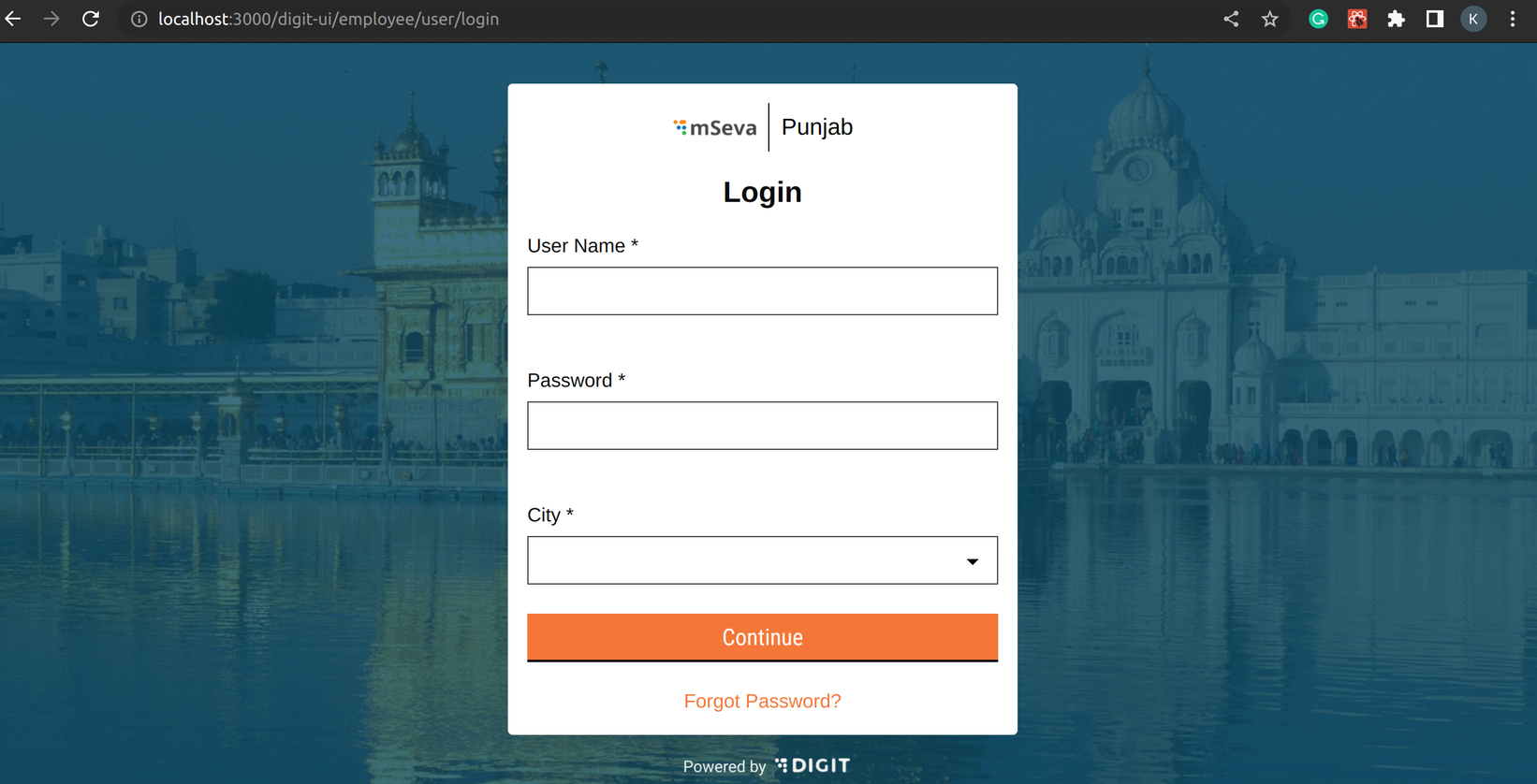
1. **Employee:** If you log in as an employee, the below screen is displayed.
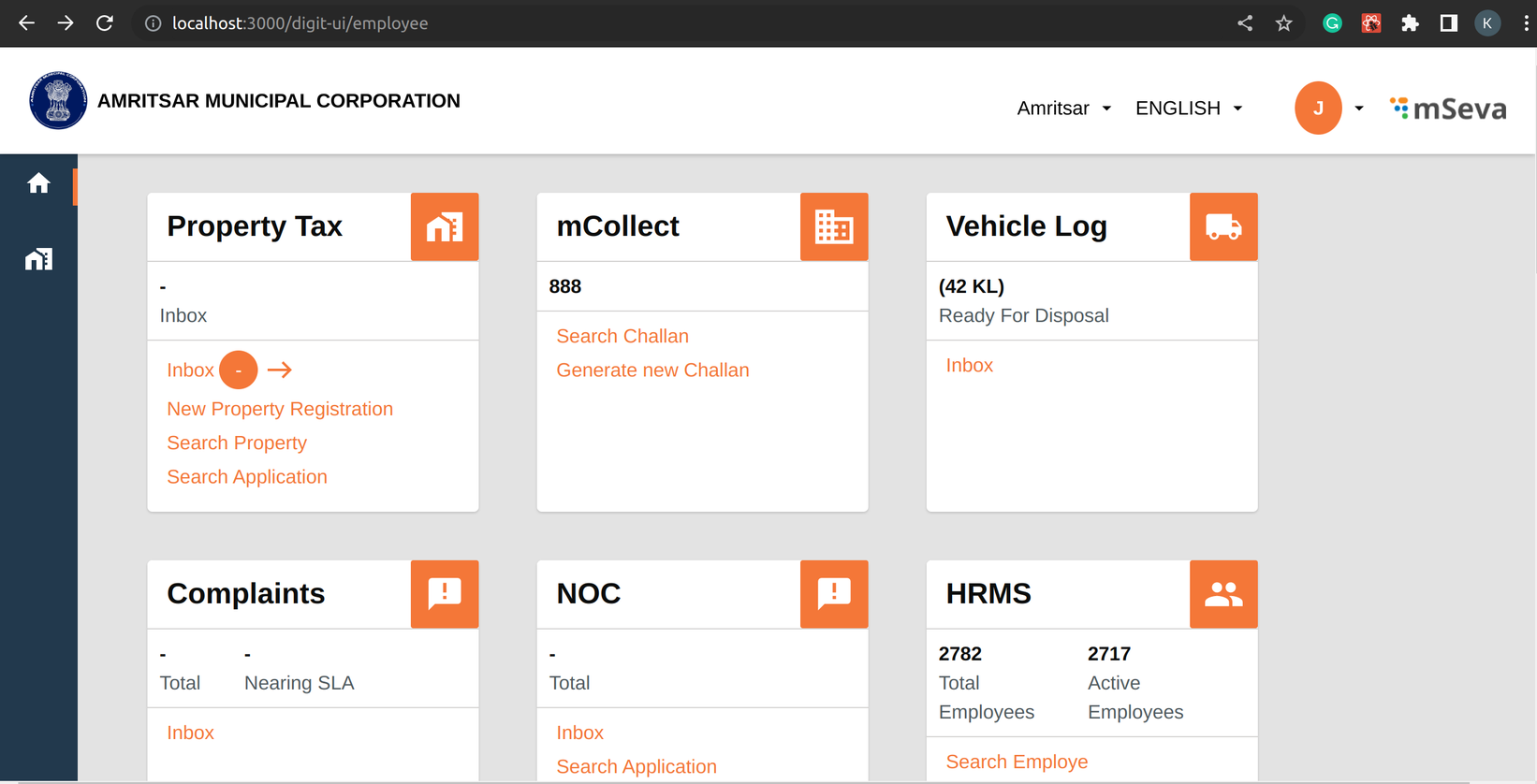
**HomePage Employee:** Once the employee is logged in, users are redirected to the employee home page.
On the home page, users can see the cards mCollect, HRMS, NOC, Property Tax, etc These cards need to be added. Refer to the instructions on the [link here](#configure-environment-file-citizen-1) to create an employee card.
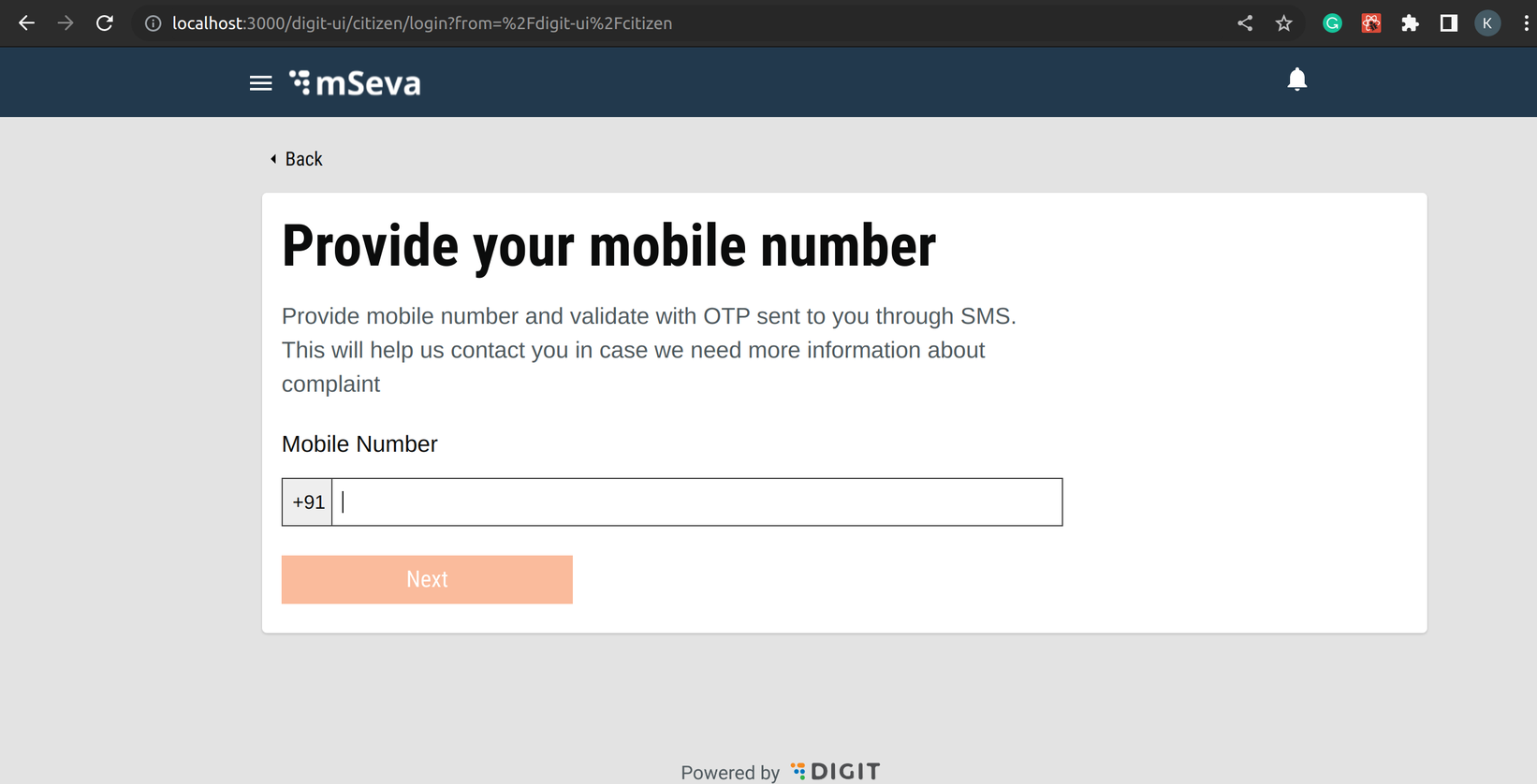
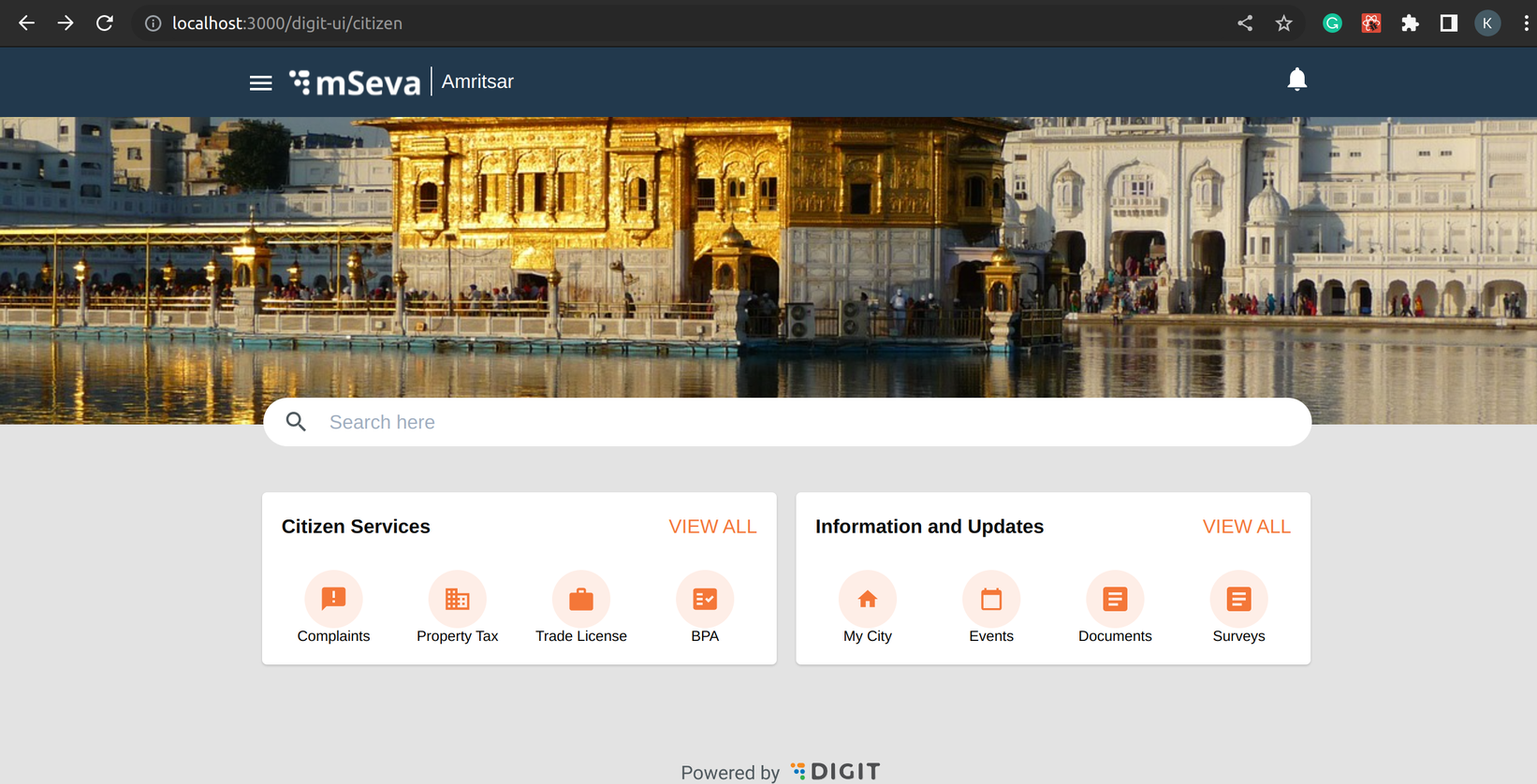
2. **HomePage Citizen:** Once the citizens are logged in successfully, users are redirected to the citizen homepage.
#### HomePage Citizen
Click on the [link here](#configure-environment-file-citizen) to create a card for your module on the home page under "Citizen Services".
### Troubleshoot
Refer to [this](/platform/guides/developer-guide/ui-developer-guide/ui-configuration-devops.md#global-configuration) section to learn about globalConfig file.
if you do not have a global config and AWS credentials are not present, then create a temporary local config under the path:
```
micro-ui/web/public/index.html
```
Include this between the head tags
```
```
{% endtab %}
{% tab title="New Folder Structure" %}
## Overview
Once the local setup is completed, the next step is to run the application locally. This document provides the steps on how to run the digit-ui on a local machine.
## Steps
### Configure Environment File
**Step 1:** To run the application in the local environment, add the `.env` file in the `example` folder -
```
micro-ui/web/
```
**Step 2:** Copy the following content and add it to the .env file. If the user is a citizen, configure the .env file as shown below:
```js-templates
SKIP_PREFLIGHT_CHECK=true
REACT_APP_USER_TYPE=EMPLOYEE
REACT_APP_EMPLOYEE_TOKEN=c835932f-2ad4-4d05-83d6-49e0b8c59f8a
REACT_APP_CITIZEN_TOKEN=7cd58aae-30b3-41ed-a1b3-3417107a993c
REACT_APP_PROXY_API=https://unified-dev.digit.org
REACT_APP_PROXY_ASSETS=https://unified-dev.digit.org
REACT_APP_GLOBAL=https://egov-dev-assets.s3.ap-south-1.amazonaws.com/globalConfigsWorkbenchDev.js
```
**Step 3:** To run the application as an employee, update the value of the param to - `REACT_APP_USER_TYPE=EMPLOYEE.`
**Step 4:** To direct the front end to different environments, update the `REACT_APP_GLOBAL` variable and add the GlobalConfig environment file corresponding to that environment.
To learn more about global config visit [How to configure globalconfig](https://core.digit.org/guides/developer-guide/ui-developer-guide/ui-configuration#globalconfig).
Update both `REACT_APP_PROXY_API` and `REACT_APP_PROXY_ASSETS` to the environment URL.
### Initialise & Run Application
Before initializing the frontend app locally, ensure that you are in the specified directory.
```
micro-ui/web/
```
**Step 1:** To initialise the Yarn execute the below command -
```
sudo yarn install
```
**Step 2:** Once the yarn initialization is successful execute the below command -
```
sudo yarn run start
```
**Step 3:** Running this command will start the application.
### Login As
There are two types of login -
1. **Employee:** If you log in as an employee, the below screen is displayed.
**HomePage Employee:** Once the employee is logged in, users are redirected to the employee home page.
On the home page, users can see the cards mCollect, HRMS, NOC, Property Tax, etc These cards need to be added. Refer to the instructions on the [link here](#configure-environment-file-citizen-1) to create an employee card.
2. **HomePage Citizen:** Once the citizens are logged in successfully, users are redirected to the citizen homepage.
#### HomePage Citizen
Click on the [link here](#configure-environment-file-citizen) to create a card for your module on the home page under "Citizen Services".
### Troubleshoot
Refer to [this](/platform/guides/developer-guide/ui-developer-guide/ui-configuration-devops.md#global-configuration) section to learn about globalConfig file.
if you do not have a global config and AWS credentials are not present, then create a temporary local config under the path:
```
micro-ui/web/example/public/index.html
```
Include this between the head tags
```
```
Link to [example](https://github.com/egovernments/DIGIT-Frontend/blob/sample/micro-ui/web/micro-ui-internals/example/public/index.html).
{% endtab %}
{% endtabs %}
---
# Agent Instructions
This documentation is published with GitBook. GitBook is the documentation platform designed so that both humans and AI agents can read, navigate, and reason over technical content effectively. Learn more at gitbook.com.
## Querying This Documentation
If you need additional information that is not directly available in this page, you can query the documentation by asking a question.
Perform an HTTP GET request on the following URL with the `ask` and `goal` query parameters:
```
GET https://docs.digit.org/platform/guides/developer-guide/ui-developer-guide/run-application.md?ask=&goal=
```
`ask` is the immediate question: it should be specific, self-contained, and written in natural language.
`goal` is what the user is ultimately trying to achieve, the reason they need the answer. Sharing it helps GitBook give you a better, more relevant answer. A goal is most helpful when it describes the outcome the user wants rather than restating the question. For example, with `ask=how do I create an API token`, a goal like `automate deployments from our CI pipeline` lets GitBook tailor the answer to that use case.
The response will contain a direct answer to the question and relevant excerpts and sources from the documentation.
Use this mechanism when the answer is not explicitly present in the current page, you need clarification or additional context, or you want to retrieve related documentation sections.