> For the complete documentation index, see [llms.txt](https://docs.digit.org/llms.txt). Markdown versions of documentation pages are available by appending `.md` to page URLs; this page is available as [Markdown](https://docs.digit.org/platform/guides/developer-guide/ui-developer-guide/employee-module-setup/creation-of-new-create-form-create-screen.md).
# Create Form - Create Screen
## Introduction
The guide walks you through the steps required to create and integrate a form within a micro-frontend architecture using the DIGIT framework. You will learn how to set up the form configuration, create a custom component, and integrate the form with backend APIs.
## Steps
Create Application Form
1. Create a form where users can enter all required information and submit the form.
2. Update the Index.js file with routes.
3. `Index.js` will import **FormcomposerV2**. Add the heading, label, and form components inside it. Import the configuration file containing the form schema mapping detail (refer to the code below) into the create screen.
```
import { newConfig } from "../../configs/IndividualCreateConfig";
const configs = newConfig?newConfig:newConfig;
```
An example of a Create Screen is given below. Create a page IndividualCreate.js under the following path:
```
/micro-ui-internals/packages/modules/sample/src/pages/employee/IndividualCreate.js
```
```
import React, { useState } from "react";
import { useTranslation } from "react-i18next";
import { useHistory } from "react-router-dom";
import { FormComposerV2 } from "@egovernments/digit-ui-react-components";
import useCustomAPIMutationHook from "../../hooks/useCustomAPIMutationHook";
import { newConfig } from "../../configs/IndividualCreateConfig";
const IndividualCreate = () => {
const [toastMessage, setToastMessage] = useState("");
const tenantId = Digit.ULBService.getCurrentTenantId();
const { t } = useTranslation();
const history = useHistory();
const [gender, setGender] = useState("");
const reqCreate = {
url: `/individual/v1/_create`,
params: {},
body: {},
config: {
enable: false,
},
};
const mutation = useCustomAPIMutationHook(reqCreate);
const handleGenderChange = (e) => {
setGender(e.target.value);
};
return (
Create Individual
{
return {
...config,
};
})}
defaultValues={{}}
onSubmit={(data,) => onSubmit(data, )}
fieldStyle={{ marginRight: 0 }}
/>
{/* Toast Component */}
{toastMessage && (
)}
);
}
export default IndividualCreate;
```
Reference for the create screen: [IndividualCreate.js](https://github.com/egovernments/DIGIT-Frontend/blob/sample/micro-ui/web/micro-ui-internals/packages/modules/sample/src/pages/employee/IndividualCreate.js)
Filling in Config.js
**File Creation Path**
Create a file named `IndividualCreateConfig.js` in the following path:
```
/micro-ui-internals/packages/modules/sample/src/configs/IndividualCreateConfig.js
```
The configuration file outlines the form's meta-data and structure. The "head" field contains the form heading, while the form's components are placed in the "body" field.
This configuration file is imported into the Create screen.
```
export const newConfig = [
{
head: "Create Individual",
body: [
{
inline: true,
label: "Applicant Name",
isMandatory: false,
key: "applicantname",
type: "text",
disable: false,
populators: { name: "applicantname", error: "Required", validation: { pattern: /^[A-Za-z]+$/i } },
},
{
inline: true,
label: "date of birth",
isMandatory: false,
key: "dob",
type: "date",
disable: false,
populators: { name: "dob", error: "Required"},
},
{
isMandatory: true,
key: "genders",
type: "dropdown",
label: "Enter Gender",
disable: false,
populators: {
name: "genders",
optionsKey: "name",
error: "required ",
mdmsConfig: {
masterName: "GenderType",
moduleName: "common-masters",
localePrefix: "COMMON_GENDER",
},
},
},
{
label: "Phone number",
isMandatory: true,
key: "phno",
type: "number",
disable: false,
populators: { name: "phno", error: "Required", validation: { min: 0, max: 9999999999 } },
},
],
},
```
An example of the configuration file is available here: [IndividualCreate-Config.js](https://github.com/egovernments/DIGIT-Frontend/blob/sample/micro-ui/web/micro-ui-internals/packages/modules/sample/src/configs/IndividualCreateConfig.js)
Custom Component
* To meet unique requirements, we can design custom components in our application.
* Begin by creating a custom component featuring the necessary specifications. The Panel component displays responsive messages, similar to informational cards. This enables users to display dynamic text.
Create a **Panel.js** file in the specified path.
```
micro-ui-internals/packages/modules/sample/src/components/Panel.js
```
* Refer to the code for the panel in the link here - [Panel.js](https://github.com/egovernments/DIGIT-UI-LIBRARIES/blob/develop/react/ui-components/src/atoms/Panels.js)
* Import the custom component in the Module.js file.
```
import Panel from "./components/Panel.js";
```
* Add the custom component to the Module.js file
```
const componentsToRegister = {
SampleModule,
SampleCard,
Panel
};
```
* To include the **Panel** Component in your configuration file, specify the **component name** and **type** as "component". Refer to the code below to find how to do it:
```
{
"label": "Panel Name",
"type": "component",
"isMandatory": false,
"key": "panel",
"component": "Panel",
"customProps": {
"module": "HCM"
},
"populators": {
"name": "panel",
"error": "sample error message for panel"
},
"validation": {
"min": 1,
"max": 10
}
}
```
Enable Module in the UI framework
* Click on to see the UI.
* Access the create form screen by navigating to the URL below.
```
/sample/create-individual
```
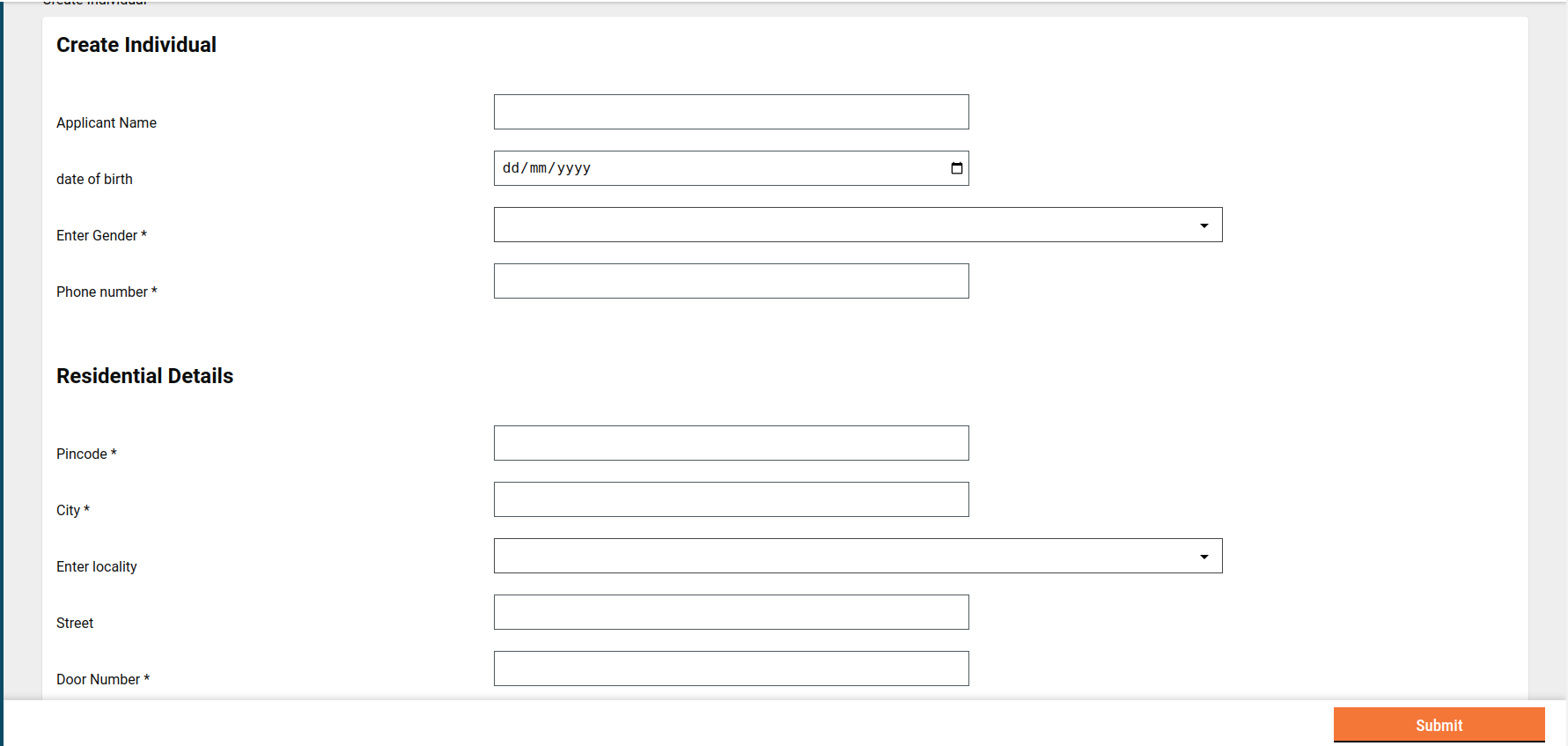
* The screen is similar to the image below, illustrating the Create Form.
Integration with Backend API
We have completed the UI for the Employee module. Now, let's integrate it with the backend API.
**Hooks**\
We will implement custom hooks in our code to handle data transfers to the backend. These hooks will make API calls and format the responses accordingly.\
Refer to the link - [Common Hooks](/platform/guides/developer-guide/ui-developer-guide/create-a-new-ui-module-package/common-hooks.md)
After setting up the backend service, we will use hooks or a service to send data to the backend upon form submission.
This On Submit function is added to the Create screen.
```
const onSubmit = async(data) => {
console.log(data, "data");
setToastMessage("Form submitted successfully!");
await mutation.mutate(
{
url: `/individual/v1/_create`,
params: { tenantId: "pg.citya" },
body: {
Individual: {
tenantId: "pg.citya",
name: {
givenName: data.applicantname,
},
dateOfBirth: null,
gender: data.genders.code,
mobileNumber: data.phno,
address: [
{
tenantId: "pg.citya",
pincode: data.pincode,
city: data.city,
street: data.street,
doorNo: data.doorno,
"locality":
{
"code" : data.locality.code,
},
landmark: data.landmark,
"type": "PERMANENT"
},
],
identifiers: null,
skills: [
{
"type": "DRIVING",
"level": "UNSKILLED"
}
],
"photograph": null,
additionalFields: {
"fields": [
{
"key": "EMPLOYER",
"value": "ULB"
}
]
},
isSystemUser: null,
userDetails: {
"username": "8821243212",
"tenantId": "pg.citya",
"roles": [
{
"code": "SANITATION_WORKER",
"tenantId": "pg.citya"
}
],
"type": "CITIZEN"
},
},
},
config: {
enable: true,
},
},
);
const configs = newConfig;
};
```
Refer to the file here - [IndividualCreate.js](https://github.com/egovernments/DIGIT-Frontend/blob/sample/micro-ui/web/micro-ui-internals/packages/modules/sample/src/pages/employee/IndividualCreate.js)\
Once the integration is complete the data is saved into the database.
---
# Agent Instructions
This documentation is published with GitBook. GitBook is the documentation platform designed so that both humans and AI agents can read, navigate, and reason over technical content effectively. Learn more at gitbook.com.
## Querying This Documentation
If you need additional information that is not directly available in this page, you can query the documentation by asking a question.
Perform an HTTP GET request on the following URL with the `ask` and `goal` query parameters:
```
GET https://docs.digit.org/platform/guides/developer-guide/ui-developer-guide/employee-module-setup/creation-of-new-create-form-create-screen.md?ask=&goal=
```
`ask` is the immediate question: it should be specific, self-contained, and written in natural language.
`goal` is what the user is ultimately trying to achieve, the reason they need the answer. Sharing it helps GitBook give you a better, more relevant answer. A goal is most helpful when it describes the outcome the user wants rather than restating the question. For example, with `ask=how do I create an API token`, a goal like `automate deployments from our CI pipeline` lets GitBook tailor the answer to that use case.
The response will contain a direct answer to the question and relevant excerpts and sources from the documentation.
Use this mechanism when the answer is not explicitly present in the current page, you need clarification or additional context, or you want to retrieve related documentation sections.